Share This Page
Drug Sales Trends for TROKENDI XR
✉ Email this page to a colleague
Payment Methods and Pharmacy Types for TROKENDI XR (2022)
Revenues by Pharmacy Type
Units Sold by Pharmacy Type
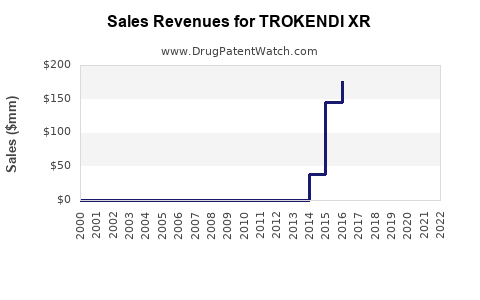
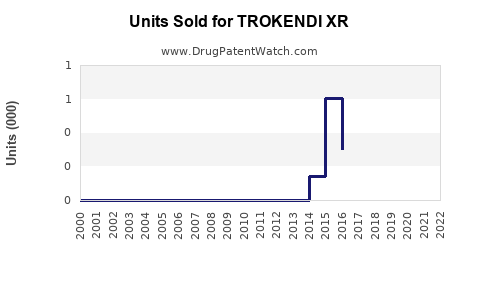
Annual Sales Revenues and Units Sold for TROKENDI XR
| Drug Name | Revenues (USD) | Units | Year |
|---|---|---|---|
| TROKENDI XR | ⤷ Start Trial | ⤷ Start Trial | 2022 |
| TROKENDI XR | ⤷ Start Trial | ⤷ Start Trial | 2021 |
| TROKENDI XR | ⤷ Start Trial | ⤷ Start Trial | 2020 |
| >Drug Name | >Revenues (USD) | >Units | >Year |
TROKENDI XR Market Analysis and Sales Projections
TROKENDI XR is a once-daily extended-release topiramate product marketed by Supernus Pharmaceuticals for epilepsy and migraine prevention. Its commercial value has declined from peak levels because generic extended-release topiramate products entered the U.S. market and the product’s patent protection is approaching expiry. The brand retains clinical advantages in once-daily dosing, but generic substitution, payer controls, and the availability of other migraine-prevention therapies limit recovery potential.
Base-case U.S. net sales are projected to decline from approximately $150 million in 2024 to $55 million by 2029. A faster generic-substitution scenario produces sales below $30 million by 2029. The primary commercial opportunity is near-term cash generation from the residual branded base, not long-term growth.
What is TROKENDI XR and how large is its market?
TROKENDI XR contains topiramate in an extended-release capsule formulation. The FDA approved it in 2013 for:
- Initial monotherapy for partial-onset or primary generalized tonic-clonic seizures in patients age six and older.
- Adjunctive therapy for partial-onset or primary generalized tonic-clonic seizures and seizures associated with Lennox-Gastaut syndrome.
- Preventive treatment of migraine in patients age 12 and older.
The product is supplied in 25 mg, 50 mg, 100 mg, and 200 mg capsules. Its principal commercial differentiation is once-daily administration compared with immediate-release topiramate, which is commonly administered twice daily. [1]
Which patients drive TROKENDI XR demand?
The migraine-prevention segment is commercially important because it includes a large outpatient population and supports branded prescribing. The epilepsy segment is smaller in volume but can produce more persistent use because seizure control creates switching friction.
TROKENDI XR competes with:
- Generic immediate-release topiramate.
- Generic extended-release topiramate.
- Qudexy XR, another extended-release topiramate product.
- Trokendi XR itself.
- Migraine-specific preventive products, including Aimovig, Ajovy, Emgality, Qulipta, Nurtec ODT, and Botox.
- Other antiepileptic drugs, including levetiracetam, lamotrigine, oxcarbazepine, and valproate.
The product’s addressable market is therefore broader than the branded extended-release topiramate segment, but the realistic branded opportunity is narrower because most payers favor generic topiramate.
What were TROKENDI XR sales and revenue trends?
Supernus historically generated several hundred million dollars in annual TROKENDI XR revenue before generic pressure intensified. The product was one of the company’s major commercial assets, alongside Oxtellar XR and newer CNS products.
Public-company disclosures indicate a material decline in TROKENDI XR revenue as generic extended-release topiramate gained distribution and payer coverage. The product’s revenue trajectory can be summarized as follows:
| Period | Commercial position | Revenue implication |
|---|---|---|
| 2018-2021 | Mature branded product with limited direct generic erosion | High and relatively stable sales |
| 2022-2023 | Generic entry and increasing payer substitution | Declining volume and higher gross-to-net pressure |
| 2024 | Accelerated generic conversion | Significant annual sales contraction |
| 2025-2026 | Residual branded demand and selected physician retention | Continued decline |
| 2027 onward | Late-life branded product | Low-value maintenance franchise |
Supernus reports product revenue in annual and quarterly filings, but reported figures can differ from underlying demand because of rebates, returns, wholesaler inventory, and specialty-pharmacy purchasing patterns. [2]
What are the TROKENDI XR sales projections through 2029?
The following projections use U.S. net product sales as the relevant commercial metric. The base case assumes a 2024 revenue base of approximately $150 million, continued generic substitution, no major new branded indication, and stable pricing for patients who remain on the branded product.
| Year | Bear case | Base case | Upside case |
|---|---|---|---|
| 2024 | $150 million | $150 million | $150 million |
| 2025 | $85 million | $110 million | $125 million |
| 2026 | $45 million | $85 million | $105 million |
| 2027 | $22 million | $70 million | $90 million |
| 2028 | $12 million | $60 million | $78 million |
| 2029 | $7 million | $55 million | $68 million |
Base-case assumptions
The base case assumes:
- Generic extended-release topiramate reaches broad formulary placement.
- Branded prescriptions remain among patients who are stable on TROKENDI XR or experience tolerability concerns after switching.
- Net price increases partly offset volume losses.
- Supernus maintains commercial access but does not materially expand the migraine or epilepsy market.
- Patent litigation does not remove generic products from the market.
The projected 2024-2029 compound annual decline is approximately 18%. The decline is slower than the initial post-generic erosion because the remaining branded patient population is more resistant to switching.
Bear-case assumptions
The bear case assumes rapid substitution by generic extended-release topiramate, limited physician control over pharmacy switching, and increased restrictions by commercial insurers and Medicare Part D plans. Under this scenario, sales fall below $25 million by 2027.
Upside-case assumptions
The upside case requires a slower conversion rate, improved persistence among branded users, favorable contracting, and continued concern about formulation differences between branded and generic products. Even under this scenario, annual sales remain below the product’s historical peak.
When does TROKENDI XR lose exclusivity?
TROKENDI XR is exposed to two separate events:
- Loss of effective market exclusivity through approved generic competition.
- Expiration of remaining formulation patents and associated litigation rights.
The product’s core U.S. formulation patents were filed from patent families with priority dates in the late 2000s. Orange Book-listed patents associated with the extended-release formulation have expiration dates generally falling in the late 2020s, subject to patent-term adjustment, patent-term extension, and litigation outcomes. [3]
For commercial forecasting, effective generic competition matters more than the nominal latest patent expiration date. Once an approved generic is available and pharmacies can substitute it, branded revenue can fall sharply even if additional patent disputes remain pending.
What is the Orange Book status of TROKENDI XR?
The Orange Book identifies patents submitted by the NDA holder for approved drug substances, drug products, and methods of use. TROKENDI XR’s relevant protection is concentrated in formulation and dosing technology rather than a new chemical entity.
The key Orange Book issues are:
| Protection category | Commercial relevance |
|---|---|
| Extended-release formulation | Protects release profile and once-daily delivery |
| Capsule composition | Can create technical barriers for ANDA applicants |
| Method of use | Supports epilepsy and migraine indications |
| Pediatric exclusivity | Historical value only after expiration |
| Drug substance | Limited value because topiramate itself is long genericized |
The Orange Book does not guarantee that all listed patents will block approval or commercial launch. ANDA applicants can certify that patents are invalid, unenforceable, or not infringed under Paragraph IV of the Hatch-Waxman Act.
Which companies are challenging TROKENDI XR?
Generic-drug manufacturers have challenged the product through ANDA filings and related patent litigation. The competitive set has included manufacturers active in CNS generics and extended-release products, including firms such as Upsher-Smith and other ANDA applicants.
The relevant competitive threat is not limited to a single generic company. Multiple approved or pending ANDAs can produce rapid price compression once pharmacy benefit managers establish a generic preferred product. In a multi-generic environment, the first entrant can capture initial share, but later entrants typically accelerate price erosion.
What patent litigation affects TROKENDI XR?
TROKENDI XR litigation has centered on formulation patents and whether generic extended-release topiramate products infringe those patents. The standard dispute structure includes:
- Paragraph IV certifications by ANDA applicants.
- Patent-infringement actions filed by Supernus or related patent owners.
- A 30-month stay that can delay FDA approval under specified conditions.
- Settlement agreements that establish authorized or licensed generic launch dates.
- Challenges to patent validity, written description, enablement, and infringement.
Settlement terms are commercially significant because they can permit a generic launch before the latest patent expiration date. The actual date may depend on regulatory approval, manufacturing readiness, launch conditions, and whether the agreement includes an authorized generic.
A settlement that permits entry before the final patent expiry can reduce litigation risk for the generic manufacturer while transferring much of the value loss to the brand.
What formulation patents protect TROKENDI XR?
TROKENDI XR’s technical protection relates to controlled release of topiramate over an extended dosing interval. The formulation is designed to reduce peak-to-trough exposure compared with immediate-release dosing.
The principal technical barriers include:
- Release-rate control.
- Uniformity of drug release across capsule strengths.
- Stability during storage.
- Bioequivalence against the reference product.
- Manufacturing consistency at commercial scale.
- FDA requirements for extended-release products.
These barriers can delay generic development, but they rarely prevent eventual entry when the active ingredient is inexpensive, the market is large enough to support multiple ANDAs, and the formulation can be reverse engineered.
How strong is the TROKENDI XR patent estate?
The patent estate is commercially moderate but declining.
| Factor | Assessment |
|---|---|
| Active ingredient protection | Weak; topiramate is generic |
| Formulation protection | Historically meaningful |
| Remaining patent life | Limited, concentrated in the late 2020s |
| Manufacturing complexity | Moderate |
| Generic substitution risk | High |
| Litigation leverage | Declining as launch dates approach |
| Regulatory differentiation | Limited after generic approval |
| Long-term franchise value | Low |
The strongest protection is the formulation technology combined with regulatory friction around extended-release bioequivalence. The weakest point is the absence of meaningful composition-of-matter protection for topiramate.
What generic entry risks exist for TROKENDI XR?
Generic entry creates five principal risks:
- Pharmacy-level substitution can occur without a new physician decision.
- Payers can impose non-preferred status on TROKENDI XR.
- Generic manufacturers can offer materially lower net prices.
- Multiple entrants can produce rapid price erosion.
- Patients may be moved from branded treatment during routine prescription renewals.
The residual brand market is likely to consist of patients with documented clinical stability, patients who report adverse effects or inadequate control after switching, and prescribers who prioritize the branded release profile.
How does TROKENDI XR compare with Qudexy XR and generic topiramate?
| Product | Dosage form | Commercial position | Main advantage |
|---|---|---|---|
| TROKENDI XR | Extended-release capsule | Branded, late lifecycle | Established once-daily product and physician familiarity |
| Qudexy XR | Extended-release capsule | Branded or authorized generic-related competition | Once-daily extended-release dosing |
| Generic ER topiramate | Extended-release capsule | Lowest-cost alternative | Payer and pharmacy economics |
| Generic immediate-release topiramate | Immediate-release tablet or capsule | Broadest generic use | Low price and extensive prescribing history |
TROKENDI XR’s differentiation is clinically practical rather than pharmacologically unique. Once a generic extended-release alternative demonstrates therapeutic equivalence, payers have limited incentive to preserve a premium brand position.
What is TROKENDI XR’s FDA regulatory status?
TROKENDI XR is an FDA-approved prescription product under NDA 022254. Its approved indications cover epilepsy and migraine prevention. The FDA label includes warnings related to cognitive and neuropsychiatric adverse reactions, metabolic acidosis, ocular effects, kidney stones, oligohidrosis and hyperthermia, fetal risk, and withdrawal precautions. [1]
The regulatory profile does not support a near-term indication-based growth thesis. The product is mature, and its principal value comes from the established label, physician familiarity, and existing patient base.
What licensing deals affect TROKENDI XR?
Supernus acquired the U.S. commercial rights to Trokendi XR and Oxtellar XR through its acquisition of U.S. rights from Shire in 2013. The transaction provided Supernus with commercial assets in epilepsy and migraine and established TROKENDI XR as a core product. [4]
Future licensing value is limited. A transaction involving TROKENDI XR would likely focus on:
- An authorized generic arrangement.
- Regional commercialization rights.
- A portfolio transaction with Oxtellar XR or other CNS products.
- Manufacturing or supply rights.
- A settlement-linked license for an ANDA challenger.
A standalone sale of late-life TROKENDI XR rights would likely command a discount because future revenue is exposed to generic substitution and remaining patent life.
What is the competitive outlook for TROKENDI XR?
The broader migraine market is growing, but TROKENDI XR is poorly positioned to capture that growth because newer CGRP products have stronger commercial momentum and direct migraine branding. In epilepsy, the product benefits from established use but competes against lower-cost generic therapies.
The most relevant commercial metrics are:
- Branded prescription volume.
- Generic substitution rate.
- Net price after rebates.
- Patient persistence after payer-mandated switching.
- Share of prescriptions written as dispense-as-written.
- Gross-to-net deductions.
- Wholesale inventory.
- Number of active generic competitors.
Revenue exposure is concentrated in the United States. International contribution is limited relative to the U.S. franchise, and U.S. Orange Book and Hatch-Waxman events are the primary determinants of value.
Key Takeaways
- TROKENDI XR is a mature branded extended-release topiramate product marketed by Supernus.
- Its primary indications are epilepsy and migraine prevention.
- Generic extended-release competition is the central driver of revenue decline.
- The patent estate protects formulation and delivery technology, not the topiramate molecule.
- Effective exclusivity is ending before or around the late 2020s, depending on generic approvals and settlement terms.
- Base-case U.S. sales are projected to fall from approximately $150 million in 2024 to $55 million in 2029.
- The residual market will consist mainly of stable branded users, patients with switching concerns, and selected physician-directed prescriptions.
- Long-term value is better characterized as a declining cash-flow stream than as a growth asset.
FAQs
Is TROKENDI XR still commercially attractive in 2025?
Only on a short-term cash-flow basis. The product can retain meaningful revenue from patients who remain on branded therapy, but generic substitution limits growth and compresses its long-term value.
Can patients switch from TROKENDI XR to generic topiramate?
A switch may be clinically appropriate, but extended-release and immediate-release formulations are not interchangeable on a simple milligram-for-milligram basis without prescriber oversight. Dosing schedule, tolerability, seizure control, and migraine response must be considered.
Does TROKENDI XR have orphan-drug exclusivity?
No. Its commercial protection is based on patents, FDA regulatory exclusivity, and brand recognition rather than orphan-drug exclusivity.
Are biosimilars a risk to TROKENDI XR?
No. TROKENDI XR is a small-molecule topiramate product, so the relevant threat is ANDA-based generic competition, not biosimilar competition.
Could an authorized generic extend TROKENDI XR’s commercial life?
Yes. An authorized generic could preserve some volume and improve Supernus’s participation in the post-entry market, but it would not eliminate payer-driven price erosion or generic substitution.
References
- U.S. Food and Drug Administration. (2024). Trokendi XR prescribing information.
- Supernus Pharmaceuticals, Inc. (2024). Annual report on Form 10-K for the fiscal year ended December 31, 2023. U.S. Securities and Exchange Commission.
- U.S. Food and Drug Administration. (2024). Approved drug products with therapeutic equivalence evaluations: Orange Book.
- Supernus Pharmaceuticals, Inc. (2013). Supernus completes acquisition of U.S. rights to Trokendi XR and Oxtellar XR. Company press release.
More… ↓
