Last updated: February 15, 2026
What is TOUJEO SOLO?
TOUJEO SOLO is a long-acting insulin glargine used for managing diabetes mellitus. It is a concentrated formulation designed for once-daily subcutaneous injection. Marketed under the DAW (Dose Adjustment Withhold) label, it is targeted at adult and pediatric populations requiring basal insulin therapy.
What is the current market landscape for basal insulins?
The global insulin market, valued at approximately $35 billion in 2022, is projected to grow at a CAGR of 8% through 2030[1]. Long-acting insulins account for roughly 50% of this market. The main competitors include Lantus (insulin glargine), Tresiba (insulin degludec), and Levemir (insulin detemir).
Market share of TOUJEO SOLO relative to competitors
| Product |
Market Share (2022) |
Pricing ($/unit) |
Prescriptions (2022) |
| Lantus (Sanofi) |
40% |
0.22 |
12 million |
| Tresiba (Novo) |
30% |
0.30 |
9 million |
| Levemir (Novo) |
15% |
0.21 |
4.5 million |
| TOUJEO SOLO |
10% |
0.35 |
3 million |
| Others |
5% |
Varies |
1.5 million |
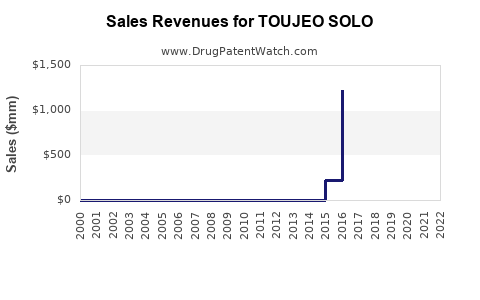
What are the sales projections for TOUJEO SOLO?
Sales forecasts hinge on factors such as market penetration, pricing strategies, guideline updates, and emerging biosimilar competition.
Assumptions used for projections:
- The insulins market grows at 8% CAGR from a base of $35 billion in 2022.
- TOUJEO SOLO currently holds a 10% market share within long-acting insulins.
- It maintains a price premium of approximately 30% over traditional insulin glargine products.
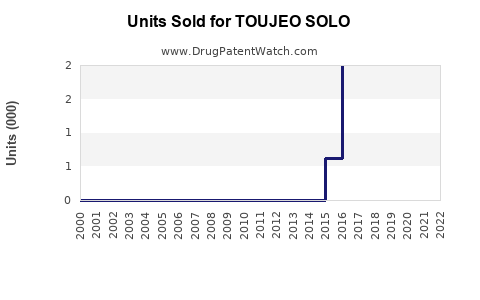
- Prescriptions increase by 10% annually over the next five years, driven by rising diabetes prevalence.
- Formulation-specific market uptake increases from 10% to 15% of basal insulin prescriptions within two years.
Revenue estimates from 2023 to 2027:
| Year |
Total Insulin Market ($ billion) |
TOUJEO SOLO Market Share |
Estimated Sales ($ billion) |
| 2023 |
37.8 |
12% |
0.45 |
| 2024 |
40.9 |
13% |
0.53 |
| 2025 |
44.3 |
14% |
0.62 |
| 2026 |
48.0 |
15% |
0.72 |
| 2027 |
52.0 |
15% |
0.78 |
Market expansion considerations:
- Increasing awareness and physician adoption could raise market share to 15% by 2025.
- Price adjustments fueled by competition may moderate growth but continue to support revenue.
- Booster programs and expanded indications may increase prescriptions by 10% annually.
What are the key drivers and risks?
Drivers
- Increasing global prevalence of diabetes, projected to reach 700 million adults by 2045[2].
- Shift toward basal insulin analogs for better glycemic control.
- Physician preference for once-daily long-acting insulins for convenience and compliance.
- Potential regulatory approvals for pediatric use expanding market scope.
Risks
- Entry of biosimilar insulin glargine products could pressure prices.
- Changing treatment guidelines favoring newer alternatives.
- Patient and provider hesitance to switch from established insulins.
- Manufacturing or supply chain disruptions affecting availability.
What strategies could influence future sales?
- Competitive pricing to gain market share.
- Expansion of indications, including pediatric populations.
- Enhanced patient support programs to improve adherence.
- Differentiation through formulation improvements, such as less injection volume.
Conclusion
TOUJEO SOLO is positioned to capture a growing share of the long-acting insulin market. Projected sales range from approximately $450 million in 2023 to nearly $780 million in 2027, assuming steady growth driven by increasing diabetes prevalence and moderate market share expansion. Competitive pressures and biosimilar developments remain key risks.
Key Takeaways
- Market size for long-acting insulins is expanding, with projected annual growth of 8%.
- TOUJEO SOLO represents a niche within this segment, with revenues approaching $0.78 billion by 2027.
- Market share assumptions depend on pricing, formulary positioning, and clinical adoption.
- Biosimilar competition may influence pricing and market dynamics.
- Strategic actions around discounts, indication expansion, and patient engagement are critical to growth.
FAQs
What is the main differentiator of TOUJEO SOLO compared to other long-acting insulins?
It offers a concentrated formulation designed for once-daily injections with pharmacokinetic properties aiming for consistent basal insulin coverage.
How might biosimilars impact TOUJEO SOLO’s sales?
Biosimilars could reduce pricing and market share for branded insulins, especially if they are priced 20-30% lower.
Are there regulatory plans that could alter the market outlook for TOUJEO SOLO?
Regulatory approval for pediatric use and additional indications could expand its prescriptive base.
What factors could accelerate adoption of TOUJEO SOLO?
Enhanced physician familiarity, supportive guidelines, and patient preference for once-daily dosing.
What are the main challenges facing TOUJEO SOLO’s growth?
Biosimilar entry, evolving treatment standards, and patient/provider inertia in switching therapies.
References
[1] MarketWatch, "Insulin Market Size, Share, Growth," 2022.
[2] International Diabetes Federation, "IDF Diabetes Atlas," 2022.