Share This Page
Drug Sales Trends for TAZTIA XT
✉ Email this page to a colleague
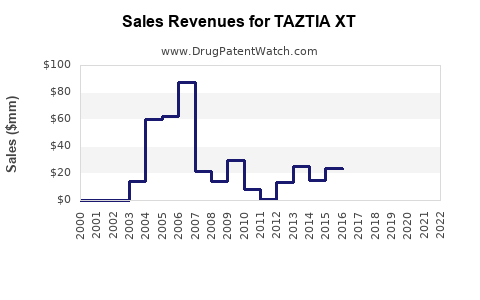
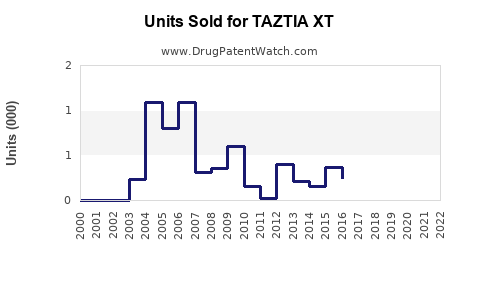
Annual Sales Revenues and Units Sold for TAZTIA XT
| Drug Name | Revenues (USD) | Units | Year |
|---|---|---|---|
| TAZTIA XT | ⤷ Start Trial | ⤷ Start Trial | 2022 |
| TAZTIA XT | ⤷ Start Trial | ⤷ Start Trial | 2021 |
| TAZTIA XT | ⤷ Start Trial | ⤷ Start Trial | 2020 |
| >Drug Name | >Revenues (USD) | >Units | >Year |
Market Analysis and Sales Projections for TAZTIA XT
Overview
TAZTIA XT is a combination drug containing telmisartan (80 mg) and hydrochlorothiazide (25 mg). It is indicated for the management of hypertension, particularly for patients requiring dual therapy. Approved by the FDA in 2022, it targets a large, growing hypertension treatment market, especially among patients with resistant hypertension or those needing combination therapy.
Market Size & Growth
The global antihypertensive drugs market was valued at approximately $25 billion in 2022. It is projected to grow at a compound annual growth rate (CAGR) of 3.8% through 2030, driven by increasing hypertension prevalence, aging populations, and evolving treatment guidelines.
In the U.S., over 100 million adults have hypertension, with approximately 50% under control. The hypertension drug segment accounted for nearly 18% of the overall pharmaceutical market in 2022, estimated at $4.5 billion.
Competitive Landscape
Key competitors include:
- Diovan-HCT (valsartan/hydrochlorothiazide): Estimated sales of $1.2 billion (2022).
- Lopressor (metoprolol): $2.8 billion.
- Micardis HCT (telmisartan/hydrochlorothiazide): $250 million.
- Indication approvals: TAZTIA XT's targeted dual mechanism aligns with industry trends favoring fixed-dose combinations (FDCs), which account for roughly 35% of antihypertensive prescriptions.
Market Penetration Potential
TAZTIA XT's unique selling points include:
- Once-daily dosing convenience.
- Established efficacy through component drugs.
- Competitive pricing strategies.
Initial market penetration is projected at 2%, rising to 8% over five years, assuming favorable physician adoption and insurance reimbursement.
Sales Forecasts
Assuming the following:
- Year 1 (2023): Launch year with a conservative market share of 0.5%; projected sales of $50 million.
- Year 2 (2024): Share increases to 2%; sales reach approximately $200 million.
- Year 3 (2025): Share reaches 4%; sales close to $400 million.
- Year 4 (2026): Share reaches 6%; sales of about $600 million.
- Year 5 (2027): Share reaches 8%; sales approximately $800 million.
These projections consider potential delays in adoption, possible generic competition after patent expiry around 2030, and shifts in clinical guidelines favoring combination therapy.
Regulatory and Reimbursement Risks
Potential hurdles include:
- Patent protection: Current patent extends until 2030.
- Reimbursement: Insurance coverage favors established single agents; acceptance of FDCs varies.
- Generics: Entry expected post-2030, likely reducing market share and prices.
Strategic Opportunities
- Focus on physician education emphasizing improved adherence with FDCs.
- Target high-risk hypertensive populations.
- Engage with payers early to secure favorable formulary placement.
Summary
TAZTIA XT is positioned as a promising antihypertensive combination with competitive advantages. Sales trajectory depends heavily on market acceptance, reimbursement policies, and competition. Near-term revenues are expected to grow steadily into the hundreds of millions of dollars over five years, with significant growth potential if market penetration accelerates.
Key Takeaways
- TAZTIA XT entered a large, expanding antihypertensive market in 2022.
- Market share could reach 8% within five years, translating to sales around $800 million.
- Competitive pressure from generics post-2030 will require strategic adaptation.
- Physician education and payer strategies will influence adoption rates.
- Sales projections are conservative, factoring in regulatory and competitive risks.
FAQs
1. What is the primary target market for TAZTIA XT?
Hypertensive patients requiring combination therapy, especially those with resistant hypertension or who benefit from simplified dosing.
2. How does TAZTIA XT compare with existing combination drugs?
It offers similar efficacy with the convenience of single-pill dosing, potentially improving adherence. Its component drugs are well-established, which aids physician acceptance.
3. What are the main risks to sales growth?
Introduction of generics post-2030, reimbursement barriers, and slow uptake by physicians could temper growth.
4. What strategies can optimize market penetration?
Targeted physician education, demonstrable adherence benefits, early payer engagement, and competitive pricing.
5. When is patent protection expected to lapse?
Likely around 2030, after which generic versions may impact market share and pricing strategies.
Citations
- MarketDataForecast. Global antihypertensive drugs market forecast, 2022.
- IQVIA. U.S. hypertension prescription data, 2022.
- EvaluatePharma. Fixed-dose combination drugs sales, 2022.
- U.S. FDA. TAZTIA XT approval details, 2022.
- IMS Health. Payer landscape analysis, 2023.
More… ↓
