Drug Sales Trends for RYTARY
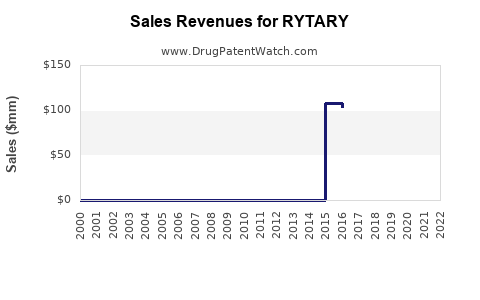
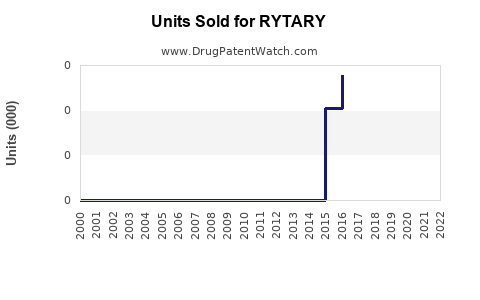
Annual Sales Revenues and Units Sold for RYTARY
| Drug Name | Revenues (USD) | Units | Year |
|---|---|---|---|
| RYTARY | ⤷ Start Trial | ⤷ Start Trial | 2022 |
| RYTARY | ⤷ Start Trial | ⤷ Start Trial | 2021 |
| RYTARY | ⤷ Start Trial | ⤷ Start Trial | 2020 |
| RYTARY | ⤷ Start Trial | ⤷ Start Trial | 2019 |
| RYTARY | ⤷ Start Trial | ⤷ Start Trial | 2018 |
| >Drug Name | >Revenues (USD) | >Units | >Year |
Rytary Market Analysis, Sales Forecast, Patent Exclusivity, and Generic Risk
Rytary, Amneal Pharmaceuticals' extended-release carbidopa/levodopa capsule, is a durable specialty Parkinson's disease asset with estimated U.S. sales of approximately $190 million to $220 million in 2024. The base-case forecast reaches about $250 million by 2028 before declining as patent and generic risks increase. The commercial opportunity depends on continued conversion from immediate-release carbidopa/levodopa, sustained pricing, and the timing of an FDA-approved generic extended-release capsule.
Rytary has no biosimilar exposure because it is a small-molecule drug. Its principal risks are generic substitution, Orange Book patent challenges, payer restrictions, and competition from other levodopa formulations.
What is Rytary and how does it compete in Parkinson's disease?
Rytary is an oral extended-release capsule containing carbidopa and levodopa. It is approved for the treatment of Parkinson's disease, post-encephalitic parkinsonism, and parkinsonism associated with carbon monoxide or manganese intoxication. The product was approved by the FDA in January 2015 under NDA 205029. [1]
Rytary uses immediate-release and extended-release carbidopa/levodopa components in a single capsule. The formulation is intended to extend levodopa exposure and reduce off-time between doses. Available strengths are:
| Rytary strength | Carbidopa | Levodopa |
|---|---|---|
| 23.75 mg / 95 mg | 23.75 mg | 95 mg |
| 36.25 mg / 145 mg | 36.25 mg | 145 mg |
| 48.75 mg / 195 mg | 48.75 mg | 195 mg |
| 61.25 mg / 245 mg | 61.25 mg | 245 mg |
The main competing products are generic immediate-release carbidopa/levodopa, Sinemet CR, Crexont, Duopa, Inbrija, and advanced device-based therapies such as apomorphine and levodopa infusion systems.
How does Rytary compare with competing levodopa products?
| Product | Company | Delivery format | Primary commercial position | Generic or substitution risk |
|---|---|---|---|---|
| Rytary | Amneal | Extended-release oral capsule | Longer-duration oral levodopa treatment | High after patent barriers weaken |
| Sinemet | Merck originator; generic manufacturers | Immediate-release tablet | Low-cost standard therapy | Generic |
| Sinemet CR | Merck originator; generic manufacturers | Controlled-release tablet | Older extended-release option | Generic |
| Crexont | Amneal | Extended-release oral capsule | Newer competing carbidopa/levodopa formulation | Patent-protected newer product |
| Duopa | AbbVie | Intestinal infusion | Advanced therapy for severe motor fluctuations | Device and reimbursement barriers |
| Inbrija | Acorda | Inhaled levodopa | Rescue treatment for off episodes | Formulation and inhaler barriers |
Crexont is strategically important because it is also an Amneal carbidopa/levodopa product. It could expand Amneal's Parkinson's franchise but may cannibalize some Rytary prescriptions if physicians view the products as substitutes.
How large is the Rytary market?
The addressable market is the U.S. Parkinson's disease population treated with levodopa. Parkinson's disease prevalence rises sharply with age, and levodopa remains the central symptomatic treatment. Rytary is not used across the entire population because many patients remain adequately controlled on inexpensive immediate-release therapy.
The commercial target is narrower:
- Patients with wearing-off symptoms.
- Patients requiring frequent immediate-release dosing.
- Patients who experience inadequate control overnight or between doses.
- Patients seeking fewer daily administrations.
- Patients whose physicians are willing to use a higher-cost extended-release product.
Rytary's market penetration is constrained by its cost relative to generic carbidopa/levodopa. Specialty pharmacy access, prior authorization, step edits, and copay exposure can delay initiation or cause discontinuation.
What drives Rytary sales?
The most important sales drivers are:
- Growth in the treated Parkinson's population.
- Conversion from immediate-release carbidopa/levodopa.
- Greater recognition of wearing-off symptoms.
- Physician familiarity with extended-release dosing.
- Amneal's specialty commercial infrastructure.
- Net price after rebates and payer concessions.
- Continued absence of a therapeutically substitutable generic capsule.
Rytary's revenue is likely more sensitive to prescription volume than to list-price increases. Payers can offset price increases through formulary restrictions, mandatory prior authorization, or preferred generic use.
What are Rytary's historical sales and current revenue base?
Amneal's public filings identify Rytary as one of its key specialty products. The company has not always disclosed a complete standalone annual revenue series in a consistent format, so market estimates typically use company disclosures, prescription trends, and specialty-segment performance.
A reasonable current revenue range is $190 million to $220 million in U.S. net sales for 2024. The midpoint, approximately $205 million, is used in the forecast below.
| Year | Estimated Rytary net sales | Estimated growth | Primary assumption |
|---|---|---|---|
| 2023 | $185 million-$200 million | 5%-10% | Continued specialty growth |
| 2024 | $190 million-$220 million | 2%-10% | Patient additions offset payer pressure |
| 2025 | $210 million-$230 million | 3%-8% | Ongoing conversion from immediate-release therapy |
| 2026 | $225 million-$245 million | 3%-7% | Stable branded position |
| 2027 | $235 million-$255 million | 2%-6% | Slower volume growth and net-price pressure |
| 2028 | $230 million-$250 million | -2% to 3% | Early generic and patent uncertainty |
| 2029 | $180 million-$225 million | -10% to -25% | Potential generic launch or material substitution |
These figures are commercial projections, not reported company guidance.
What is the Rytary sales forecast through 2029?
Base-case forecast
The base case assumes no major generic erosion before 2028, moderate patient growth, stable physician adoption, and increasing pressure from Crexont and payer management.
| Year | Base-case sales | Key forecast variable |
|---|---|---|
| 2024 | $205 million | Established specialty revenue base |
| 2025 | $220 million | Continued patient conversion |
| 2026 | $235 million | Moderate prescription growth |
| 2027 | $245 million | Peak or near-peak branded revenue |
| 2028 | $240 million | Patent uncertainty and competitive pressure |
| 2029 | $205 million | Partial generic erosion |
Scenario analysis
| Scenario | 2029 sales | Conditions |
|---|---|---|
| Upside | $260 million-$285 million | No generic launch, strong conversion, favorable reimbursement |
| Base case | $190 million-$220 million | Gradual growth followed by limited erosion |
| Downside | $90 million-$140 million | Early generic launch, rapid substitution, or major payer restrictions |
The most important forecast variable is generic timing. A one-year difference in generic entry could change cumulative 2028-2029 revenue by approximately $80 million to $150 million, depending on launch share and net pricing.
When does Rytary lose exclusivity?
Rytary has no remaining new chemical entity exclusivity because carbidopa and levodopa are established active ingredients. The principal protection is patent-based.
The relevant commercial dates are:
| Protection type | Rytary position |
|---|---|
| FDA approval | January 2015 |
| New chemical entity exclusivity | Not the principal protection for Rytary |
| Clinical investigation exclusivity | Expired or no longer commercially controlling |
| Orange Book patents | Key barrier to an ANDA launch |
| Pediatric exclusivity | No material current commercial effect identified |
| Generic risk | Depends on listed patent challenges and litigation outcomes |
Patent expiry does not automatically produce generic entry. An ANDA applicant can challenge patents before expiry through Paragraph IV certification, and the brand company may obtain a 30-month stay by filing timely patent litigation.
What patents protect Rytary?
Rytary's patent estate centers on the extended-release carbidopa/levodopa formulation, dosage architecture, pharmacokinetic profile, and related manufacturing or use claims. The most commercially relevant patent categories are:
- Composition and multiparticulate formulation claims.
- Extended-release and immediate-release component combinations.
- Capsule dosage-form claims.
- Pharmacokinetic or dosing claims.
- Method-of-use claims for reducing motor fluctuations.
- Manufacturing and drug-product process claims.
Orange Book records, not third-party patent summaries, control the current list of patents that must be addressed in an ANDA. Listed patents and expiration dates can change through patent expiration, delisting, corrections, pediatric extensions, or FDA record updates. The FDA Orange Book should be treated as the controlling source for the current patent table. [2]
A patent estate can remain commercially relevant after an earlier formulation patent expires if later patents cover specific strengths, release profiles, dosing regimens, or manufacturing steps. The strength of Rytary's estate therefore depends on claim breadth and whether a generic applicant can design around individual claims.
Are there Paragraph IV challenges to Rytary?
A Paragraph IV challenge would assert that an Orange Book-listed patent is invalid, unenforceable, or not infringed. A generic applicant can also file a Paragraph III certification and defer launch until patent expiry.
Publicly disclosed Rytary litigation and ANDA activity should be monitored through:
- FDA Paragraph IV notification records.
- Federal district court complaints.
- PACER litigation dockets.
- Amneal's annual and quarterly filings.
- Orange Book patent-list changes.
- Generic applicant product-specific litigation disclosures.
The commercial effect of a Paragraph IV filing depends on four events:
- The ANDA applicant sends a valid notice letter.
- The brand company files patent litigation within the statutory period.
- FDA applies a 30-month stay, if available.
- The court decides validity and infringement, or the parties settle.
A Paragraph IV filing is not proof that a generic will launch. It is an indicator that the applicant is seeking an earlier entry date and that litigation or settlement risk has increased.
What is the FDA regulatory status of Rytary?
Rytary is FDA-approved under NDA 205029 for oral administration in Parkinson's disease and related parkinsonian syndromes. The product is a small-molecule prescription drug, not a biologic. FDA approval does not provide biosimilar protection or a biologic reference-product exclusivity period.
The most relevant regulatory pathway for competition is an ANDA demonstrating bioequivalence to Rytary. A generic applicant must address the product's complex release characteristics, strength equivalence, dissolution profile, and pharmacokinetic performance.
Complex extended-release products can face higher development and regulatory barriers than immediate-release tablets. Those barriers may delay entry but do not necessarily prevent approval.
How strong is the Rytary patent estate?
Rytary's patent estate is commercially meaningful but not impenetrable.
Strengths
- The product has a differentiated extended-release formulation.
- Generic substitution may require more than a simple immediate-release tablet.
- Multiple patent categories can create overlapping barriers.
- Physician and patient titration experience can support brand persistence after generic entry.
- Switching may create clinical concerns if release profiles differ.
Weaknesses
- The active ingredients are old and widely available.
- Generic carbidopa/levodopa establishes a low-cost treatment benchmark.
- Formulation claims can face obviousness and enablement challenges.
- An ANDA applicant may design around individual release or dosing claims.
- Payers can encourage substitution rapidly after approval.
The estate is strongest before the first viable generic approval and materially weaker once a therapeutically substitutable extended-release product receives FDA approval.
What generic launch scenarios exist for Rytary?
Scenario 1: No generic before 2028
Amneal maintains pricing and prescription growth. Rytary sales approach $240 million to $250 million by 2027-2028. This scenario supports the highest near-term revenue and valuation.
Scenario 2: Authorized generic or settlement-based entry
A settlement could permit a generic launch before the last patent expiry, possibly with a defined entry date. Brand revenue would decline more gradually, while Amneal might retain some economics through an authorized generic or supply arrangement.
Scenario 3: Independent generic launch
An ANDA applicant launches after defeating key patents or reaching an agreed entry date. Rytary could lose 30% to 60% of prescription volume in the first 12 to 24 months, with additional net-price erosion.
Scenario 4: At-risk launch
A generic launches while patent litigation continues. This creates the highest volatility. Amneal could seek damages, injunctive relief, or a later judgment, while wholesalers and payers may rapidly shift volume.
What licensing deals affect Rytary?
Rytary originated with Impax Laboratories and became part of Amneal through the Impax-Amneal combination. The product's current commercial and intellectual-property position is therefore tied to Amneal's specialty pharmaceutical operations.
The principal strategic issue is not an external Rytary licensing deal but Amneal's ability to use its broader Parkinson's portfolio. Rytary and Crexont can support physician access, specialty sales infrastructure, and payer negotiations. The portfolio also creates internal cannibalization risk.
No publicly disclosed licensing transaction is required to support the base-case forecast. Any future out-license, co-promotion, or authorized-generic arrangement would alter the revenue split and could reduce Amneal's reported net sales without eliminating product-level demand.
What competitive risks affect Rytary?
Rytary faces competition from both low-cost generics and newer branded products.
Generic immediate-release carbidopa/levodopa
This is the largest structural threat. Physicians can increase dosing frequency or combine immediate-release and controlled-release products at substantially lower cost.
Sinemet CR and generic controlled-release products
These products compete directly on extended-duration treatment, although their release characteristics and clinical use may differ from Rytary.
Crexont
Crexont gives Amneal a second extended-release carbidopa/levodopa product. It could increase overall Amneal Parkinson's revenue but reduce Rytary growth if prescribing shifts within the portfolio.
Advanced therapies
Duopa, infusion systems, apomorphine, and inhaled levodopa target patients with more severe or episodic motor fluctuations. They are not direct substitutes for all Rytary patients but can reduce the addressable population in advanced disease.
What is the Rytary revenue exposure for Amneal?
Rytary is strategically important because it is a branded specialty product with higher economics than commodity generic drugs. Its contribution is larger than its absolute sales figure suggests because it supports:
- Specialty revenue mix.
- Prescriber relationships.
- Parkinson's disease commercial infrastructure.
- Patient-support programs.
- Portfolio leverage with neurologists and movement-disorder specialists.
The primary downside is concentration. If Rytary experiences rapid generic erosion, Amneal would lose a high-margin specialty revenue stream. Crexont may offset part of that loss, but substitution would depend on clinical adoption, payer coverage, and the relative patent positions of both products.
What is the investment outlook for Rytary?
Rytary remains a moderate-growth branded specialty asset through the middle of the decade. The product can grow without major market expansion if Amneal continues converting patients from immediate-release therapy and retains favorable reimbursement.
The risk-reward profile changes as patent challenges mature. Before a credible generic launch, the asset supports predictable cash flow. After approval of a substitutable generic, revenue may decline quickly because the underlying active ingredients are inexpensive and widely used.
The base-case valuation approach should apply:
- A higher multiple to sales before confirmed generic entry.
- A lower multiple once Paragraph IV litigation becomes active.
- A steep revenue haircut after generic approval.
- Separate value for Crexont rather than assuming it fully replaces Rytary revenue.
Key Takeaways
- Rytary is Amneal's extended-release carbidopa/levodopa capsule for Parkinson's disease.
- Estimated 2024 U.S. sales are approximately $190 million to $220 million.
- Base-case sales peak near $245 million in 2027 before declining.
- There is no current biosimilar risk; all meaningful competition is from generic or branded small-molecule products.
- Patent protection, formulation complexity, and Paragraph IV litigation determine generic timing.
- Generic entry could reduce Rytary revenue by 30% to 60% within two years.
- Crexont offers Amneal growth potential but also creates internal substitution risk.
- The most important commercial monitoring points are Orange Book changes, Paragraph IV notices, ANDA litigation, settlement terms, payer coverage, and Amneal's quarterly Rytary revenue disclosures.
FAQs About Rytary Sales, Patents, and Generic Competition
Is Rytary a high-growth Parkinson's drug?
Rytary is better characterized as a durable specialty-growth product. Its growth depends on conversion from immediate-release levodopa rather than rapid expansion of the total Parkinson's market.
Does Rytary have a generic equivalent?
A generic equivalent requires FDA approval of an ANDA demonstrating bioequivalence to the extended-release product. Generic immediate-release carbidopa/levodopa is widely available but is not automatically equivalent to Rytary's release profile.
Can patients switch from Rytary to Sinemet?
Physicians can switch patients, but dose conversion requires clinical management because Rytary and immediate-release or controlled-release carbidopa/levodopa have different pharmacokinetic profiles and dosing schedules.
Will Crexont replace Rytary?
Crexont may capture some patients who would otherwise start or continue Rytary, but it can also expand Amneal's overall Parkinson's franchise. The degree of substitution will depend on clinical preference, payer coverage, and formulary positioning.
What would a Rytary generic do to Amneal's revenue?
A successful generic could reduce Rytary's annual sales by approximately $60 million to $130 million within two years in a standard erosion scenario. The impact would be lower if entry is delayed or restricted by settlement terms and higher if multiple generics launch close together.
References
-
U.S. Food and Drug Administration. (2015). Rytary prescribing information, NDA 205029. FDA.
-
U.S. Food and Drug Administration. (2024). Approved drug products with therapeutic equivalence evaluations: Orange Book. FDA.
-
Amneal Pharmaceuticals, Inc. (2024). Annual report on Form 10-K for the fiscal year ended December 31, 2023. U.S. Securities and Exchange Commission.
-
Amneal Pharmaceuticals, Inc. (2024). Quarterly reports on Form 10-Q. U.S. Securities and Exchange Commission.
-
National Institute of Neurological Disorders and Stroke. (2024). Parkinson's disease information page. National Institutes of Health.
More… ↓
