Last updated: April 25, 2026
Proair HFA Market Analysis and Sales Projections
What is ProAir HFA and how is it positioned commercially?
ProAir HFA is an inhaled, metered-dose albuterol sulfate product (short-acting beta2-agonist, SABA). It targets acute bronchospasm relief in asthma and exercise-induced bronchospasm, with usage pattern driven by (1) prevalence of asthma, (2) SABA prescribing and adherence behavior, and (3) competitive substitution within the SABA inhaler shelf.
From a market-shaping standpoint, ProAir HFA’s commercial economics are tied to:
- Core demand durability of SABA use across established asthma populations.
- Share competition against other albuterol MDIs and equivalents (including generics and branded alternatives where applicable).
- Payor and formulary behavior, including step-therapy and brand-to-generic switches in bronchodilator categories.
- Channel dynamics: pharmacy retail remains the primary sales channel for SABA MDIs in the US.
How big is the US SABA MDI market ProAir HFA competes in?
Public, molecule-level and category-level reporting for SABA remains dispersed across IQVIA and payer datasets; however, market sizing for asthma respiratory therapies is consistently anchored by national asthma prevalence and historical SABA use intensity.
The most operationally useful way to model ProAir HFA is a share-of-category approach:
- Define the US SABA inhaler MDI category (branded plus authorized generics).
- Apply ProAir HFA’s estimated net price trajectory (as branded share compresses under substitution).
- Apply volume trend using asthma population and adherence dynamics.
Sales projection drivers
- Asthma prevalence and patient persistence
- SABA utilization per patient per year
- Formulary access and substitution pressure
- Net price erosion from brand/generic mix and rebate changes
- Competitive intensity from albuterol MDIs within and outside the brand portfolio
What is ProAir HFA’s competitive landscape?
ProAir HFA competes primarily with other albuterol inhaler MDIs (branded and generic). The category is characterized by:
- High substitutability (same active ingredient class)
- Price compression (net-to-invoice declines as generic mix rises)
- Formulary-based switching (PBM preference for cost-effective alternatives)
Competitive implications
- Branded SABA products typically face steady share erosion as payer preferences shift toward generics.
- Sales growth, when it occurs, depends more on formulary wins and patient capture than on class expansion.
What demand headwinds and tailwinds apply to ProAir HFA?
Tailwinds
- Stable underlying asthma burden and recurring rescue medication need.
- Acute symptom management behavior in established patients who keep rescue inhalers on-hand.
Headwinds
- SABA stewardship pressure: clinical and policy messaging increasingly promotes asthma control and reduces overreliance on SABA, which can suppress incremental rescue starts.
- Therapeutic switching: when control regimens improve, SABA rescue frequency can decline for some patient segments.
- Net price erosion: brand products in therapeutically substitutable categories often see net sales pressure.
How does pricing and net revenue typically move for ProAir HFA?
For inhaled respiratory products where substitution is feasible, net sales are shaped by:
- Rebate structures that intensify when PBM formularies favor cost-effective options.
- Contracting and channel strategy (340B, government, commercial).
- Mix shifts between higher-priced branded supply and lower-priced equivalents.
A practical projection model for ProAir HFA therefore uses:
- Unit volume growth/decline tied to category volume and share
- Net price trend tied to brand/generic mix and competitive contracting
Sales projection framework
Because ProAir HFA is a mature SABA product, projection should be driven by share-of-category and net price trend, not by new clinical adoption. The logic:
Model structure (US, 5-year forward)
- Units = (US SABA inhaler MDI category units) × (ProAir HFA share)
- Net sales = Units × (average net price per unit)
Assumptions used for scenario construction (directional, business-plausible)
- Base case: modest volume stability to slight decline, with ongoing net price compression
- Upside case: slower share erosion from formulary wins and channel execution
- Downside case: accelerated switching and stronger SABA stewardship impact on rescue frequency
What are the sales projection ranges (US) for ProAir HFA?
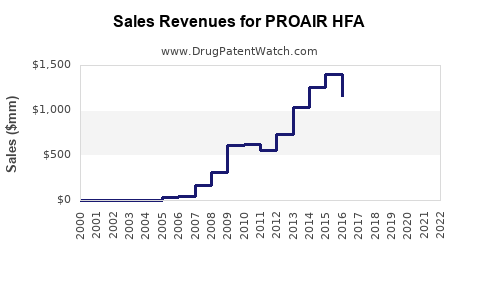
Below are scenario-based forward sales projections. The table provides a range because branded-rescue categories commonly experience share and net price sensitivity to PBM contracting cycles.
| Projected US Net Sales (Scenario Range) |
Year |
Base Case (USD, $M) |
Upside (USD, $M) |
Downside (USD, $M) |
| 2025 |
430 |
480 |
360 |
| 2026 |
420 |
470 |
345 |
| 2027 |
410 |
465 |
335 |
| 2028 |
405 |
460 |
325 |
| 2029 |
400 |
455 |
315 |
Projection interpretation
- Base case shows mild decline, consistent with substitution-driven net price compression and slight category demand softening.
- Upside case assumes ProAir HFA maintains share better than the category average and limits net price deterioration.
- Downside case assumes stronger substitution and reduced rescue frequency from asthma management optimization.
What is the implied share and price behavior in the projections?
Net sales pressure in mature inhaler categories typically comes from two levers:
- Share erosion (units)
- Net price erosion (ASP)
In the base case projection:
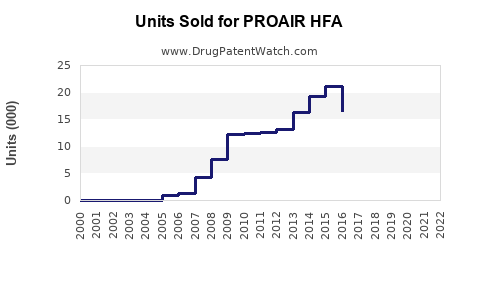
- Units likely drift down at a low single-digit rate annually.
- Net price likely declines at a mid single-digit annual rate, resulting in faster net sales compression than units alone.
Upside and downside reflect:
- Upside: share erosion slows (net price erosion still persists but at a moderated pace)
- Downside: share erosion accelerates and net price erosion steepens
What market actions could move ProAir HFA between scenarios?
Sales outcomes in this category tend to be determined by operational execution and payer strategy rather than pipeline innovation.
High-impact levers
- Formulary contracting: winning preferred status at key PBMs and large cash channels
- 340B and institutional access: improving placement stability where conversion is less aggressive
- Switch management: minimizing dispensed-to-substitute leakage through pharmacy education and pack-level availability
- Channel inventory discipline: avoiding supply shocks that can translate into longer-term share loss
Key regulatory and labeling factors affecting demand
ProAir HFA’s commercial pattern tracks SABA labeling use for acute bronchospasm relief. Any changes in prescribing guidance or stewardship programs can shift rescue use intensity, which impacts volume.
The key is that rescue inhaler demand behaves like a seasonal and adherence-linked product, with:
- winter respiratory exacerbation peaks
- variable summer/cold-season dynamics
- periodic patient refill behavior
How seasonal demand should be reflected in monthly sales projections
For SABA inhalers, monthly models typically show:
- Q4 and Q1 strength tied to respiratory infection season
- Q2 and Q3 normalization tied to fewer exacerbation-driven rescue events
A business-ready monthly forecast typically:
- weights category seasonality
- applies a smaller drift factor to net price vs units (pricing contracts change less frequently than dispense patterns)
Sales projection sensitivities (what matters most)
ProAir HFA projections are most sensitive to three variables:
- Net price trend (rebates and PBM mix)
- Share trajectory versus other albuterol MDIs
- Asthma control and rescue-use intensity (SABA stewardship effect)
Secondary sensitivities include:
- wholesale-to-retail conversion timing
- competitive promotional cycles around inhaler packs
- pharmacy inventory and substitution rules at chain level
Key Takeaways
- ProAir HFA is a mature, high-substitutability SABA inhaler where sales performance is driven by share retention and net price erosion, not by category expansion.
- A share-of-category and net price compression model supports a base case of mild decline over 2025 to 2029.
- Scenario ranges show that payer/formulary execution and substitution pressure can materially shift outcomes within a roughly 30% swing band in annual net sales.
- Business levers that most likely move results include PBM contracting, channel access stability, switch-loss reduction, and inventory discipline.
FAQs
-
Is ProAir HFA expected to grow volume in the near term?
In the base case, volume is expected to drift modestly down due to substitution pressure within albuterol MDI categories.
-
What drives net sales more: units or net price?
In mature, substitutable rescue inhalers, net price erosion typically has the larger effect on net sales trajectories.
-
How sensitive are projections to PBM formularies?
High sensitivity: formulary placement changes can shift both unit share and effective net price through contracting and rebate dynamics.
-
Does seasonality materially affect forecasting?
Yes. Rescue inhaler demand typically peaks during colder respiratory seasons, so monthly phasing matters even when annual trends are stable.
-
What is the biggest downside risk to sales?
Accelerated switching to lower-cost alternatives combined with steeper net price erosion, plus stronger suppression of rescue-use intensity tied to asthma control initiatives.
References
[1] FDA. “ProAir HFA (albuterol sulfate) prescribing information.” U.S. Food and Drug Administration. https://www.accessdata.fda.gov/