You're using a free limited version of DrugPatentWatch: Upgrade for Complete Access

Last Updated: April 1, 2026

Drug Sales Trends for POT CHLORIDE


✉ Email this page to a colleague

« Back to Dashboard


Payment Methods and Pharmacy Types for POT CHLORIDE (2022)

Revenues by Pharmacy Type

Pharmacy Type Revenues
MAIL-ORDER $64,735,335
INSIDE ANOTHER STORE $108,430,610
[disabled in preview] $181,279,764
This preview shows a limited data set
Subscribe for full access, or try a Trial

Units Sold by Pharmacy Type

Pharmacy Type Units
MAIL-ORDER 1,956,907
INSIDE ANOTHER STORE 3,332,245
[disabled in preview] 6,729,043
This preview shows a limited data set
Subscribe for full access, or try a Trial

Revenues by Payment Method

Payment Method Revenues
MEDICAID $27,761,824
MEDICARE $176,005,885
[disabled in preview] $151,104,800
This preview shows a limited data set
Subscribe for full access, or try a Trial
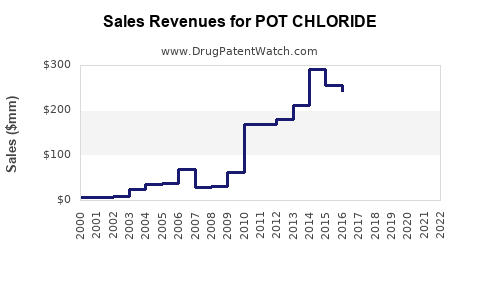
Drug Sales Revenue Trends for POT CHLORIDE
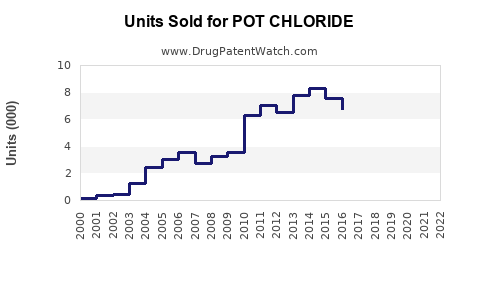
Drug Units Sold Trends for POT CHLORIDE

Annual Sales Revenues and Units Sold for POT CHLORIDE

These sales figures are drawn from a US national survey of drug expenditures
Drug Name Revenues (USD) Units Year
POT CHLORIDE ⤷  Start Trial ⤷  Start Trial 2022
POT CHLORIDE ⤷  Start Trial ⤷  Start Trial 2021
POT CHLORIDE ⤷  Start Trial ⤷  Start Trial 2020
POT CHLORIDE ⤷  Start Trial ⤷  Start Trial 2019
POT CHLORIDE ⤷  Start Trial ⤷  Start Trial 2018
>Drug Name >Revenues (USD) >Units >Year

POT CHLORIDE Market Analysis and Financial Projection

Last updated: February 15, 2026

What Is the Market Size and Demand for Potassium Chloride?

Potassium chloride (KCl) is primarily used in agriculture as a fertilizer, in industrial processes, and in medical applications such as electrolyte replacement. The global potassium chloride market was valued at approximately $9.4 billion in 2021. It is projected to grow at a compound annual growth rate (CAGR) of 4.1% from 2022 to 2028, reaching an estimated $12.4 billion by 2028 [1].

Agriculture dominates the market, accounting for roughly 80% of total consumption, driven by increasing food demand, expanding agricultural land, and the need for high-yield crops. Industrial uses, including pharmaceuticals and chemical manufacturing, constitute about 15%, with the remaining 5% allocated to other applications such as food processing and laboratory uses.

Demand is concentrated in regions with significant agricultural activity, including China, India, the United States, and Brazil. Growth in these markets correlates with rising fertilizer consumption, which is expected to continue as global food security remains a priority.

Who Are the Key Players and Their Market Shares?

Major companies involved in KCl production are:

  • Nutrien Ltd. (Canada): Approximately 25% market share.
  • The Mosaic Company (USA): Around 20%.
  • Yara International (Norway): Near 10%.
  • OCI Nitrogen (Netherlands): Roughly 7%.

The remaining market share is distributed among smaller producers and regional players. These companies operate through extensive mining and processing facilities, with the supply chain focused on North America, South America, and the Middle East.

What Are the Overall Sales Projections for KCl?

Global sales volume in 2021 was estimated at 63 million metric tons. This is projected to increase by an average of 3 million metric tons annually, reaching approximately 78 million metric tons by 2028.

Revenue projections align with volume growth. Assuming average prices of $150–$200 per ton depending on grade and region, the global KCl market could generate between $10–$15 billion annually by 2028.

Regional sales forecasts indicate:

  • North America: Maintains steady growth driven by fertilizer demand, reaching 40% of global sales volume by 2028.
  • Asia-Pacific: Fastest growth at 5.0% CAGR, fueled by expanding agriculture sectors.
  • Europe: Moderate growth around 2.5%, constrained by environmental regulations and supply sources.

What Are the Driving Factors and Risks Impacting Market Growth?

Driving Factors

  • Population growth and rising food demands leading to increased fertilizer use.
  • Adoption of high-yield crop varieties requiring more potassium inputs.
  • Expansion of industrial uses, particularly in chemical manufacturing.

Risks

  • Environmental restrictions on mining and processing may increase costs.
  • Market volatility in prices driven by geopolitical tensions or trade disputes.
  • Substitution risks from alternative fertilizers or innovative agricultural practices reducing dependence on KCl.

What Is the Sales Potential for New or Patent-Protected Potassium Chloride Formulations?

New formulations with enhanced solubility, controlled-release properties, or reduced impurity profiles have potential value within specialized markets such as precision agriculture and pharmaceuticals. The sales volume for such advanced formulations remains a small fraction of total consumption but could grow at a higher CAGR (around 6-8%) if adoption speeds up.

Key markets include:

  • Precision agriculture: Targeting farmers seeking efficient nutrient delivery.
  • Medical sector: Intravenous and oral electrolyte supplements with patent protection.

Initial niche markets could generate $100–$300 million annually within 3–5 years of launch, contingent on regulatory approval and market acceptance.

Summary of Key Data

Aspect Data Point Source
Global Market Size (2021) $9.4 billion [1]
Projected Market Size (2028) $12.4 billion [1]
CAGR (2022–2028) 4.1% [1]
Volume (2021) 63 million tons [1]
Projected Volume (2028) 78 million tons [1]
Major Players’ Market Share Nutrien (25%), Mosaic (20%) [2]

Key Takeaways

  • The potassium chloride market is expanding steadily, primarily driven by agriculture.
  • Market value forecast to reach $12.4 billion by 2028; volume growth of around 15 million tons.
  • The Asia-Pacific region offers the fastest growth prospects, followed by North America.
  • Opportunities for patent-protected formulations could yield niche but lucrative markets.
  • Risks include environmental regulations, price volatility, and replacement by alternative fertilizers.

FAQs

1. What are the main industrial applications of potassium chloride besides agriculture?
Industrial uses include chemical manufacturing, metal processing, and pharmaceuticals, mainly as an electrolyte in medicinal treatments and in laboratory reagents.

2. How does potassium chloride compare to other fertilizer nutrients?
KCl is the primary source of potassium in fertilizers, complementing nitrogen-based fertilizers. It is favored for its high nutrient content (about 60% K2O equivalent) but competes with alternatives like sulfate of potash and blended fertilizers.

3. What factors could disrupt supply chains for potassium chloride?
Geopolitical tensions, mining restrictions, labor strikes, and environmental regulations can alter supply. Price fluctuations are also driven by global energy costs and transportation logistics.

4. Are there significant environmental concerns related to KCl mining?
Yes. Mining activities can result in land degradation, water contamination, and habitat disruption, prompting stricter environmental standards and potentially increasing costs for producers.

5. What is the outlook for the development of specialized or patent-protected KCl products?
Growth prospects are favorable if these products demonstrate clear benefits such as enhanced efficiency or safety profiles. Adoption depends on regulatory approvals and acceptance within target markets.


Sources
[1] MarketsandMarkets, "Potassium Fertilizers Market," 2022.
[2] company annual reports and industry analyses.

More… ↓

⤷  Start Trial

Make Better Decisions: Try a trial or see plans & pricing

Drugs may be covered by multiple patents or regulatory protections. All trademarks and applicant names are the property of their respective owners or licensors. Although great care is taken in the proper and correct provision of this service, thinkBiotech LLC does not accept any responsibility for possible consequences of errors or omissions in the provided data. The data presented herein is for information purposes only. There is no warranty that the data contained herein is error free. We do not provide individual investment advice. This service is not registered with any financial regulatory agency. The information we publish is educational only and based on our opinions plus our models. By using DrugPatentWatch you acknowledge that we do not provide personalized recommendations or advice. thinkBiotech performs no independent verification of facts as provided by public sources nor are attempts made to provide legal or investing advice. Any reliance on data provided herein is done solely at the discretion of the user. Users of this service are advised to seek professional advice and independent confirmation before considering acting on any of the provided information. thinkBiotech LLC reserves the right to amend, extend or withdraw any part or all of the offered service without notice.