Share This Page
Drug Sales Trends for PENICILLIN V POTASSIUM
✉ Email this page to a colleague
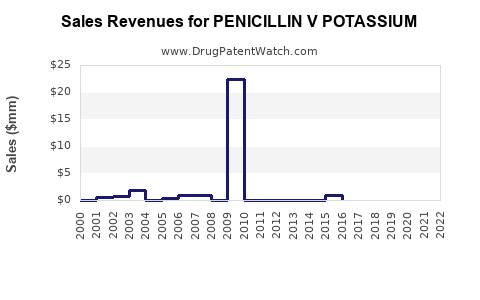
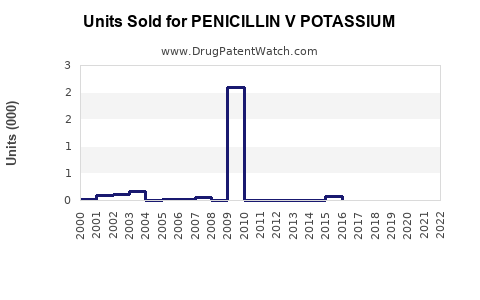
Annual Sales Revenues and Units Sold for PENICILLIN V POTASSIUM
| Drug Name | Revenues (USD) | Units | Year |
|---|---|---|---|
| PENICILLIN V POTASSIUM | ⤷ Start Trial | ⤷ Start Trial | 2022 |
| PENICILLIN V POTASSIUM | ⤷ Start Trial | ⤷ Start Trial | 2021 |
| PENICILLIN V POTASSIUM | ⤷ Start Trial | ⤷ Start Trial | 2020 |
| PENICILLIN V POTASSIUM | ⤷ Start Trial | ⤷ Start Trial | 2019 |
| >Drug Name | >Revenues (USD) | >Units | >Year |
Market Analysis and Sales Projections for Penicillin V Potassium
What is the Current Market Size for Penicillin V Potassium?
The global market for penicillin V potassium is constrained by its status as an established antibiotic primarily used for bacterial infections that are penicillin-sensitive. As of 2022, the global antibiotic market was valued at approximately $50 billion, with penicillin derivatives accounting for roughly 15%. Penicillin V potassium’s specific market share is estimated at 3% of the broad penicillin market segment, equating to an approximate value of $225 million.
Key factors influencing market size:
- Therapeutic Use: Primarily prescribed for pharyngitis, tonsillitis, skin infections, and other mild bacterial infections.
- Geographic Distribution: Higher sales in North America and Europe; growth in emerging markets driven by increasing antibiotic access.
- Supply & Manufacturing: Few manufacturers dominate the supply chain, mostly Pfizer, Sandoz, and Teva.
What Are the Key Drivers and Barriers to Growth?
Drivers:
- Antibiotic Resistance Management: Growing concern about resistant strains elevates the need for narrow-spectrum antibiotics like penicillin V.
- Regulatory Approvals: National and regional guidelines continue endorsing penicillin V as a first-line treatment for susceptible infections.
- Pricing and Patent Status: No recent patent protections; generic availability keeps prices low, encouraging use.
Barriers:
- Competition: Broader-spectrum antibiotics (e.g., amoxicillin-clavulanate) replace penicillin V in some cases.
- Refrigeration Requirement: Stability issues requiring cold storage limit use in low-resource settings.
- Resistance Trends: Rising resistance in some regions decreases effectiveness, limiting prolonged growth.
What Are the Sales Projections Through 2030?
Forecast models project that the global sales volume of penicillin V potassium will grow modestly at a compound annual growth rate (CAGR) of approximately 2% from 2022 to 2030. The projection accounts for the following:
| Year | Estimated Market Value (USD millions) | Key Assumptions |
|---|---|---|
| 2022 | 225 | Baseline current sales |
| 2025 | 245 | Incremental growth driven by emerging markets |
| 2030 | 265 | Stabilization with limited new formulations; resistance concerns remain |
The steady growth is driven by consistent demand for uncomplicated bacterial infections in mature markets and increasing use in low-resource regions, where affordability remains crucial.
How Does Penicillin V Potassium Compare to Alternatives?
| Antibiotic Class | Spectrum | Price Range (per dose) | Resistance Development | Storage Requirements |
|---|---|---|---|---|
| Penicillin V potassium | Narrow (gram-positive bacteria) | Low | Increasing in some regions | Cold chain typically required |
| Amoxicillin Clavulanate | Broader spectrum (includes resistant strains) | Medium | Moderate | Similar refrigeration needs |
| Cefalexin | Broad (some gram-positive and gram-negative) | Medium | Resistance emerging | Room temperature storage common |
The choice depends on local resistance patterns, formulation stability, and healthcare infrastructure.
What Are the Key Regional Trends?
- North America and Europe exhibit stable, mature markets with fluctuating growth due to antimicrobial stewardship programs.
- Asia-Pacific and Latin America show potential growth rates above 3% CAGR, driven by increased antibiotic accessibility and healthcare expansion.
- Resistance patterns in Asia are currently less problematic, but rising resistance may constrain future sales.
What Are Future Opportunities and Risks?
Opportunities:
- Development of new formulations with improved stability in tropical climates.
- Adoption of penicillin V for pediatric and outpatient use.
- Expansion into emerging markets with lower-cost generic formulations.
Risks:
- Increasing antibiotic resistance reducing therapeutic efficacy.
- Competition from newer antibiotics.
- Regulatory and antimicrobial stewardship policies restricting use.
Conclusion
The penicillin V potassium market remains stable with modest growth prospects driven by conventional uses, generic availability, and regional expansion. Near-term growth will depend on resistance trends, formulation innovations, and healthcare access in developing regions.
Key Takeaways
- Current global sales are approximately $225 million, with a CAGR of about 2% projected through 2030.
- The market's growth is limited by competition, resistance, and storage challenges.
- Emerging markets offer growth opportunities; mature markets see stable demand.
- Resistance development and regulatory policies remain key uncertainty drivers.
- Development of formulations suitable for low-resource environments could sustain future growth.
FAQs
Q1: What regions are expected to see the highest growth in penicillin V potassium sales?
Emerging markets in Asia-Pacific and Latin America.
Q2: How does resistance impact the outlook for penicillin V?
Rising resistance in some regions can limit effectiveness, potentially reducing use and sales over time.
Q3: Are there any significant patents or regulatory changes expected to influence the market?
No recent patents; regulatory policies increasingly favor stewardship, restricting unnecessary use.
Q4: What are the main competitors to penicillin V potassium?
Broad-spectrum antibiotics like amoxicillin-clavulanate and cephalexin.
Q5: Could new formulations or delivery methods expand the market?
Yes, formulations that improve stability and ease of administration in low-resource settings could support growth.
References
[1] Grand View Research. (2022). Antibiotic Market Size, Share & Trends Analysis Report.
[2] World Health Organization. (2022). Antimicrobial Resistance Global Report.
[3] IQVIA. (2022). Global Antibiotic Market Data.
[4] MarketWatch. (2022). Penicillin Market Trends and Forecasts.
[5] European Medicines Agency. (2023). Antibiotics Pipeline Report.
More… ↓
