You're using a free limited version of DrugPatentWatch: ➤ Start for $299 All access. No Commitment.

Last Updated: April 17, 2026

Drug Sales Trends for PAROXETINE


✉ Email this page to a colleague

« Back to Dashboard


Payment Methods and Pharmacy Types for PAROXETINE (2022)

Revenues by Pharmacy Type

Pharmacy Type Revenues
MAIL-ORDER $8,292,888
INSIDE ANOTHER STORE $39,265,555
[disabled in preview] $71,911,386
This preview shows a limited data set
Subscribe for full access, or try a Trial

Units Sold by Pharmacy Type

Pharmacy Type Units
MAIL-ORDER 573,576
INSIDE ANOTHER STORE 2,633,056
[disabled in preview] 3,766,263
This preview shows a limited data set
Subscribe for full access, or try a Trial

Revenues by Payment Method

Payment Method Revenues
MEDICAID $12,244,496
MEDICARE $17,828,683
[disabled in preview] $89,396,649
This preview shows a limited data set
Subscribe for full access, or try a Trial
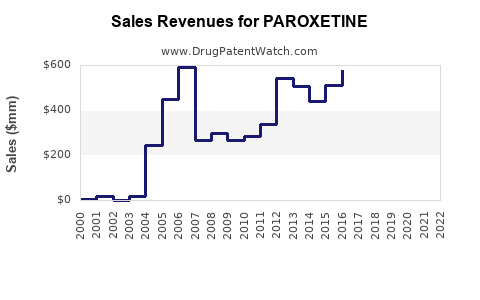
Drug Sales Revenue Trends for PAROXETINE
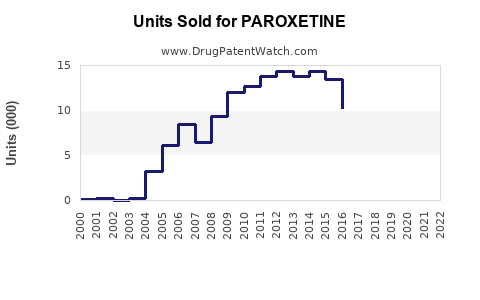
Drug Units Sold Trends for PAROXETINE

Annual Sales Revenues and Units Sold for PAROXETINE

These sales figures are drawn from a US national survey of drug expenditures
Drug Name Revenues (USD) Units Year
PAROXETINE ⤷  Start Trial ⤷  Start Trial 2022
PAROXETINE ⤷  Start Trial ⤷  Start Trial 2021
PAROXETINE ⤷  Start Trial ⤷  Start Trial 2020
PAROXETINE ⤷  Start Trial ⤷  Start Trial 2019
PAROXETINE ⤷  Start Trial ⤷  Start Trial 2018
PAROXETINE ⤷  Start Trial ⤷  Start Trial 2017
PAROXETINE ⤷  Start Trial ⤷  Start Trial 2016
>Drug Name >Revenues (USD) >Units >Year

PAROXETINE Market Analysis and Financial Projection

Last updated: February 14, 2026

What Is the Global Market Size and Growth for Paroxetine?

The global antidepressant market, which includes paroxetine, is valued at approximately $17 billion in 2022. Paroxetine, a selective serotonin reuptake inhibitor (SSRI) primarily used for depression, OCD, and anxiety disorders, accounts for roughly 6-8% of this market segment. The market is expected to grow at a compound annual growth rate (CAGR) of 3-5% through 2028, driven mainly by rising mental health awareness and increasing prescription rates across North America, Europe, and Asia-Pacific.

How Do Current Market Trends Shape Paroxetine Sales?

Despite being a well-established medication, paroxetine faces competition from newer SSRIs such as escitalopram and sertraline, which are perceived to have fewer side effects. Nevertheless, paroxetine retains a significant share due to its longstanding approval, established efficacy, and generic availability, which makes it one of the more affordable options.

Major prescription data indicates around 15-20 million patients globally are on paroxetine therapy, with leading markets including the US (approximately 7 million prescriptions annually), Germany, and Japan. This usage rate has remained relatively stable over the past five years, reflecting ongoing reliance but limited market expansion among new patients.

Regulatory trends favor generic drugs; patent expirations occurred in multiple regions between 2018 and 2020. This transition accelerated sales of generic paroxetine formulations, increasing access but reducing revenue per prescription for branded versions.

What Are the Sales Projections for Paroxetine?

Forecasts suggest global sales of paroxetine will reach $1.2 billion by 2028, with a CAGR of approximately 2-3%. The major growth will occur in emerging markets, where mental health treatment infrastructure improves, and prices are more sensitive to generic drug availability.

In North America, sales are projected to stabilize around $600 million annually, constrained by market saturation and competition from other SSRIs. Conversely, Asia-Pacific presents a growth opportunity, with projected sales reaching $300 million by 2028, driven by expanding healthcare access and increasing mental health awareness.

The branded product market share is expected to decline further, while generic formulations will dominate. In markets with strong healthcare reimbursement, paroxetine prescriptions will continue to be driven by clinical guidelines favoring SSRIs with long-term safety profiles.

How Does Paroxetine Compare to Related Drugs?

Aspect Paroxetine Other SSRIs
Market Share 6-8% of antidepressant segment Larger share (e.g., sertraline around 10%)
Patent Status Generic status since 2018-2020 Many with patent protections (e.g., escitalopram)
Side Effect Profile Higher incidence of sexual dysfunction and weight gain Generally milder side effects
Prescriptions (2022) 15-20 million globally Higher, especially for newer SSRIs

What Are the Key Opportunities and Risks?

Opportunities:

  • Expanding into low-income markets where antidepressant use is still emerging
  • Developing combination formulations or delivery systems
  • Leveraging long-term safety data to maintain prescriber confidence

Risks:

  • Market saturation in mature economies
  • Increasing preference for newer SSRIs with improved side effect profiles
  • Generic price erosion resulting from patent expirations and parallel imports
  • Regulatory and reimbursement shifts favoring newer drugs or non-pharmacologic therapies

What Strategies Will Drive Future Sales?

Pharmaceutical companies should focus on:

  • Broadening indications, such as off-label uses
  • Targeting underpenetrated markets in Asia and Latin America
  • Investing in pharmacovigilance to bolster safety profiles
  • Enhancing patient adherence programs through digital health tools

Key Takeaways

  • The global paroxetine market is mature, with stable sales in developed regions and growth potential in emerging markets.
  • Competition from newer SSRIs and generics limits revenue opportunities; sales projections anticipate modest growth.
  • Market share is declining slightly as prescriber preferences shift and patent protections lapse.
  • Expansion into underserved regions and indication extensions represent potential avenues for growth.

FAQs

  1. What are the primary conditions treated with paroxetine?
    Major depression, obsessive-compulsive disorder, panic disorder, social anxiety disorder, and generalized anxiety disorder.

  2. How competitive is the current market for paroxetine?
    Highly competitive due to widespread generic availability and competition from newer SSRIs with better side effect profiles.

  3. What factors could impact future sales of paroxetine?
    Patent expirations, prescriber preferences, regulatory decisions, and healthcare reimbursement policies.

  4. Are there any ongoing developments to improve paroxetine formulations?
    No recent advancements; focus is on generic manufacturing, quality control, and expanding indications.

  5. Which markets could see the largest growth in paroxetine sales?
    China, India, and Southeast Asian countries, driven by rising mental health awareness and improving healthcare infrastructure.


References

  1. MarketWatch. (2022). Global Antidepressant Market Size and Forecast.
  2. IQVIA. (2022). Prescription Data for Antidepressants.
  3. Grand View Research. (2022). Antidepressant Drugs Market Analysis.
  4. U.S. Food and Drug Administration. (2020). Patent Expirations for Paroxetine.
  5. World Health Organization. (2021). Mental Health Gap Action Programme.

More… ↓

⤷  Start Trial

Make Better Decisions: Try a trial or see plans & pricing

Drugs may be covered by multiple patents or regulatory protections. All trademarks and applicant names are the property of their respective owners or licensors. Although great care is taken in the proper and correct provision of this service, thinkBiotech LLC does not accept any responsibility for possible consequences of errors or omissions in the provided data. The data presented herein is for information purposes only. There is no warranty that the data contained herein is error free. We do not provide individual investment advice. This service is not registered with any financial regulatory agency. The information we publish is educational only and based on our opinions plus our models. By using DrugPatentWatch you acknowledge that we do not provide personalized recommendations or advice. thinkBiotech performs no independent verification of facts as provided by public sources nor are attempts made to provide legal or investing advice. Any reliance on data provided herein is done solely at the discretion of the user. Users of this service are advised to seek professional advice and independent confirmation before considering acting on any of the provided information. thinkBiotech LLC reserves the right to amend, extend or withdraw any part or all of the offered service without notice.