Share This Page
Drug Sales Trends for ORTHO TRI-CYCLEN LO
✉ Email this page to a colleague
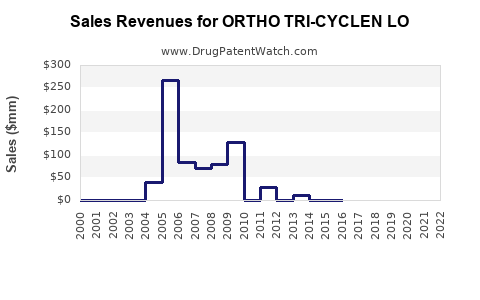
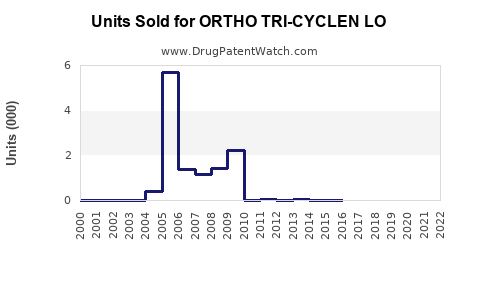
Annual Sales Revenues and Units Sold for ORTHO TRI-CYCLEN LO
| Drug Name | Revenues (USD) | Units | Year |
|---|---|---|---|
| ORTHO TRI-CYCLEN LO | ⤷ Start Trial | ⤷ Start Trial | 2022 |
| ORTHO TRI-CYCLEN LO | ⤷ Start Trial | ⤷ Start Trial | 2021 |
| ORTHO TRI-CYCLEN LO | ⤷ Start Trial | ⤷ Start Trial | 2020 |
| >Drug Name | >Revenues (USD) | >Units | >Year |
Ortho Tri-Cyclen Lo Market Analysis, Sales Projections, Patent Status, and Generic Competition
Ortho Tri-Cyclen Lo is a legacy combined oral contraceptive containing norgestimate and ethinyl estradiol. Its commercial market is now generic-led, with limited value remaining in the original brand. The product has no meaningful remaining market exclusivity, and generic products such as Tri-Lo-Marzia, Tri-Lo-Estarylla, and Tri-Lo-Sprintec determine pricing and volume.
A standalone brand revenue forecast is not publicly verifiable because Johnson & Johnson does not separately report Ortho Tri-Cyclen Lo sales. The commercial forecast below therefore uses a modeled U.S. market estimate based on prescription volume, generic substitution, and net pricing assumptions.
What is Ortho Tri-Cyclen Lo and how large is its market?
Ortho Tri-Cyclen Lo is a triphasic oral contraceptive with three escalating norgestimate doses and a constant low dose of ethinyl estradiol:
| Product characteristic | Ortho Tri-Cyclen Lo |
|---|---|
| Active ingredients | Norgestimate and ethinyl estradiol |
| Estrogen dose | 25 mcg ethinyl estradiol |
| Progestin schedule | 0.18 mg, 0.215 mg, and 0.25 mg norgestimate |
| Dosage form | 28-day oral tablet pack |
| FDA approval | 2002 |
| Therapeutic category | Combined hormonal contraceptive |
| Original manufacturer | Ortho-McNeil, later associated with Janssen |
| Current market structure | Generic-led |
| Prescription channel | Retail pharmacy, mail order, Medicaid, commercial insurance |
The product was positioned as a lower-estrogen alternative to Ortho Tri-Cyclen, which contains 35 mcg of ethinyl estradiol. Its commercial differentiation historically came from brand recognition, physician familiarity, and contraceptive coverage rather than a durable patent barrier.
The addressable U.S. market is the broader market for combined oral contraceptives, not only the norgestimate/ethinyl estradiol segment. The Centers for Disease Control and Prevention reports that oral contraceptives remain one of the most widely used reversible contraceptive methods among U.S. women of reproductive age (CDC, 2024).
How much revenue does Ortho Tri-Cyclen Lo generate?
No current, audited standalone revenue figure is publicly available for Ortho Tri-Cyclen Lo. Johnson & Johnson reports pharmaceutical sales at business-unit and product-family levels, but does not separately disclose this legacy contraceptive brand.
The original brand likely has minimal current U.S. revenue because:
- Multiple generic manufacturers compete on the same active ingredients and dosage schedule.
- Pharmacy benefit managers generally impose generic substitution.
- The brand has no current product differentiation that commands a broad premium.
- The original product is listed as discontinued or commercially inactive in portions of the FDA product database, while generic equivalents remain available.
- Contraceptive prescriptions are highly sensitive to formulary tier placement and copay differences.
A reasonable commercial interpretation is that current Ortho Tri-Cyclen Lo brand sales are immaterial relative to the generic market. Any remaining brand volume would most likely come from legacy prescribers, patient preference, non-substitution prescriptions, or isolated payer arrangements.
What are the sales projections for Ortho Tri-Cyclen Lo?
The following projection estimates the U.S. market for the Ortho Tri-Cyclen Lo-equivalent product, including generic products. It is not a forecast of the original brand alone.
Base-case U.S. market projection
| Year | Estimated prescriptions | Estimated net revenue | Generic share | Brand-equivalent share |
|---|---|---|---|---|
| 2024 | 6.0 million | $105 million | 98% | 2% |
| 2025 | 5.9 million | $103 million | 98.5% | 1.5% |
| 2026 | 5.8 million | $101 million | 99% | 1% |
| 2027 | 5.7 million | $99 million | 99% | 1% |
| 2028 | 5.6 million | $97 million | 99.2% | 0.8% |
| 2029 | 5.5 million | $95 million | 99.3% | 0.7% |
These figures use a modeled average net revenue of approximately $17 to $18 per monthly prescription across commercial, Medicaid, cash-pay, and mail-order channels. The projection assumes a gradual decline in prescriptions as patients shift to long-acting reversible contraception, progestin-only products, newer oral contraceptives, and over-the-counter contraceptive options.
The modeled market is not equivalent to manufacturer list-price sales. Wholesale acquisition cost can be materially higher than net revenue after rebates, Medicaid discounts, 340B discounts, pharmacy concessions, and payer adjustments.
Scenario analysis
| Scenario | 2029 prescriptions | 2029 net market revenue | Main assumptions |
|---|---|---|---|
| Downside | 4.6 million | $73 million | Faster migration to long-acting methods and continued price erosion |
| Base case | 5.5 million | $95 million | Moderate volume decline and stable generic competition |
| Upside | 6.3 million | $126 million | Stable oral-contraceptive use and limited additional price compression |
The original Ortho Tri-Cyclen Lo brand would capture only a small fraction of these totals. A reasonable base-case estimate for current branded revenue is below $2 million annually in the United States, with a continuing decline unless the product returns to active commercial promotion or obtains a differentiated distribution arrangement.
When did Ortho Tri-Cyclen Lo lose exclusivity?
Ortho Tri-Cyclen Lo lost practical exclusivity when FDA-approved generic equivalents entered the market. The commercially relevant exclusivity period has ended, even if individual formulation, manufacturing, or method patents may have had later expiration dates.
FDA-approved generics use the same active ingredients, strengths, dosage form, and therapeutic schedule. They are approved through the Abbreviated New Drug Application pathway and rely on the reference product’s safety and efficacy record rather than repeating the full clinical development program (FDA, 2024a).
The product has no current new chemical entity exclusivity. Any historical three-year exclusivity associated with a new formulation or supplemental approval would also have expired. Pediatric exclusivity, if granted for any related product or indication, would not create a current commercial barrier.
What patents protect Ortho Tri-Cyclen Lo?
The current patent estate is commercially weak. The original product was approved more than two decades ago, and generic competition confirms that no patent-based barrier prevents ANDA approval and marketing.
Patent categories historically relevant to the product
| Patent category | Commercial relevance today |
|---|---|
| Active-ingredient patents | Expired or not relevant to current generic entry |
| Composition-of-matter patents | Not applicable to the old combination product |
| Tablet formulation patents | Any relevant protection has expired or can be designed around |
| Packaging patents | Limited value and generally avoidable |
| Method-of-use patents | No material current barrier for routine contraception |
| Manufacturing patents | Potentially relevant to individual suppliers, but not a market-wide barrier |
The FDA Orange Book is the central source for patents and exclusivity associated with approved prescription products. Generic applicants must address listed patents through Paragraph I, II, III, or IV certifications. For a legacy product such as Ortho Tri-Cyclen Lo, the practical market result is that generic manufacturers have already navigated the applicable patent and regulatory framework (FDA, 2024b).
What is the Orange Book status of Ortho Tri-Cyclen Lo?
The Orange Book status should be distinguished between the original reference product and current generic products.
The reference product’s commercial importance is limited because:
- The product has no active market exclusivity.
- Generic versions are approved and marketed.
- The product does not have a meaningful current patent moat.
- Retail substitution is generally permitted where state law and payer rules allow it.
- The brand’s historical approval does not prevent generic competition.
Orange Book listings can change as products are discontinued, relisted, transferred, or associated with different application holders. The relevant commercial conclusion remains stable: the product is an off-patent, mature oral contraceptive with generic competition.
Which companies compete with Ortho Tri-Cyclen Lo?
The principal competitors are generic manufacturers selling norgestimate and ethinyl estradiol tablets in the same triphasic strength sequence.
Major generic product names
| Product | Market position |
|---|---|
| Tri-Lo-Marzia | Generic equivalent marketed by multiple distributors and manufacturers |
| Tri-Lo-Estarylla | Generic equivalent with broad pharmacy presence |
| Tri-Lo-Sprintec | Generic equivalent used in retail and managed-care channels |
| Norgestimate/ethinyl estradiol tablets | Generic products sold under manufacturer or distributor labels |
The competitive landscape also includes clinically substitutable contraceptives:
- Ortho Tri-Cyclen generics with 35 mcg ethinyl estradiol
- Monophasic norgestimate/ethinyl estradiol products
- Drospirenone/ethinyl estradiol products
- Levonorgestrel/ethinyl estradiol products
- Progestin-only pills
- Hormonal intrauterine systems
- Etonogestrel implants
- Depot medroxyprogesterone injections
- Transdermal patches and vaginal rings
The largest competitive risk does not come from another branded version of Ortho Tri-Cyclen Lo. It comes from therapeutic switching to other contraceptive formats.
Are there Paragraph IV challenges involving Ortho Tri-Cyclen Lo?
Paragraph IV litigation is not a current commercial driver for Ortho Tri-Cyclen Lo. Generic products are already on the market, and the product has passed the period in which a new Paragraph IV challenge would materially delay generic entry.
A Paragraph IV certification asserts that an Orange Book-listed patent is invalid, unenforceable, or not infringed. The filing can trigger litigation and a potential 30-month stay of FDA approval under the Hatch-Waxman Act. That mechanism is commercially important for new products with active listed patents, but it has little relevance to a mature product with established generic substitution (Congress, 1984).
What litigation affects Ortho Tri-Cyclen Lo?
No major current litigation appears to create a material barrier to generic supply or market access for Ortho Tri-Cyclen Lo. Historical pharmaceutical litigation involving oral contraceptives may have concerned labeling, marketing, product liability, or other Ortho-branded products rather than an active patent dispute capable of restoring exclusivity.
For investors and licensors, the litigation assessment is straightforward:
| Risk area | Current assessment |
|---|---|
| Patent infringement litigation | Low |
| Paragraph IV entry litigation | Low |
| Product-liability exposure | Possible but not a market-exclusivity issue |
| Antitrust exposure | Low based on current product maturity |
| Supply-chain disputes | Manufacturer-specific |
| Settlement-driven launch restrictions | No material current effect identified |
What manufacturing and intellectual-property barriers remain?
Manufacturing barriers are modest but not zero. A supplier must maintain validated processes for a multi-strength, triphasic tablet regimen, meet content-uniformity requirements, control dissolution across strengths, and comply with current good manufacturing practice requirements.
The main operational risks are:
- Active pharmaceutical ingredient supply interruptions
- Packaging errors across the three hormonal phases
- Recalls involving tablet sequencing
- Contract manufacturing constraints
- FDA inspection findings
- Low-margin economics that cause manufacturers to exit
- Retail shortages caused by concentrated supplier capacity
These risks can affect short-term availability without creating durable intellectual-property protection.
How does Ortho Tri-Cyclen Lo compare with Ortho Tri-Cyclen?
| Attribute | Ortho Tri-Cyclen Lo | Ortho Tri-Cyclen |
|---|---|---|
| Estrogen dose | 25 mcg | 35 mcg |
| Progestin | Norgestimate | Norgestimate |
| Dosing pattern | Triphasic | Triphasic |
| Brand status | Legacy, generic-led | Legacy, generic-led |
| Premium potential | Very limited | Very limited |
| Generic competition | Extensive | Extensive |
| Current patent value | Low | Low |
| Main commercial risk | Generic price erosion and switching | Same risks |
Ortho Tri-Cyclen Lo may retain a prescribing rationale for patients seeking a lower estrogen dose, but that clinical distinction does not translate into meaningful brand pricing power because generic equivalents are available.
What is the regulatory status of Ortho Tri-Cyclen Lo?
Ortho Tri-Cyclen Lo was approved by FDA as a prescription combined oral contraceptive. Continued commercial availability depends on the status of specific National Drug Codes, application holders, distributors, and generic manufacturers.
The active generic market is regulated through ANDAs. FDA approval establishes therapeutic equivalence to the reference product when the generic satisfies relevant quality, bioequivalence, labeling, and manufacturing requirements. The reference product’s historical approval therefore continues to support generic substitution even when the original branded product is no longer actively promoted.
What licensing deals affect Ortho Tri-Cyclen Lo?
No major current licensing transaction appears to drive the product’s market value. The commercial model is dominated by generic manufacturing, distribution agreements, and pharmacy-channel contracts rather than originator licensing.
Any value in a licensing transaction would likely come from:
- A generic product portfolio acquisition
- A supply agreement with a national pharmacy chain
- A contract manufacturing relationship
- A regional distribution arrangement
- A broader contraceptive portfolio transaction
A standalone license for the original Ortho Tri-Cyclen Lo brand would have limited strategic value unless it included manufacturing rights, regulatory rights, distribution infrastructure, or a broader women’s-health portfolio.
What generic launch scenarios exist for Ortho Tri-Cyclen Lo?
The most likely commercial scenario is continued generic availability with gradual price compression. A supply interruption by one or more manufacturers could temporarily increase unit prices or shift volume to remaining suppliers, but it would not restore patent exclusivity.
Generic market scenarios
| Scenario | Likely outcome |
|---|---|
| Stable supply | Continued low-cost generic competition |
| Manufacturer exit | Temporary price increase and pharmacy substitution |
| FDA manufacturing action | Short-term shortage risk |
| Brand relaunch | Limited uptake unless payer coverage improves |
| New formulation | Possible differentiation, but requires new regulatory and commercial investment |
| OTC migration | Long-term pressure on prescription oral-contraceptive volume |
Key Takeaways
- Ortho Tri-Cyclen Lo is a mature, off-patent contraceptive with extensive generic competition.
- The original brand has little current revenue and no meaningful exclusivity-based valuation.
- The U.S. generic-equivalent market is estimated at approximately $95 million in 2029 under the base case.
- Generic products such as Tri-Lo-Marzia, Tri-Lo-Estarylla, and Tri-Lo-Sprintec control the market.
- Paragraph IV litigation and patent settlements are no longer material commercial risks.
- The main threats are therapeutic switching, generic price erosion, manufacturer exits, and supply interruptions.
- A standalone brand acquisition or license would have limited value without distribution or manufacturing assets.
- The product’s remaining commercial opportunity is primarily generic, not branded.
FAQs About Ortho Tri-Cyclen Lo
Is Ortho Tri-Cyclen Lo still available?
The original brand has limited commercial availability, while generic equivalents containing norgestimate and ethinyl estradiol remain available through retail, mail-order, and managed-care channels.
What is the generic name for Ortho Tri-Cyclen Lo?
The generic name is norgestimate and ethinyl estradiol tablets in a triphasic regimen containing 25 mcg of ethinyl estradiol.
Is Tri-Lo-Marzia the same as Ortho Tri-Cyclen Lo?
Tri-Lo-Marzia is marketed as a generic equivalent of Ortho Tri-Cyclen Lo, subject to FDA approval requirements for therapeutic equivalence.
Does Ortho Tri-Cyclen Lo have biosimilar competition?
No. Biosimilars apply to biologic products. Ortho Tri-Cyclen Lo is a small-molecule oral drug and competes with generic drugs approved through the ANDA pathway.
Could Ortho Tri-Cyclen Lo return as a profitable branded product?
A profitable relaunch would require a meaningful commercial advantage, such as improved payer coverage, a new delivery system, a differentiated formulation, or a broader women’s-health portfolio. A conventional brand relaunch would face immediate generic substitution and limited pricing power.
References
-
Centers for Disease Control and Prevention. (2024). Contraception and birth control methods. https://www.cdc.gov/contraception/
-
U.S. Food and Drug Administration. (2024a). Generic drugs: Questions and answers. https://www.fda.gov/drugs/generic-drugs/generic-drugs-questions-answers
-
U.S. Food and Drug Administration. (2024b). Approved drug products with therapeutic equivalence evaluations. https://www.fda.gov/drugs/drug-approvals-and-databases/approved-drug-products-therapeutic-equivalence-evaluations-orange-book
-
U.S. Congress. (1984). Drug Price Competition and Patent Term Restoration Act of 1984, Pub. L. No. 98-417, 98 Stat. 1585.
-
U.S. Food and Drug Administration. (2002). Ortho Tri-Cyclen Lo prescribing information. FDA drug labeling database.
More… ↓
