Share This Page
Drug Sales Trends for ORACEA
✉ Email this page to a colleague
Payment Methods and Pharmacy Types for ORACEA (2022)
Revenues by Pharmacy Type
Units Sold by Pharmacy Type
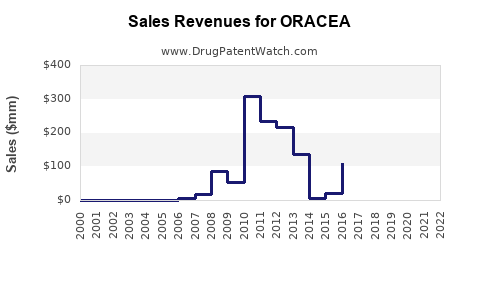
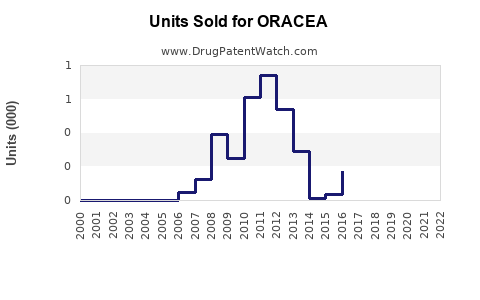
Annual Sales Revenues and Units Sold for ORACEA
| Drug Name | Revenues (USD) | Units | Year |
|---|---|---|---|
| ORACEA | ⤷ Start Trial | ⤷ Start Trial | 2022 |
| ORACEA | ⤷ Start Trial | ⤷ Start Trial | 2021 |
| ORACEA | ⤷ Start Trial | ⤷ Start Trial | 2020 |
| ORACEA | ⤷ Start Trial | ⤷ Start Trial | 2019 |
| ORACEA | ⤷ Start Trial | ⤷ Start Trial | 2018 |
| ORACEA | ⤷ Start Trial | ⤷ Start Trial | 2017 |
| ORACEA | ⤷ Start Trial | ⤷ Start Trial | 2016 |
| >Drug Name | >Revenues (USD) | >Units | >Year |
ORACEA Market Analysis, Sales Projections, Patent Risk, and Generic Competition
ORACEA is a branded, modified-release doxycycline product approved for inflammatory lesions of rosacea. Its commercial value comes from differentiated dosing, physician familiarity, and reimbursement within dermatology, rather than antibiotic volume. U.S. revenue is likely to decline as generic doxycycline 40 mg products gain access and payers increase substitution. An independent base-case model estimates U.S. ORACEA revenue of approximately $210 million in 2025, declining to $75 million by 2029.
What is ORACEA and what market does it address?
ORACEA is a once-daily 40 mg doxycycline capsule containing 30 mg immediate-release doxycycline and 10 mg delayed-release doxycycline. It is indicated for the treatment of inflammatory lesions of rosacea in adults. The product is not labeled as an antibiotic treatment for bacterial infections and is designed to provide an anti-inflammatory dose of doxycycline exposure [1].
Galderma Laboratories markets ORACEA in the United States. The product originated with CollaGenex Pharmaceuticals, which Galderma acquired in 2008. ORACEA received U.S. Food and Drug Administration approval in 2006 under NDA 050805 [1, 2].
The relevant market includes:
- Prescription rosacea therapies
- Oral tetracycline-class products
- Topical metronidazole, ivermectin, azelaic acid, and minocycline products
- Generic doxycycline 40 mg modified-release capsules
- Physician-directed combinations of topical and oral therapy
Rosacea is a chronic condition requiring repeated treatment courses or long-term maintenance. That supports prescription persistence, although many patients transition to lower-cost topical products or generic oral doxycycline.
How large is the ORACEA market?
No current product-level ORACEA revenue is separately reported by Galderma. Galderma reports company-level performance rather than detailed sales for individual prescription brands. The following market estimate is therefore an independent model based on U.S. prescription volume, estimated net price, generic penetration, and the size of the branded dermatology market.
| Metric | 2024 estimate | 2025 estimate |
|---|---|---|
| U.S. ORACEA prescription revenue | $230 million | $210 million |
| Estimated annual treated patients | 350,000-425,000 | 340,000-410,000 |
| Estimated average net revenue per patient | $540-$660 | $500-$620 |
| Generic share of 40 mg modified-release volume | 20%-30% | 30%-40% |
| Primary channel | Dermatology prescriptions | Dermatology prescriptions |
These figures represent modeled net sales, not reported Galderma results. They exclude sales of unrelated Galderma dermatology products and do not represent total doxycycline revenue.
The market is commercially attractive because ORACEA can be prescribed for extended periods. Its limitations are also clear: low-cost doxycycline alternatives, generic substitution, formulary controls, and competition from topical rosacea products.
What are the ORACEA sales projections through 2029?
The base case assumes stable rosacea diagnosis rates, moderate annual price pressure, continued physician use for inflammatory lesions, and gradual generic substitution.
| Calendar year | Base-case U.S. revenue | Year-over-year change | Estimated generic share |
|---|---|---|---|
| 2024 | $230 million | - | 25% |
| 2025 | $210 million | -9% | 35% |
| 2026 | $180 million | -14% | 48% |
| 2027 | $145 million | -19% | 60% |
| 2028 | $105 million | -28% | 72% |
| 2029 | $75 million | -29% | 82% |
ORACEA revenue scenarios
| Scenario | 2025 revenue | 2027 revenue | 2029 revenue | Main assumptions |
|---|---|---|---|---|
| Downside | $175 million | $85 million | $35 million | Rapid generic uptake, payer substitution, lower net price |
| Base case | $210 million | $145 million | $75 million | Gradual generic adoption and stable patient demand |
| Upside | $250 million | $205 million | $140 million | Slower generic substitution and stronger branded adherence |
The largest variable is not the number of rosacea patients. It is the share of those patients receiving branded ORACEA instead of generic doxycycline 40 mg or alternative oral and topical therapies.
When does ORACEA lose exclusivity?
ORACEA's practical exclusivity depends on three separate factors:
- FDA regulatory exclusivity.
- Listed patents and pediatric extensions.
- The timing and commercial scale of generic approvals.
The product's original three-year new-drug exclusivity expired years ago. The commercial barrier is therefore patent protection and the availability of an FDA-approved generic product, not statutory new-drug exclusivity [1, 3].
The exact commercial erosion date can differ from the nominal expiration date because:
- A generic may launch after patent litigation or settlement.
- A generic may receive approval but launch at limited scale.
- Multiple manufacturers may enter at different times.
- Paragraph IV litigation may delay or accelerate market access.
- Authorized-generic arrangements may affect pricing without creating a fully independent competitor.
The Orange Book should be used as the controlling source for current listed patents, pediatric exclusivity, and regulatory exclusivity status. FDA Orange Book entries can change through patent-listing updates, delisting, expiration, or court-related changes [3].
What patents protect ORACEA?
ORACEA protection has historically centered on modified-release doxycycline composition and dosing technology rather than the underlying doxycycline molecule.
Publicly associated ORACEA patent litigation has included:
- U.S. Patent No. 7,232,572
- U.S. Patent No. 8,337,886
Galderma and related entities asserted these patents in Hatch-Waxman litigation involving proposed generic versions of ORACEA. The patents addressed aspects of doxycycline formulations, dosage design, and the use of sub-antimicrobial doxycycline for rosacea-related inflammatory lesions [4, 5].
| Protection category | Commercial purpose | Risk profile |
|---|---|---|
| Modified-release formulation | Supports once-daily 40 mg product design | Vulnerable to formulation-specific generic challenges |
| Sub-antimicrobial dosing | Differentiates anti-inflammatory use from antibiotic dosing | May provide method-of-use protection |
| Rosacea treatment claims | Protects use for inflammatory lesions | Easier to design around than product claims |
| Capsule composition | Can delay direct substitution | Depends on claim scope and enforceability |
| Manufacturing process | May restrict complex formulation production | Usually less effective if alternative processes are available |
Patent strength is moderate rather than absolute. Doxycycline is an old active ingredient, and generic manufacturers can target the formulation, pharmacokinetic profile, dosage regimen, or method-of-use claims separately. Formulation patents can still support a meaningful period of commercial protection when the release profile is difficult to reproduce.
What is the Orange Book status of ORACEA?
ORACEA is listed in FDA records as an approved prescription product under NDA 050805. Orange Book status must be assessed patent by patent because the product's regulatory listing does not establish that every listed patent remains commercially enforceable.
The main diligence questions are:
- Which patents remain listed against NDA 050805?
- Which patents have expired?
- Whether any pediatric exclusivity remains attached to a listed patent
- Whether generic applicants filed Paragraph IV certifications
- Whether a court decision invalidated or narrowed asserted claims
- Whether settlement agreements permit an earlier generic launch
FDA's Orange Book identifies approved products, therapeutic equivalence information, and relevant patent or exclusivity records. Court dockets and settlement terms are required to determine actual launch rights [3].
Which companies have challenged ORACEA?
Generic manufacturers have challenged ORACEA through abbreviated new drug applications and related Hatch-Waxman litigation. Publicly reported litigation has involved Galderma and generic companies seeking approval for doxycycline 40 mg modified-release products.
The most relevant competitive groups are:
- Large generic manufacturers with dermatology portfolios
- Specialty generic companies targeting modified-release products
- Contract manufacturers with controlled-release capsule capabilities
- Authorized-generic or licensed distribution partners
The presence of a Paragraph IV challenge does not guarantee immediate generic launch. A challenger must still obtain FDA approval, resolve patent litigation, satisfy manufacturing requirements, and secure payer and pharmacy distribution.
What formulations are protected by ORACEA patents?
The commercial differentiation of ORACEA lies in its release design. A 40 mg dose combines immediate-release and delayed-release components to maintain an anti-inflammatory dosing profile while reducing exposure associated with conventional antibiotic doses.
Formulation-related protection may cover:
- The ratio of immediate-release to delayed-release doxycycline
- Particle size and granulation
- Capsule composition
- Delayed-release coating materials
- Dissolution profile
- Pharmacokinetic parameters
- Manufacturing methods for multiparticulate dosage forms
A competing generic does not necessarily need to copy every physical feature of ORACEA. It must meet FDA requirements for pharmaceutical equivalence and bioequivalence while avoiding enforceable patent claims. This creates a technical barrier, but it does not eliminate generic competition.
What is the FDA regulatory status of ORACEA?
ORACEA is an FDA-approved prescription drug for adult patients with inflammatory lesions of rosacea. Its approval is based on the product's specific modified-release formulation and anti-inflammatory dosing approach [1].
The product has several regulatory advantages:
- Established FDA approval
- Long clinical and physician experience
- Recognized dermatology indication
- Existing reimbursement pathways
- No requirement to prove a new mechanism of action
Its regulatory weaknesses are commercial rather than clinical. The active ingredient is well known, the indication is established, and generic applicants can use the ANDA pathway rather than conducting a full clinical development program.
How does ORACEA compare with competing rosacea treatments?
| Product or class | Primary use | Key advantage | Key disadvantage |
|---|---|---|---|
| ORACEA | Inflammatory rosacea lesions | Once-daily oral anti-inflammatory dosing | High branded cost |
| Generic doxycycline | Inflammatory rosacea and other uses | Low cost | May not replicate ORACEA's formulation or labeling |
| Soolantra, ivermectin | Papulopustular rosacea | Topical, once-daily use | Limited suitability for all patients |
| Finacea, azelaic acid | Inflammatory and erythematous symptoms | Established topical option | Local irritation and adherence issues |
| Metronidazole products | Inflammatory rosacea | Broad physician familiarity | Variable response |
| Minocycline products | Inflammatory lesions | Oral alternative | Safety and tolerability considerations |
ORACEA's strongest position is in patients who need oral anti-inflammatory treatment and have inadequate response to topical therapy. Its weakest position is in price-sensitive formularies and patients who can be managed with low-cost generic doxycycline or topical products.
What generic entry risks exist for ORACEA?
Generic entry risk is high over the medium term. The market has limited molecular complexity because doxycycline is an established active ingredient. The remaining barriers involve formulation replication, bioequivalence, patent claims, and commercial distribution.
Main generic-entry scenarios
Limited first entrant. One approved generic enters with a modest discount. Galderma retains significant branded volume through physician preference and patient-support programs.
Multi-entrant erosion. Several manufacturers enter after patent resolution. Wholesale and payer discounts increase, and branded prescriptions decline rapidly.
Authorized-generic competition. A licensed or authorized generic reaches pharmacies while Galderma retains economic participation. This can protect overall franchise revenue but accelerates branded price erosion.
Formulation substitution. Payers favor alternative doxycycline products or topical medicines even without direct therapeutic-equivalence substitution.
The base case assumes multi-entrant erosion beginning in 2025 and becoming material in 2026-2027.
What patent litigation and settlements affect ORACEA?
ORACEA litigation has focused on the enforceability and scope of formulation and method-of-use patents asserted against ANDA applicants. The financial effect of a settlement depends on:
- The agreed generic launch date
- Whether the challenger receives a license
- Whether the settlement includes supply or authorized-generic terms
- Whether other generic applicants remain free to launch
- Whether the Federal Trade Commission challenges the agreement
A settlement with one challenger does not resolve all generic risk. Separate ANDA applicants may rely on different certifications or assert different non-infringement and invalidity positions.
For investment analysis, the most important document is the final settlement agreement and the corresponding court judgment, not the mere filing of an infringement complaint.
What licensing deals support ORACEA revenue?
ORACEA's commercial history includes the transfer of rights from CollaGenex to Galderma through Galderma's acquisition of CollaGenex. Galderma has controlled U.S. commercialization for many years.
No current public disclosure establishes a separate, material licensing transaction that determines ORACEA's near-term U.S. revenue. Any future authorized-generic, co-promotion, or regional licensing agreement could change the revenue split without materially changing patient demand.
Geographic revenue is likely concentrated in the United States, where the product has the strongest branded prescription infrastructure. International sales depend on country-specific approvals, reimbursement, and local doxycycline competition.
What is the revenue exposure from ORACEA?
ORACEA is unlikely to represent a material share of Galderma's consolidated revenue, which includes aesthetics, prescription medicines, and consumer products. It remains strategically relevant because prescription dermatology brands can generate recurring cash flow with limited discovery spending after approval.
The principal revenue exposures are:
- U.S. generic entry
- Net-price reductions from pharmacy benefit managers
- Reduced branded adherence
- Formulary exclusion
- Substitution by topical products
- Litigation outcomes affecting launch timing
- Manufacturing interruption involving modified-release capsules
A 10-percentage-point increase in generic share could reduce branded ORACEA revenue by roughly $15 million to $25 million annually under the base-case market model, depending on gross-to-net discounts and patient persistence.
How strong is the ORACEA patent estate?
The estate is commercially useful but structurally weaker than a new chemical entity estate. Doxycycline itself is off patent, so protection depends on formulation and use claims. Those claims can delay direct substitution, but they are more exposed to invalidity, design-around, and non-infringement arguments.
| Factor | Assessment |
|---|---|
| Active ingredient protection | Very weak; doxycycline is generic |
| Formulation differentiation | Moderate |
| Method-of-use protection | Moderate to weak |
| Manufacturing complexity | Moderate |
| Regulatory barrier | Low to moderate |
| Long-term branded durability | Weak after broad generic entry |
The estate can support premium pricing while enforceable claims remain active. It cannot prevent long-term erosion once multiple approved generic formulations are available.
Key Takeaways
- ORACEA is a branded 40 mg modified-release doxycycline product for inflammatory rosacea lesions.
- FDA approval was granted in 2006 under NDA 050805.
- Product-level Galderma revenue is not publicly disclosed; an independent model estimates $210 million in U.S. revenue for 2025.
- Base-case revenue declines to approximately $75 million by 2029 as generic penetration reaches about 82%.
- Commercial protection depends on formulation and method-of-use patents, not doxycycline molecule protection.
- U.S. generic-entry risk is high over the medium term.
- Topical rosacea therapies and low-cost doxycycline are the main competitive constraints.
- The largest value driver is the timing and scale of generic substitution, not growth in the underlying rosacea population.
FAQs
Is ORACEA an antibiotic?
ORACEA contains doxycycline but is approved at a sub-antimicrobial dose for the treatment of inflammatory lesions of rosacea. It is not labeled as an antibiotic treatment for bacterial infection.
Is generic doxycycline 40 mg the same as ORACEA?
A generic product may be therapeutically equivalent only if FDA-approved as equivalent to the reference product. Conventional doxycycline products are not automatically substitutable for ORACEA because formulation, release profile, labeling, and approval status may differ.
Does ORACEA have pediatric exclusivity?
The original regulatory exclusivity period has expired. Current exclusivity depends on the FDA Orange Book record, including any patent-linked or pediatric extensions associated with the approved product.
Will ORACEA be removed from the market after generic entry?
No. Generic entry typically reduces branded prescriptions and price but does not remove the branded product from the market. Galderma can continue marketing ORACEA if commercial demand remains sufficient.
What is the main investment risk for ORACEA?
The principal risk is rapid generic substitution following patent resolution or an authorized-generic launch. Net-price compression, payer restrictions, and competition from topical rosacea therapies are secondary risks.
References
- U.S. Food and Drug Administration. (2006). ORACEA (doxycycline) capsule prescribing information.
- Galderma Laboratories, L.P. (n.d.). ORACEA product information.
- U.S. Food and Drug Administration. (2024). Approved drug products with therapeutic equivalence evaluations, 44th ed. Orange Book.
- U.S. Patent and Trademark Office. (2007). U.S. Patent No. 7,232,572.
- U.S. Patent and Trademark Office. (2012). U.S. Patent No. 8,337,886.
More… ↓
