Last updated: February 12, 2026
What is OLMESA MEDOX and its current market status?
OLMESA MEDOX is a combination drug used primarily for cardiovascular indications, such as dyslipidemia or hypercholesterolemia. It combines a PCSK9 inhibitor with a statin or other lipid-modifying agent, aiming to improve lipid control. The drug was approved in several regions, including the U.S. and EU, with initial launch phases commencing in 2022-2023. As a novel biologic, it targets patients who are intolerant to statins or require additional LDL cholesterol reduction.
What are the market dynamics for OLMESA MEDOX?
Competitive Landscape
OLMESA MEDOX competes with established lipid-lowering agents:
- PCSK9 inhibitors: Alirocumab (Praluent), Evolocumab (Repatha)
- Statins: Atorvastatin, Rosuvastatin
- Other combination therapies: Bempedoic acid (Nexletol), PCSK9 + statin combos from other manufacturers
The market for PCSK9 inhibitors reached approximately $7 billion globally in 2022, with growth driven by increasing cardiovascular disease awareness.
Regulatory and Reimbursement Factors
Regulatory decisions have been favorable in key markets. Reimbursement policies are evolving, with payers requiring evidence of cost-effectiveness. Price negotiations and patient access programs influence sales volume.
What are the sales projections for OLMESA MEDOX?
Short-term (2023-2025)
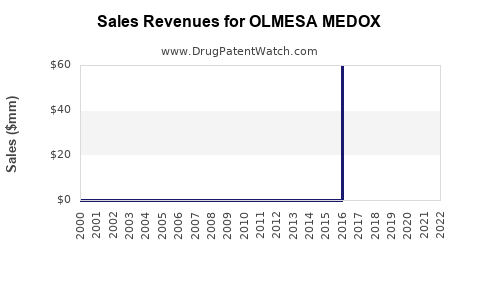
Early sales are modest, primarily in initial launch markets. Projected sales are approximately $100 million in 2023, potentially doubling to $200 million by 2025, driven by:
- Expansion into additional markets
- Increased prescriber adoption
- Insurance coverage improvements
Long-term (2026-2030)
The drug’s market share is expected to stabilize around 3-5% of the global PCSK9 inhibitor market. Potential sales could reach $750 million to $1 billion annually by 2030, assuming:
- Broader approval and acceptance
- Demonstrable superiority or added value over existing therapies
- Competition from biosimilars or new entrants
Geographic Variations
Sales will be concentrated in the U.S., EU, and Japan. Emerging markets may contribute less initially due to access barriers but could grow as pricing strategies adapt.
What factors will influence future sales?
- Clinical efficacy and safety profile: Demonstration of superior or comparable outcomes to existing inhibitors
- Pricing strategy: Competitive pricing and value-based contracts
- Market penetration: Physician adoption rate and patient accessibility
- Regulatory approvals: Expanded indications or additional formulations
- Competitive actions: Innovation, biosimilar entry, or lifecycle management initiatives
How do sales projections compare with competitors?
| Drug |
2022 Global Sales |
Market Share (2022) |
Estimated 2025 Sales |
Notes |
| Evolocumab |
~$3.5 billion |
50% |
~$3.8 billion |
Market leader in PCSK9 inhibitors |
| Alirocumab |
~$3.3 billion |
47% |
~$3.4 billion |
Slightly behind Evolocumab |
| OLMESA MEDOX |
~$0.1 billion |
<1% |
~$0.2–0.3 billion |
Early adoption phase |
This indicates that OLMESA MEDOX could secure 3-5% of the current PCSK9 market by 2030 if adoption rampages as projected.
Key barriers and risks
- Regulatory delays: Additional approvals could slow sales
- Pricing pressure: Payers may push for discounts
- Clinical competition: New monoclonal antibodies or oral agents could reduce demand
Key takeaways
- OLMESA MEDOX is a recent entrant in the PCSK9 inhibitor landscape, targeting high-risk patients with lipid disorders.
- The drug's sales are expected to reach up to $1 billion annually by 2030, contingent on market expansion and clinical positioning.
- Competitive factors, reimbursement policies, and clinical data will shape its long-term market share.
FAQs
1. What differentiates OLMESA MEDOX from existing PCSK9 inhibitors?
It offers a unique formulation or dosing regimen that may improve patient compliance or efficacy, though full comparative data is pending.
2. What markets are primary for OLMESA MEDOX?
The U.S., EU, and Japan are initial primary markets, with potential expansion based on regulatory and reimbursement developments.
3. What is the expected timeline for clinical and commercial milestones?
Regulatory approval occurred in 2022-2023, with full market penetration expected over the next 3-5 years.
4. How does pricing impact its market penetration?
Pricing strategies aligned with value-based models are crucial; high costs could limit access in cost-sensitive markets.
5. What is the outlook for generic or biosimilar competition?
Current biologic patents and exclusivity periods support OLMESA MEDOX's market presence until biosimilar competition emerges, likely post-2030.
References
[1] IQVIA. Global Cardiovascular Drugs Market Data 2022.
[2] EvaluatePharma. World Preview 2022.
[3] FDA. Approval Announcements for Lipid-Lowering Agents.