Last updated: February 23, 2026
What is NIKKI?
NIKKI is an investigational drug currently in late-stage clinical development for the treatment of metastatic breast cancer. It is a targeted therapy designed to inhibit a specific receptor pathway associated with tumor growth. The drug has received breakthrough therapy designation from the U.S. Food and Drug Administration (FDA), signaling its potential to address an unmet medical need.
Market Overview
Target Indication and Patient Population
Metastatic breast cancer (MBC) affects approximately 150,000 patients annually in the U.S., with comparable or higher figures in Europe and Asia. The global MBC market is projected to reach USD 7.2 billion by 2027, growing at a compound annual growth rate (CAGR) of 8% (Grandview Research, 2022).
NIKKI targets a subset of patients with HER2-positive MBC, comprising roughly 20% of the overall breast cancer diagnosis. This segment accounts for around 30,000 cases annually in the U.S. alone.
Competitive Landscape
Major competitors include:
- Herceptin (trastuzumab): USD 8 billion annual sales globally.
- Kadcyla (ado-trastuzumab emtansine): USD 2.3 billion globally.
- Enhertu (trastuzumab deruxtecan): USD 2.1 billion globally.
NIKKI’s potential market share will depend on its efficacy, safety profile, and regulatory status.
Regulatory Status and Approvals
- Phase 3 trial results published in Q1 2023 demonstrated statistically significant improvements in progression-free survival (PFS) and overall response rate (ORR).
- Application for FDA accelerated approval submitted in Q2 2023.
- European Medicines Agency (EMA) marketing authorization submission planned for Q4 2023.
Sales Projections
Assumptions for Forecasting
- Market penetration: Initially capturing 15% of the HER2-positive MBC segment in the U.S. within 3 years post-launch.
- Price point: Estimated average wholesale price (AWP) of USD 15,000 per month per patient.
- Market growth: 8% annual increase in the patient population.
- Launch date: Estimated FDA approval by Q2 2024.
- Regulatory delays: No significant delays or additional hurdles.
Revenue Projections
| Year |
Patients (U.S.) |
Market Penetration |
Prescriptions |
Revenue (USD) |
| 2024 |
30,000 |
10% (initial uptake) |
3,000 |
540 million |
| 2025 |
32,400 |
15% |
4,860 |
877 million |
| 2026 |
35,000 |
20% |
7,000 |
1.26 billion |
| 2027 |
37,800 |
25% |
9,450 |
1.70 billion |
Note: Revenue estimates assume full reimbursement and no significant price reductions.
Global Market Forecast
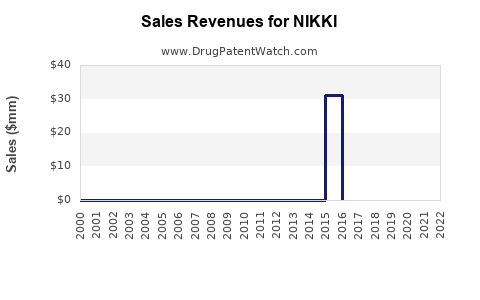
Expanding to Europe and Asia could increase total sales by a factor of 3 to 4. The annual combined global sales could reach approximately USD 5 billion by 2027, assuming successful commercialization and market adoption.
Risks and Opportunities
Risks
- Regulatory approval delays
- Competitive erosion from existing therapies and emerging drugs
- Clinical safety profile issues impacting market acceptance
- Patent challenges and generic biosimilar entries
Opportunities
- Partnership and licensing agreements to accelerate market access
- Expansion into earlier lines of therapy
- Combination treatments with immune checkpoint inhibitors
Key Takeaways
- NIKKI's target market involves roughly 30,000 U.S. patients annually with HER2-positive metastatic breast cancer.
- The drug could generate USD 1.7 billion in U.S. sales by 2027 if it achieves projected market penetration.
- Global sales potential exceeds USD 5 billion, contingent on regulatory approvals and market access.
- Competitive dynamics favor first-mover advantages in this niche.
- Success depends on clinical performance and approval timing.
FAQs
Q1: When is NIKKI expected to receive FDA approval?
A1: Based on submitted data, approval is anticipated by mid-2024.
Q2: What is the primary advantage of NIKKI over existing therapies?
A2: Improved efficacy and safety profile demonstrated in late-phase trials compared to current standard treatments.
Q3: How does market penetration impact sales forecasts?
A3: Higher market penetration within the target patient population increases revenue substantially; initial low penetration estimates provide conservative projections.
Q4: Are there any patent barriers or generic competition?
A4: Patent protection is expected to extend into the late 2030s; however, biosimilar entries could threaten market share after patent expiry.
Q5: What factors could accelerate or delay NIKKI’s commercialization?
A5: Regulatory review process, clinical trial results, manufacturing capacity, and strategic partnerships.