Share This Page
Drug Sales Trends for NEXIUM 24HR
✉ Email this page to a colleague
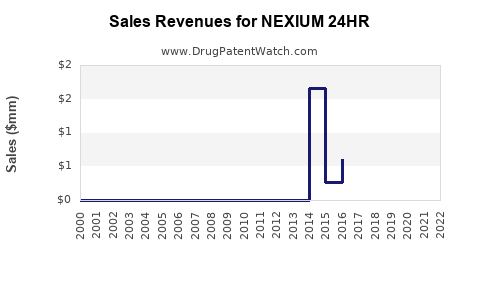
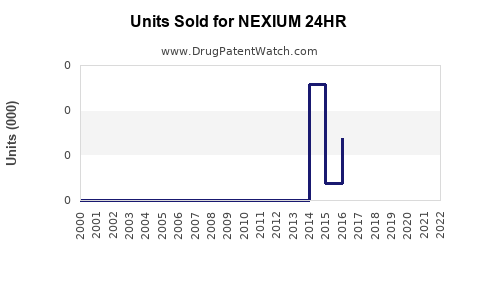
Annual Sales Revenues and Units Sold for NEXIUM 24HR
| Drug Name | Revenues (USD) | Units | Year |
|---|---|---|---|
| NEXIUM 24HR | ⤷ Start Trial | ⤷ Start Trial | 2022 |
| NEXIUM 24HR | ⤷ Start Trial | ⤷ Start Trial | 2021 |
| NEXIUM 24HR | ⤷ Start Trial | ⤷ Start Trial | 2020 |
| NEXIUM 24HR | ⤷ Start Trial | ⤷ Start Trial | 2019 |
| NEXIUM 24HR | ⤷ Start Trial | ⤷ Start Trial | 2018 |
| >Drug Name | >Revenues (USD) | >Units | >Year |
Nexium 24HR Market Analysis, Sales Forecast, Patent Position, and Generic Risk
Nexium 24HR is the U.S. over-the-counter version of esomeprazole magnesium 20 mg, used for frequent heartburn. The product operates in a mature proton-pump inhibitor market with strong consumer recognition, broad private-label competition, and limited remaining patent protection. Haleon controls the consumer-health brand portfolio that includes Nexium in the United States, while product-specific revenue is not separately reported.
The base-case estimate places U.S. Nexium 24HR retail sales at approximately $425 million in 2025, declining to about $375 million by 2029 as private-label substitution, retailer brands, and competing OTC PPIs pressure pricing. The principal commercial risk is not a new patent challenge. It is permanent erosion of brand share caused by generic and store-brand esomeprazole.
What is Nexium 24HR and how is it regulated?
Nexium 24HR contains esomeprazole magnesium, the S-isomer of omeprazole. The product is marketed as a 20 mg delayed-release capsule for adults and children age 18 and older who experience frequent heartburn, generally defined in the labeling as heartburn occurring two or more days per week.
The FDA approved Nexium 24HR as a nonprescription product in 2014 under NDA 022101. The product launched in the United States in 2015 after AstraZeneca switched the prescription product to OTC status.[1]
| Product attribute | Nexium 24HR profile |
|---|---|
| Active ingredient | Esomeprazole magnesium |
| Strength | 20 mg |
| Dosage form | Delayed-release capsule |
| Route | Oral |
| OTC indication | Frequent heartburn |
| Typical labeled course | One capsule daily for 14 days |
| U.S. regulatory pathway | FDA-approved OTC NDA |
| Original innovator | AstraZeneca |
| Current consumer-health platform | Haleon portfolio |
| Primary alternatives | Store-brand esomeprazole, Prilosec OTC, Prevacid 24HR, famotidine products |
Nexium 24HR is not an antacid. It suppresses gastric acid production through irreversible inhibition of the gastric proton pump. Its delayed-release formulation protects esomeprazole from degradation in the stomach and releases the active ingredient in the intestine.
How large is the Nexium 24HR market?
The relevant market is the U.S. OTC heartburn and acid-reflux category, which includes PPIs, H2-receptor antagonists and antacids. Nexium 24HR competes most directly with OTC esomeprazole products and with branded PPIs such as Prilosec OTC and Prevacid 24HR.
Public company filings do not disclose Nexium 24HR sales as a standalone line item. Haleon reports by broad consumer-health category and brand portfolio rather than by each OTC product. Retail scanner datasets from Circana and NIQ are therefore the usual sources for precise brand-share analysis, but those datasets are subscription products.
A practical market framework is:
| Market segment | Nexium 24HR exposure | Competitive pressure |
|---|---|---|
| Branded OTC PPI | High | Strong |
| Private-label esomeprazole | Direct substitute | Very strong |
| Omeprazole products | Therapeutic substitute | Strong |
| Lansoprazole products | Therapeutic substitute | Moderate |
| Famotidine | Different mechanism, same consumer need | Strong |
| Antacids | Acute symptom relief | Moderate |
Nexium retains advantages in brand awareness, physician familiarity, national distribution and perceived efficacy. Store brands generally have a lower price per dose and are favored by large retailers that control shelf placement, online search ranking and promotional pricing.
What are the Nexium 24HR sales projections through 2029?
The following forecast is a scenario-based estimate of U.S. retail sales, not reported Haleon revenue. It assumes a mature category, stable consumer demand for heartburn products, modest volume growth and continuing price compression.
| Year | Base-case retail sales | Year-over-year change | Main driver |
|---|---|---|---|
| 2024 | $440 million | -3.0% | Private-label share gains |
| 2025 | $425 million | -3.4% | Retail price and volume pressure |
| 2026 | $412 million | -3.1% | Continued store-brand substitution |
| 2027 | $400 million | -2.9% | Stable category demand |
| 2028 | $387 million | -3.3% | Promotion and channel pressure |
| 2029 | $375 million | -3.1% | Mature branded OTC erosion |
Bull-case projection
A favorable scenario would hold 2025-2029 retail sales near $440 million to $455 million annually. This outcome would require successful premium pricing, stronger digital marketing, effective retailer execution and limited switching to private-label esomeprazole.
Bear-case projection
A downside scenario would reduce sales to approximately $300 million by 2029. The principal causes would be accelerated private-label adoption, wider availability of low-priced generic esomeprazole, retailer delisting or reduced shelf allocation, and lower consumer willingness to pay for branded PPIs.
Revenue interpretation
Retail sales should not be treated as Haleon net revenue. Retailer discounts, wholesale deductions, trade promotion, returns and channel mix reduce manufacturer-recognized sales. Haleon’s public reports provide category-level performance but do not isolate Nexium 24HR revenue.[2]
What is the Orange Book status of Nexium 24HR?
Nexium 24HR is an FDA-approved OTC drug, but its current commercial protection does not depend on an active, enforceable product patent in the way a recently approved prescription medicine typically does.
The original prescription Nexium franchise was protected by a group of esomeprazole and formulation patents. The principal U.S. exclusivity period for the prescription product expired years ago, and generic esomeprazole products entered the prescription market. The OTC product now competes in an open market with private-label products and generic equivalents.
The FDA Orange Book remains the controlling source for current listed patents and exclusivity. A product’s historical patent estate should not be confused with current blocking rights. Patent families associated with omeprazole, esomeprazole salts and delayed-release formulations have largely reached expiration or have limited practical value against current OTC competition.[3]
| Protection category | Current commercial significance |
|---|---|
| Original esomeprazole compound and salt patents | Expired or commercially exhausted |
| Prescription formulation patents | Largely expired |
| OTC NDA approval | Supports lawful marketing but does not create market exclusivity |
| Brand name and trademarks | Active commercial protection |
| Packaging and trade dress | Limited, non-blocking protection |
| Consumer advertising claims | Subject to FDA and FTC requirements |
When did Nexium lose exclusivity?
Nexium lost meaningful prescription-market exclusivity in the 2010s as generic esomeprazole entered the U.S. market. The exact loss of exclusivity depended on the patent, dosage form and regulatory pathway involved.
The commercial consequence was substantial: generic esomeprazole became available at prescription prices far below the branded product, while OTC Nexium retained a premium based on brand recognition and consumer marketing. The OTC switch expanded consumer access but also made the brand more vulnerable to private-label competition.
Nexium 24HR does not have a traditional period of OTC market exclusivity comparable to the five-year new chemical entity period for an innovative prescription drug. Its commercial position depends on branding, distribution, regulatory compliance and formulation execution.
Which companies are challenging Nexium 24HR?
The competitive challenge comes from manufacturers and retailers selling equivalent or substitutable acid-reflux products rather than from a single litigation-driven Paragraph IV entrant.
Key competitors include:
- Haleon, through Nexium 24HR.
- Procter & Gamble, through Prilosec OTC.
- Sanofi, through Prevacid 24HR.
- Perrigo, which supplies private-label and store-brand OTC products.
- Retailer-owned brands sold through CVS, Walgreens, Walmart, Target, Amazon and grocery pharmacies.
- Generic manufacturers supplying prescription and OTC esomeprazole products.
The most important competitive threat is private label. Retailers can offer esomeprazole at a substantial discount while using the same active ingredient, strength and general delayed-release technology. Retailer control of shelf positioning and online search results can increase substitution even when the branded product maintains higher unaided awareness.
Are there Paragraph IV challenges to Nexium 24HR?
Paragraph IV litigation is primarily relevant to abbreviated new drug applications that challenge listed patents for an approved drug. Nexium 24HR’s current OTC commercial exposure is less dependent on a new Paragraph IV event because esomeprazole products already have broad generic competition and the major historical patent barriers have expired or lost practical force.
A new Paragraph IV filing against an active OTC patent could create litigation risk, but the market impact would likely be incremental unless the challenged patent covered a commercially important formulation or a unique delivery system. The greater risk is ordinary price competition from already available products.
What formulation patents protect Nexium 24HR?
The commercial product uses a delayed-release dosage form. Formulation protection historically centered on:
- Esomeprazole magnesium stability.
- Enteric coating technology.
- Protection from gastric degradation.
- Multiparticulate or pellet-based release systems.
- Capsule and tablet manufacturing processes.
These technologies are technically relevant but do not automatically create current market exclusivity. Many delayed-release PPI technologies are now mature and can be implemented by generic manufacturers under approved regulatory pathways.
A formulation patent could still matter if it covers a narrow, enforceable release profile or a manufacturing process that materially improves stability. The practical strength of such a patent depends on claim scope, expiration date, validity, design-around options and whether the FDA-approved generic uses the claimed process.
How strong is the Nexium 24HR patent estate?
The current patent estate is weak as a barrier to generic entry and moderate as a brand-defense asset.
| Patent-strength factor | Assessment |
|---|---|
| Active compound protection | Weak; historical protection has expired |
| Core delayed-release technology | Weak to moderate |
| Manufacturing know-how | Moderate but difficult to enforce broadly |
| Trademark protection | Strong against confusingly similar branding |
| Regulatory exclusivity | Limited |
| Consumer franchise | Stronger than patent position |
| Generic entry barrier | Low |
| Litigation leverage | Limited |
Nexium’s commercial moat is therefore marketing-based rather than patent-based. The brand can defend trademarks, packaging and advertising claims, but it cannot prevent lawful sale of equivalent esomeprazole products.
What FDA and regulatory issues affect sales?
The principal regulatory risks are labeling compliance, safety communications and consumer misuse.
The Nexium 24HR label limits self-treatment to a 14-day course and directs consumers to seek medical advice when symptoms persist or recur frequently. FDA safety communications for PPIs have addressed potential risks associated with long-term use, including bone fractures, magnesium deficiency, Clostridioides difficile-associated diarrhea, vitamin B12 deficiency and kidney-related events.[4]
These communications do not necessarily remove the product from the market. They can affect consumer conversion, physician recommendations and advertising claims. A change in labeling or a stronger warning could reduce demand, especially among frequent users who treat recurring symptoms without medical supervision.
What generic launch risks exist for Nexium 24HR?
Generic launch risk is already realized rather than prospective. Esomeprazole competitors are available, and retail private-label products can replicate the core consumer proposition.
The remaining launch risks are commercial:
- A large retailer expands its private-label esomeprazole line.
- Online marketplaces improve generic search visibility.
- Retailers reduce branded shelf space.
- Competitors use coupons or loyalty-program discounts to narrow the price gap.
- Consumers shift from PPIs to famotidine because of safety perceptions.
- A lower-priced product gains a recommendation advantage in pharmacy channels.
The most damaging scenario would combine private-label availability with retailer-controlled placement and aggressive price promotion. That combination can reduce both volume and net pricing.
How does Nexium 24HR compare with Prilosec OTC and Prevacid 24HR?
| Product | Active ingredient | Brand owner or marketer | Principal advantage | Principal weakness |
|---|---|---|---|---|
| Nexium 24HR | Esomeprazole | Haleon | Strong brand recognition and PPI efficacy perception | Premium price and generic substitution |
| Prilosec OTC | Omeprazole | Procter & Gamble | Long consumer history and broad recognition | Older brand positioning |
| Prevacid 24HR | Lansoprazole | Sanofi | Established heartburn franchise | Smaller consumer mindshare in many channels |
| Store-brand esomeprazole | Esomeprazole | Retailers and private-label suppliers | Low price | Lower brand trust and marketing support |
| Pepcid AC | Famotidine | Kenvue | Rapid consumer-recognized heartburn relief | Different duration and mechanism |
Nexium has a stronger premium position than most private-label products, but the active-ingredient advantage is limited because generic esomeprazole is widely available. The brand must justify its price through trust, convenience, packaging, promotions and perceived quality.
What licensing deals affect Nexium 24HR?
The major business transition affecting Nexium is the movement of AstraZeneca’s consumer-health assets into broader consumer-health portfolios. AstraZeneca transferred or sold consumer-health rights in various markets over time, and the GSK consumer-health business later became Haleon.[5]
Nexium ownership and marketing rights can differ by country. A commercial review must distinguish:
- U.S. Nexium 24HR rights.
- Prescription Nexium rights.
- OTC rights outside the United States.
- Trademark ownership.
- Manufacturing and supply agreements.
- Distribution rights by geographic market.
No single global Nexium owner controls every formulation and market in the same manner. Geographic diligence is necessary before extrapolating U.S. sales or patent conclusions to Europe, Canada, Japan or emerging markets.
What is the geographic coverage of Nexium 24HR?
Nexium-branded products are marketed in multiple countries, but regulatory status differs by jurisdiction. The U.S. product is an FDA-approved OTC drug. Other countries may classify esomeprazole as prescription-only, pharmacy-only or nonprescription depending on strength, pack size and indication.
Geographic revenue exposure is therefore uneven. The U.S. has the clearest OTC brand model and the greatest direct exposure to private-label competition. In countries where esomeprazole remains prescription-only, the competitive and reimbursement dynamics are different.
What manufacturing and intellectual-property barriers remain?
Manufacturing barriers are manageable for established generic manufacturers but still relevant for smaller entrants. A compliant supplier must demonstrate:
- Correct esomeprazole salt and strength.
- Delayed-release performance.
- Stability through the labeled shelf life.
- Batch-to-batch uniformity.
- Appropriate enteric coating.
- Good manufacturing practice compliance.
- Packaging that protects the product from moisture and degradation.
These requirements create execution risk but do not provide a durable barrier comparable to an unexpired composition-of-matter patent. Haleon’s advantages are more likely to arise from supply reliability, quality systems, retailer relationships and marketing scale.
Key Takeaways
- Nexium 24HR is a mature U.S. OTC esomeprazole brand marketed within Haleon’s consumer-health portfolio.
- U.S. retail sales are estimated at approximately $425 million in 2025 under the base case.
- Base-case sales decline to approximately $375 million by 2029.
- Product-level revenue is not separately disclosed by Haleon.
- The historical esomeprazole patent estate no longer provides a meaningful generic-entry barrier.
- Paragraph IV litigation is less important than ongoing private-label substitution.
- The strongest commercial assets are brand recognition, distribution and consumer trust.
- The largest risks are retailer-owned esomeprazole, price compression and declining branded shelf space.
- Nexium 24HR competes most directly with store-brand esomeprazole, Prilosec OTC and Prevacid 24HR.
- U.S. conclusions should not be applied automatically to international Nexium products.
FAQs About Nexium 24HR Sales, Patents, and Competition
Is Nexium 24HR still protected by a patent?
The core esomeprazole and delayed-release technologies have largely lost effective patent protection in the United States. Nexium’s current protection is primarily trademark, packaging and brand-based.
Who owns Nexium 24HR?
Haleon controls the relevant U.S. consumer-health brand portfolio. Ownership and marketing rights can vary by country and by prescription versus OTC product.
Does Nexium 24HR have an authorized generic?
The U.S. market includes generic and private-label esomeprazole products that compete directly with Nexium 24HR. The commercial significance of any specific authorized-generic arrangement depends on the relevant manufacturer and channel.
What is the main investment risk for Nexium 24HR?
The principal risk is branded OTC erosion from lower-priced private-label esomeprazole, not a new patent expiration event.
Can Nexium 24HR sales grow after 2025?
Growth is possible if Haleon gains share through premium positioning, product innovation, stronger retailer execution or category expansion. The base case assumes decline because the product operates in a mature market with broad equivalent competition.
References
- U.S. Food and Drug Administration. (2014). FDA approves first nonprescription use of Nexium to treat frequent heartburn. https://www.fda.gov
- Haleon plc. (2024). Annual report and financial statements 2023. https://www.haleon.com
- U.S. Food and Drug Administration. (2024). Approved drug products with therapeutic equivalence evaluations: Orange Book. https://www.accessdata.fda.gov/scripts/cder/ob/
- U.S. Food and Drug Administration. (2022). FDA drug safety communications and labeling information for proton pump inhibitors. https://www.fda.gov
- Haleon plc. (2022). Haleon demerger and consumer healthcare business information. https://www.haleon.com
More… ↓
