Share This Page
Drug Sales Trends for NATAZIA
✉ Email this page to a colleague
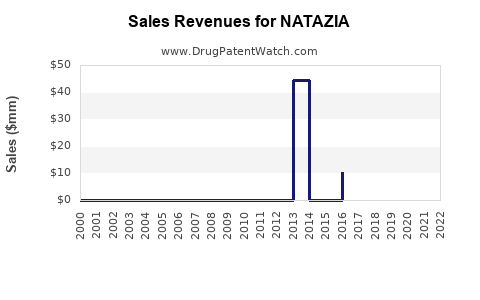
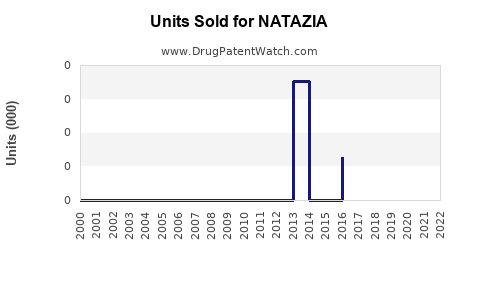
Annual Sales Revenues and Units Sold for NATAZIA
| Drug Name | Revenues (USD) | Units | Year |
|---|---|---|---|
| NATAZIA | ⤷ Start Trial | ⤷ Start Trial | 2022 |
| NATAZIA | ⤷ Start Trial | ⤷ Start Trial | 2021 |
| NATAZIA | ⤷ Start Trial | ⤷ Start Trial | 2020 |
| >Drug Name | >Revenues (USD) | >Units | >Year |
Natazia Market Analysis, Sales Forecast, Patent Position, and Generic Entry Risk
Natazia, Bayer’s oral contraceptive containing estradiol valerate and dienogest, is a mature branded product with a narrow commercial position in the U.S. Its differentiation is the use of estradiol valerate rather than ethinyl estradiol and its FDA indication for contraception and treatment of heavy or prolonged menstrual bleeding. Bayer does not separately disclose Natazia revenue, so the sales forecast below is an analyst model rather than company guidance. Base-case U.S. net sales are estimated at approximately $25 million in 2024, declining to $11 million by 2029 as prescribing shifts toward lower-cost generic oral contraceptives and long-acting contraceptives.
What is Natazia and how does it compete?
Natazia is a 28-day oral contraceptive containing estradiol valerate and dienogest. The regimen uses four phases of active tablets followed by two inactive tablets. The FDA approved Natazia in May 2010 under NDA 022252. It is indicated for:
- Prevention of pregnancy.
- Treatment of heavy or prolonged menstrual bleeding in women who choose oral contraception and have no organic pathology explaining the bleeding.[1]
Natazia competes in two overlapping markets: oral contraception and treatment of heavy menstrual bleeding. Its principal differentiators are:
| Attribute | Natazia | Standard combined oral contraceptives |
|---|---|---|
| Estrogen component | Estradiol valerate | Usually ethinyl estradiol |
| Progestin | Dienogest | Multiple options, including levonorgestrel, norethindrone, desogestrel and drospirenone |
| Dosing pattern | Four-phase active regimen | Monophasic, biphasic or triphasic |
| FDA heavy menstrual bleeding indication | Yes | Product-specific; not typical for most oral contraceptives |
| Generic substitution | More limited than older products, but possible | Extensive |
| Main prescriber rationale | Bleeding control, estrogen profile and individual tolerability | Cost, familiarity, formulary access and contraceptive efficacy |
Natazia does not have the scale of Bayer’s Mirena intrauterine system or Nexplanon, and it competes against inexpensive generic oral contraceptives that often carry materially lower patient and payer costs.
How large is the market for Natazia?
The relevant market is broader than the Natazia product category. It includes prescription oral contraceptives, combined hormonal contraception, therapies for heavy menstrual bleeding and long-acting reversible contraception.
The U.S. contraceptive market has several structural characteristics that limit Natazia’s growth:
- Oral contraception is mature and highly genericized.
- Long-acting reversible contraception has taken share from daily oral products.
- Payers often place branded oral contraceptives behind generic alternatives.
- Prescribing is sensitive to copay differences and pharmacy benefit restrictions.
- The eligible patient population for Natazia’s heavy-menstrual-bleeding indication is narrower than the general contraceptive population.
The Centers for Disease Control and Prevention identifies oral contraceptive pills as a major contraceptive method, but use is distributed across many generic and branded products rather than concentrated in one product.[2] Natazia’s commercial opportunity is therefore a specialty segment of the oral contraceptive market, not the full U.S. contraception market.
Addressable patient segments
Natazia’s most commercially relevant patient segments are:
- Women seeking contraception who have unacceptable bleeding on another oral contraceptive.
- Women with heavy or prolonged menstrual bleeding who also want oral contraception.
- Patients for whom an estradiol valerate-based regimen is preferred over an ethinyl estradiol regimen.
- Patients whose clinicians use branded products after inadequate tolerability or bleeding control with generic alternatives.
Natazia is less competitive among price-sensitive patients who are satisfied with a generic monophasic pill.
What are Natazia’s sales and revenue projections?
Bayer reports women’s healthcare revenue at a portfolio level and does not separately disclose Natazia sales in its public financial reporting. The projection below uses an estimated U.S. net-sales base and assumes limited international contribution, stable clinical positioning, gradual generic pressure and no major new indication.
Base-case Natazia sales forecast
| Year | Estimated net sales | Year-over-year change | Key assumption |
|---|---|---|---|
| 2024 | $25 million | - | Mature branded base |
| 2025 | $23 million | -8% | Continued generic and payer pressure |
| 2026 | $20 million | -13% | Greater substitution and lower new-patient starts |
| 2027 | $17 million | -15% | Declining brand loyalty and formulary contraction |
| 2028 | $14 million | -18% | Mature generic erosion |
| 2029 | $11 million | -21% | Residual branded demand in selected patients |
The base case implies a 2024-2029 revenue compound annual growth rate of approximately negative 16%.
Natazia sales scenarios
| Year | Downside case | Base case | Upside case |
|---|---|---|---|
| 2024 | $20 million | $25 million | $30 million |
| 2025 | $17 million | $23 million | $29 million |
| 2026 | $13 million | $20 million | $27 million |
| 2027 | $9 million | $17 million | $25 million |
| 2028 | $6 million | $14 million | $23 million |
| 2029 | $4 million | $11 million | $21 million |
The downside case assumes a commercially successful generic, rapid formulary exclusion or a major reduction in Bayer promotion. The upside case assumes no effective generic substitution, continued demand from heavy-menstrual-bleeding patients and stable access through commercial insurance.
Revenue exposure
Natazia is unlikely to be material to Bayer’s consolidated revenue. Bayer’s Pharmaceuticals division is dominated by larger products such as Xarelto, Eylea and other specialty medicines, while its women’s healthcare portfolio has historically been driven by intrauterine systems and contraceptive implants rather than a single oral contraceptive.[3]
For Bayer, Natazia is more relevant as a portfolio-maintenance asset than as a major earnings driver. Its commercial value includes:
- Existing prescriber familiarity.
- A differentiated indication for heavy menstrual bleeding.
- Residual brand pricing power.
- Potential lifecycle-management value in selected markets.
- Low incremental manufacturing complexity relative to biologic products.
When does Natazia lose exclusivity?
Natazia received U.S. approval in 2010. The statutory five-year new chemical entity exclusivity period, if applicable to the approved drug substance combination, would have ended in or around 2015, subject to the FDA’s regulatory classification and any pediatric extension.[1]
Patent protection and regulatory exclusivity are separate. The end of regulatory exclusivity does not itself establish the date of generic launch. An ANDA applicant may challenge listed patents through Paragraph IV certification or wait for patent expiry, depending on the Orange Book record and the applicant’s legal strategy.
The commercial exclusivity outlook is therefore determined by:
- Current Orange Book patent listings for NDA 022252.
- Patent expiration dates and any patent-term adjustment.
- Patent-term extension, if any.
- Paragraph IV certifications.
- FDA tentative and final approval decisions.
- Settlement agreements between Bayer and generic applicants.
- The commercial willingness of an ANDA sponsor to launch.
A live Orange Book review is required before relying on any specific Natazia patent expiration date for transaction or litigation decisions.[4]
What is the Orange Book status of Natazia?
Natazia is listed in the FDA Orange Book under NDA 022252. The Orange Book is the controlling public source for approved products, therapeutic-equivalence evaluations and listed patents.[4]
Natazia’s commercial risk should be assessed through three separate Orange Book questions:
- Are patents currently listed against NDA 022252?
- What are the listed patent expiration dates?
- Has any generic applicant received tentative or final approval?
The product’s age makes a pure five-year regulatory exclusivity barrier unlikely to remain relevant. The principal issue is patent-based delay and the timing of any ANDA approval.
Unlike biologic products, Natazia is not subject to the biosimilar pathway. Generic entrants would file abbreviated new drug applications, not biosimilar applications.
Which companies could challenge Natazia?
Potential challengers include large generic manufacturers with women’s-health portfolios and established oral contraceptive manufacturing capabilities. Relevant potential participants include:
- Teva Pharmaceuticals.
- Viatris.
- Sandoz.
- Zydus Pharmaceuticals.
- Lupin.
- Dr. Reddy’s Laboratories.
- Amneal Pharmaceuticals.
- Endo or other specialty generic companies with hormonal-product capabilities.
A company would need to establish bioequivalence for the estradiol valerate and dienogest combination and comply with FDA requirements governing complex oral contraceptive regimens. Commercial entry would also require manufacturing capacity, quality-system compliance, payer contracting and reliable supply of both active ingredients.
There is no material biosimilar risk because Natazia is a small-molecule drug.
What generic entry risks exist for Natazia?
Generic entry would have a disproportionate effect on Natazia because the product competes in a category with many low-cost substitutes. The main risks are:
Price erosion
A first generic entrant could reduce net pricing by 20% to 40%, depending on payer adoption and the number of subsequent entrants. Multiple entrants could produce price reductions exceeding 70% from the branded net price over time.
Formulary displacement
Pharmacy benefit managers may move Natazia to a higher tier or require prior authorization after generic approval. This can reduce new-patient starts even if existing patients remain on the branded product.
Prescriber substitution
Generic oral contraceptives are familiar to primary-care physicians, gynecologists and reproductive-health clinics. Substitution can occur through pharmacy-level conversion or through formulary-driven prescribing.
Limited switching costs
Natazia is an oral tablet, not an implanted or intrauterine product. Patients can change products at the end of a treatment cycle, which limits barriers to switching.
Indication-specific retention
The heavy-menstrual-bleeding indication may preserve a segment of demand if physicians believe Natazia offers useful bleeding control. That protection is commercial rather than regulatory unless a separately enforceable method-of-use patent remains in force.
What formulations are protected by Natazia’s product profile?
Natazia uses a multi-phase regimen of estradiol valerate and dienogest. The formulation and dosing schedule may create technical hurdles for generic development, but formulation complexity does not automatically prevent FDA approval.
The relevant technical issues include:
- Matching the four-phase active-tablet sequence.
- Demonstrating bioequivalence for both active ingredients.
- Managing pharmacokinetic differences across the dosing cycle.
- Maintaining tablet stability and content uniformity.
- Demonstrating appropriate dissolution performance.
- Packaging the product to prevent dosing errors.
- Producing a commercially reliable supply of estradiol valerate and dienogest.
Formulation patents, composition patents and method-of-use patents must be evaluated separately. A formulation patent may cover tablet composition or release characteristics. A method-of-use patent may cover treatment of heavy menstrual bleeding or a specific dosing method. Neither category should be assumed to block generic contraception use without confirming claim scope, patent validity and Orange Book listing.
How does Natazia compare with competing contraceptive products?
| Product or class | Main company or manufacturers | Primary advantage | Main Natazia threat |
|---|---|---|---|
| Generic combined oral contraceptives | Multiple generic manufacturers | Low price and broad availability | High |
| Yaz and generic drospirenone/ethinyl estradiol | Bayer historically marketed Yaz; generics widely available | Familiarity and broad prescribing | High |
| Lo Loestrin Fe and generic equivalents | AbbVie and generic companies | Low-dose estrogen positioning | Moderate to high |
| Mirena | Bayer | Long duration and heavy-menstrual-bleeding indication | High |
| Kyleena and other hormonal IUDs | Bayer and other manufacturers | Long-acting contraception | Moderate to high |
| Nexplanon | Organon | Long-acting implant | Moderate |
| NuvaRing and generic vaginal rings | Organon and generic manufacturers | Non-daily dosing | Moderate |
| Natazia | Bayer | Estradiol valerate/dienogest and bleeding indication | N/A |
Mirena is the strongest Bayer product-level competitor because it also addresses contraception and heavy menstrual bleeding while providing multi-year duration. Natazia’s advantage is reversibility without a procedure and use as a daily oral regimen.
What patent litigation and settlement risks affect Natazia?
Publicly visible commercial risk depends on whether a generic applicant files a Paragraph IV certification against an Orange Book-listed patent. If Bayer receives a Paragraph IV notice, it may file patent litigation within 45 days, potentially triggering a 30-month stay of FDA approval under the Hatch-Waxman framework.[5]
The principal litigation scenarios are:
| Scenario | Likely effect |
|---|---|
| No ANDA challenge | Brand continues until commercial generic entry or patent expiry |
| Paragraph IV challenge with litigation | FDA approval may be stayed for up to 30 months, subject to court outcomes |
| Bayer settlement allowing delayed entry | Revenue decline begins on the agreed entry date |
| Patent invalidation or non-infringement ruling | Earlier generic entry and rapid price erosion |
| Generic launch at risk | Immediate revenue pressure and potential damages exposure |
| Authorized generic launch | Bayer can retain some economics while reducing third-party generic share |
A settlement agreement could preserve value if it delays entry beyond the earliest legally available date. The economic impact depends less on the existence of litigation than on the negotiated generic launch date and the number of entrants.
What is Natazia’s FDA regulatory status?
Natazia is an FDA-approved prescription oral contraceptive under NDA 022252. Its approved labeling includes contraception and treatment of heavy or prolonged menstrual bleeding in an appropriate contraceptive population.[1]
Important regulatory considerations include:
- It is a small-molecule drug.
- Generic applicants use the ANDA pathway.
- No biosimilar pathway applies.
- The labeling contains contraindications associated with estrogen-containing contraceptives.
- Safety monitoring includes thromboembolic, cardiovascular and hepatic risks identified in the prescribing information.
- Generic approval depends on FDA findings of pharmaceutical equivalence and bioequivalence.
A generic applicant would need to address the full product regimen rather than only one active ingredient.
How strong is the Natazia patent estate?
Natazia’s patent estate should be viewed as moderate to weak from a long-term commercial perspective because:
- The product was approved in 2010.
- Regulatory exclusivity is no longer the principal barrier.
- Oral contraceptive technology is established.
- Substitution costs are low.
- Generic manufacturers have experience with hormonal products.
- The product’s commercial differentiation relies heavily on formulation, regimen and indication positioning.
Potential strengths include the four-phase regimen, combination of estradiol valerate with dienogest, packaging and any method-of-use claims covering heavy menstrual bleeding. The strength of those protections depends on claim breadth, patent validity, Orange Book listing and the availability of non-infringing generic designs.
What are the likely Natazia launch scenarios for generics?
Delayed-entry scenario
A generic applicant files a Paragraph IV certification, Bayer litigates and the parties settle for a delayed entry date. Natazia sales remain relatively stable during the litigation period and then decline rapidly after entry.
Single-generic scenario
One generic enters with limited initial competition. Bayer retains some branded share, while net sales decline by approximately 30% to 50% over two years.
Multi-generic scenario
Several generic manufacturers enter within a short period. Brand sales could fall by 60% to 85% within two to three years, with generic pricing also declining as suppliers compete.
No near-term generic scenario
No applicant secures approval or commercial launch. Natazia continues as a niche branded product, with revenue declining gradually through lower prescribing and payer pressure rather than an abrupt loss of exclusivity.
Key Takeaways
- Natazia is a mature Bayer oral contraceptive containing estradiol valerate and dienogest.
- Its differentiation comes from the estrogen component, four-phase regimen and FDA indication for heavy or prolonged menstrual bleeding.
- Bayer does not separately report Natazia sales.
- A modeled base case estimates U.S. net sales of $25 million in 2024 declining to $11 million in 2029.
- Generic substitution is the main commercial risk.
- Natazia is not exposed to biosimilar competition.
- Mirena and generic combined oral contraceptives are the most important competitive pressures.
- The five-year regulatory exclusivity period is no longer the relevant barrier.
- Current patent expiration, Paragraph IV and settlement analysis requires review of the live Orange Book and FDA ANDA records.
- The product’s long-term value is likely to remain modest unless Bayer achieves sustained differentiation in heavy-menstrual-bleeding treatment.
FAQs
Is Natazia still sold in the United States?
Natazia remains an FDA-approved prescription product under NDA 022252. Its commercial availability depends on Bayer’s distribution, pharmacy inventory and payer coverage.
Does Natazia have a generic equivalent?
The existence and commercial availability of a generic equivalent should be confirmed through current FDA Orange Book and Drugs@FDA records. A product-specific patent or ANDA review is required to determine whether an approved generic is actively marketed.
Is Natazia more effective than generic birth-control pills?
Natazia is an effective combined oral contraceptive when used according to its prescribing information. Clinical superiority over all generic oral contraceptives has not been established as a general proposition. Its differentiation is based on formulation, regimen and the heavy-menstrual-bleeding indication.
Can Natazia be used to treat endometriosis?
Natazia is not broadly labeled by the FDA as an endometriosis treatment. Physicians may make off-label treatment decisions, but those uses are separate from the product’s approved indications.
What Bayer product competes most directly with Natazia?
Mirena is the closest Bayer product-level competitor because it provides contraception and has an FDA indication for heavy menstrual bleeding. Its long duration and non-daily delivery system give it a strong commercial advantage over oral Natazia.
References
- U.S. Food and Drug Administration. (2023). Natazia prescribing information. FDA.
- Centers for Disease Control and Prevention. (2024). Contraception and birth control methods. CDC.
- Bayer AG. (2024). Annual report 2023. Bayer AG.
- U.S. Food and Drug Administration. (2024). Approved drug products with therapeutic equivalence evaluations: Orange Book. FDA.
- U.S. Congress. (1984). Drug Price Competition and Patent Term Restoration Act of 1984, 21 U.S.C. § 355.
More… ↓
