Drug Sales Trends for MYRBETRIQ
Payment Methods and Pharmacy Types for MYRBETRIQ (2022)
Revenues by Pharmacy Type
Units Sold by Pharmacy Type
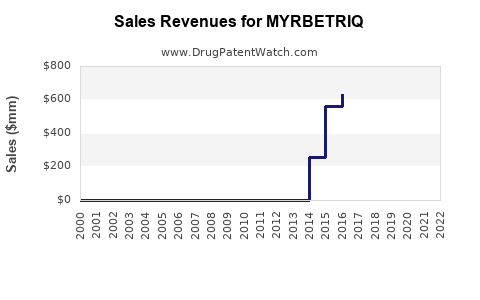
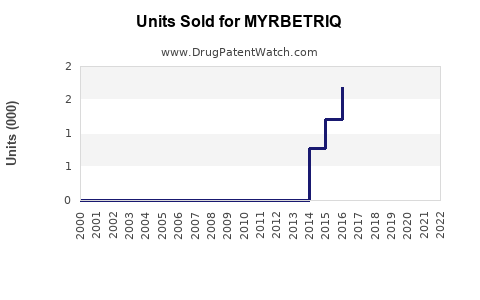
Annual Sales Revenues and Units Sold for MYRBETRIQ
| Drug Name | Revenues (USD) | Units | Year |
|---|---|---|---|
| MYRBETRIQ | ⤷ Start Trial | ⤷ Start Trial | 2022 |
| MYRBETRIQ | ⤷ Start Trial | ⤷ Start Trial | 2021 |
| MYRBETRIQ | ⤷ Start Trial | ⤷ Start Trial | 2020 |
| MYRBETRIQ | ⤷ Start Trial | ⤷ Start Trial | 2019 |
| MYRBETRIQ | ⤷ Start Trial | ⤷ Start Trial | 2018 |
| MYRBETRIQ | ⤷ Start Trial | ⤷ Start Trial | 2017 |
| >Drug Name | >Revenues (USD) | >Units | >Year |
Myrbetriq Market Analysis, Sales Forecast, Patent Expiry, and Generic Entry Risk
Myrbetriq, marketed by Astellas Pharma as mirabegron extended-release tablets, is a major branded treatment for overactive bladder. Global sales remain substantial, but the product faces a multiyear erosion cycle from generic litigation, reimbursement pressure, competition from vibegron, and loss of exclusivity in key markets. A base-case forecast places global Myrbetriq sales at approximately $1.5 billion in fiscal 2024, declining to about $1.0 billion by fiscal 2028 and below $500 million after broad generic entry.
What is Myrbetriq and how does it generate revenue?
Myrbetriq contains mirabegron, a beta-3 adrenergic receptor agonist approved for overactive bladder symptoms, including urgency, increased urinary frequency, and urge urinary incontinence. The drug is available in extended-release tablets and is also used in combination with solifenacin in some markets.
The U.S. Food and Drug Administration approved Myrbetriq in 2012 for adults with overactive bladder. Pediatric indications were added later for neurogenic detrusor overactivity in children aged three years and older and for certain neurogenic bladder conditions.[1]
Astellas markets Myrbetriq globally. The product is particularly important in the United States, Japan, and major European markets. Its commercial profile benefits from chronic use, a large diagnosed patient population, and a differentiated mechanism compared with anticholinergic therapies.
Myrbetriq commercial profile
| Metric | Assessment |
|---|---|
| Active ingredient | Mirabegron |
| Drug class | Beta-3 adrenergic receptor agonist |
| Primary indication | Overactive bladder |
| U.S. approval | 2012 |
| U.S. marketing company | Astellas Pharma US |
| Dosage form | Extended-release tablets |
| Key branded competitor | Gemtesa, vibegron |
| Main market risk | Generic mirabegron extended-release entry |
| Commercial stage | Mature, pre-generic erosion |
Astellas reports product sales by fiscal year rather than calendar year. Myrbetriq revenue has generally remained above $1 billion annually on a global basis, although growth has slowed as the product has matured and pricing pressure has increased.[2]
How much does Myrbetriq sell annually?
Astellas reported Myrbetriq sales of approximately ¥200 billion in the fiscal years around 2023 and 2024, equivalent to roughly $1.3 billion to $1.5 billion depending on currency conversion. Foreign-exchange movements materially affect reported U.S.-dollar results.
The product remains one of Astellas’ leading revenue contributors, alongside Xtandi, Xospata, and other specialty medicines. Its sales base is larger than that of most branded overactive bladder products, but its growth rate is lower than that of newer oncology products.
Historical and estimated Myrbetriq sales
| Fiscal year | Global sales estimate | Approximate U.S.-dollar equivalent | Market interpretation |
|---|---|---|---|
| FY2021 | ¥200 billion to ¥210 billion | $1.8 billion to $1.9 billion | Strong mature-brand performance |
| FY2022 | About ¥210 billion | $1.6 billion to $1.8 billion | High revenue base |
| FY2023 | About ¥205 billion | $1.4 billion to $1.5 billion | Stable, but slower growth |
| FY2024 | ¥190 billion to ¥200 billion | $1.3 billion to $1.5 billion | Currency and competitive pressure |
| FY2025E | ¥180 billion to ¥190 billion | $1.2 billion to $1.4 billion | Early erosion risk |
| FY2028E | ¥130 billion to ¥150 billion | $850 million to $1.1 billion | Pre-cliff decline |
| FY2030E | ¥60 billion to ¥90 billion | $400 million to $650 million | Generic erosion in major markets |
The estimates above are analytical projections based on Astellas’ disclosed sales trajectory, market maturity, expected generic entry timing, and branded competition. They are not Astellas guidance.
What is the Myrbetriq sales forecast through 2030?
The base case assumes limited U.S. generic erosion before 2028, increasing generic availability around 2029 or 2030, and continued competitive pressure from Gemtesa. Under that scenario, global Myrbetriq sales decline at a compound annual rate of approximately 10% to 15% from the current base through 2030.
Myrbetriq revenue scenarios
| Scenario | 2025E | 2027E | 2029E | 2030E |
|---|---|---|---|---|
| Optimistic | $1.4B | $1.3B | $1.0B | $850M |
| Base case | $1.3B | $1.2B | $750M | $500M |
| Downside | $1.2B | $950M | $500M | $250M |
The optimistic case assumes delayed generic launch, successful patent enforcement, and sustained prescribing among patients who do not tolerate anticholinergics. The downside case assumes multiple generic entrants launch near the earliest legally available date and obtain rapid formulary substitution.
Key forecasting assumptions
The forecast depends on five commercial variables:
- The timing of U.S. generic mirabegron approval and launch.
- The number of generic manufacturers entering during the first 12 months.
- The duration of any 180-day first-filer exclusivity period.
- The rate of substitution by managed-care plans and pharmacy benefit managers.
- The relative uptake of Gemtesa and combination therapy.
A single generic entrant can cause substantial price compression, but multiple simultaneous entrants typically accelerate net sales erosion. Chronic oral medicines with several approved generic suppliers often experience a 70% to 95% decline in branded sales within two to four years after broad generic entry.
When does Myrbetriq lose patent exclusivity?
Myrbetriq does not have one single global patent expiry date. Exclusivity depends on the country, dosage form, listed patent, pediatric extensions, patent-term adjustments, settlements, and the type of generic product seeking approval.
In the United States, the relevant protection extends beyond the original compound patent through formulation and method-of-use patents. Public patent records and FDA Orange Book listings identify multiple patents associated with mirabegron extended-release products, with expiration dates generally falling in the late 2020s or early 2030s.[3][4]
U.S. exclusivity timeline
| Milestone | Timing |
|---|---|
| FDA approval of Myrbetriq | 2012 |
| Core product protection | Expired or approaching expiry depending on patent |
| Formulation and method-of-use protection | Extends into the late 2020s or early 2030s |
| Pediatric exclusivity | Adds six months where applicable |
| Earliest practical U.S. generic risk | Approximately 2028 to 2030 |
| Broad generic erosion | Most likely from 2029 onward |
The commercial significance of the later patents depends on whether they cover the approved product, whether they withstand validity challenges, and whether generic applicants can avoid infringement through a different formulation or labeling strategy.
What patents protect Myrbetriq?
Myrbetriq’s U.S. patent estate includes patents directed to mirabegron, extended-release formulations, pharmaceutical compositions, and approved uses. The estate is more commercially relevant because Myrbetriq is a chronic oral dosage form with a formulation-dependent release profile.
Publicly associated U.S. patents include patent families such as:
| Patent family or patent | General subject matter | Commercial relevance |
|---|---|---|
| U.S. 8,106,162 | Mirabegron-related product protection | Core compound or product protection |
| U.S. 8,168,620 | Pharmaceutical composition or use | Product and use protection |
| U.S. 8,497,393 | Mirabegron formulation or therapeutic use | Potential generic design-around barrier |
| U.S. 9,278,096 | Extended-release formulation technology | Important for tablet substitution |
| U.S. 9,937,205 | Formulation or treatment-related claims | May support Orange Book litigation |
| U.S. 10,022,362 | Later formulation or use claims | Potential late-stage protection |
Exact enforceability depends on claim scope, terminal disclaimers, patent-term adjustments, Orange Book listing status, and court decisions. Patent numbers alone do not establish that every claim protects every commercial presentation.
What formulations are protected by Myrbetriq patents?
The principal technical barrier is the extended-release oral tablet. Generic developers must reproduce the required release profile while satisfying bioequivalence requirements. Formulation patents may claim excipient combinations, matrix systems, particle characteristics, dissolution behavior, or manufacturing parameters.
These patents can delay entry even after a compound patent expires. They can also force generic applicants to adopt alternative formulations that are more difficult to develop or less commercially attractive.
Which companies are challenging Myrbetriq patents?
Generic companies have pursued mirabegron extended-release opportunities through abbreviated new drug applications and patent certifications. Public litigation records have associated generic challenges with companies including Zydus, Lupin, Teva, and other potential ANDA applicants.
The relevant litigation risk is determined by:
- Paragraph IV certifications against Orange Book patents.
- Astellas’ filing of patent-infringement actions within the statutory period.
- The resulting 30-month FDA approval stay.
- Court rulings on infringement and validity.
- Settlement terms that may establish an agreed launch date.
A Paragraph IV notice does not guarantee an immediate launch. It creates litigation risk and can trigger an approval stay. The commercial outcome often depends on settlement timing rather than a final trial judgment.
What is the Orange Book status of Myrbetriq?
Myrbetriq is an FDA-approved prescription drug listed in the Orange Book. The listed patents are relevant to abbreviated new drug applications for mirabegron extended-release tablets.[4]
The Orange Book does not itself decide whether a patent is valid or infringed. It identifies patents that the NDA holder has submitted as covering the approved drug or an approved method of use. Generic applicants may challenge listed patents through Paragraph IV certifications or seek approval with a Section VIII label carve-out for method-of-use claims.
The most important Orange Book issue is whether remaining formulation claims cover the generic product as marketed. A narrow use patent may have less commercial value if the generic can obtain approval with a carved-out label.
How strong is the Myrbetriq patent estate?
Myrbetriq has a medium-to-strong commercial patent estate through the late 2020s, but its long-term strength is weaker than a product protected by a single late-expiring composition-of-matter patent.
Strengths
- Multiple patent families cover product, formulation, and use aspects.
- The extended-release dosage form creates technical development requirements.
- Chronic use supports rapid generic substitution once entry occurs, increasing the value of even a short delay.
- Astellas has substantial litigation resources and experience defending branded products.
Weaknesses
- The product has been marketed for more than a decade.
- Core protection is no longer the main source of exclusivity.
- Formulation patents may face obviousness and enablement challenges.
- Generic applicants can pursue design-around strategies.
- A competing beta-3 agonist reduces the brand’s pricing power before generic entry.
Overall, the estate is strong enough to support late-decade revenue, but it is unlikely to prevent eventual U.S. generic competition.
How does Myrbetriq compare with Gemtesa?
Gemtesa, containing vibegron, is the closest branded U.S. competitor. It is marketed by Sumitomo Pharma’s U.S. business and competes directly in overactive bladder.
| Factor | Myrbetriq | Gemtesa |
|---|---|---|
| Active ingredient | Mirabegron | Vibegron |
| Mechanism | Beta-3 adrenergic agonist | Beta-3 adrenergic agonist |
| Launch timing | 2012 | 2020 |
| Commercial status | Mature, high sales base | Growth-stage challenger |
| Generic risk | Late-decade risk | Later than Myrbetriq, subject to patent review |
| Key advantage | Physician familiarity and broad market access | Newer product and competitive clinical positioning |
| Key weakness | Aging patent estate | Smaller commercial scale |
Gemtesa can capture prescriptions from Myrbetriq before generic launch and may retain some patients after generic entry. Myrbetriq’s larger installed base and longer reimbursement history provide near-term advantages.
What generic launch scenarios exist for Myrbetriq?
Scenario 1: Delayed launch
Astellas successfully defends key formulation patents or reaches settlements that defer entry until approximately 2029 or 2030. Branded sales decline gradually and remain above $1 billion globally through 2027.
Scenario 2: Authorized or settlement-based entry
One or more generic companies receive an agreed launch date before the final patent expiration. Astellas preserves part of the value through settlement economics, while generic price competition begins earlier than expected.
Scenario 3: Broad generic entry
Multiple manufacturers launch after invalidating or avoiding key patents. U.S. brand sales fall sharply during the first year, with net pricing declining by more than 70% over two years.
The broad-entry case is the most damaging to revenue but is unlikely to eliminate all sales immediately. Some patients remain on the branded product because of physician preference, pharmacy availability, prior authorization structures, or clinical response.
What litigation and settlement issues affect Myrbetriq?
Myrbetriq litigation centers on ANDA applicants, Orange Book patents, formulation claims, and the statutory 30-month stay. Settlement agreements may include delayed launch dates, licenses, supply arrangements, or restrictions on generic commercialization.
Publicly available litigation information should be reviewed by jurisdiction and docket because case status can change through dismissals, amended complaints, stipulations, or confidential settlement agreements. The most material commercial question is not simply whether Astellas wins or loses, but whether the settlement allows an early generic launch and how many manufacturers receive launch rights.
What is Myrbetriq’s FDA regulatory status?
Myrbetriq is FDA approved for specified overactive bladder and pediatric bladder indications. Generic applicants must demonstrate pharmaceutical equivalence and bioequivalence for the extended-release dosage form.
The FDA may grant tentative approval while patent or exclusivity barriers remain. Final approval depends on the relevant patents, regulatory exclusivity, and any applicable court order or settlement. FDA approval alone does not establish that a generic can legally launch.
What geographic markets create the largest risk?
The United States is the largest single source of pricing and generic-entry risk because of the ANDA system, Orange Book litigation, and rapid pharmacy substitution. Japan and European markets face separate patent and reimbursement timelines. Generic erosion may occur earlier in one market than another.
Astellas can retain revenue through:
- Markets with later patent expiry.
- Countries with slower generic substitution.
- Pediatric or combination indications with separate regulatory positioning.
- Brand-loyal prescribers and controlled distribution.
- Price reductions designed to preserve volume.
Global sales will therefore decline more slowly than U.S. sales after initial generic entry.
Key Takeaways
- Myrbetriq is a mature, high-value Astellas product with estimated global sales of roughly $1.3 billion to $1.5 billion in fiscal 2024.
- Base-case sales are projected to decline to about $1.0 billion by 2028 and approximately $500 million by 2030.
- U.S. generic risk is concentrated around 2028 to 2030, depending on formulation patents, litigation, and settlements.
- The Orange Book estate includes product, formulation, and method-of-use patents, with certain protections extending into the early 2030s.
- Gemtesa is the principal branded competitor and may take share before and after generic entry.
- The patent estate is commercially meaningful but unlikely to prevent eventual broad generic competition.
- Revenue exposure is highest in the United States, where pharmacy substitution can accelerate price and volume erosion.
FAQs
Is Myrbetriq still under patent protection?
Yes. Patent protection remains relevant for the U.S. extended-release product, particularly through formulation and use patents, although the earliest core protections have expired or are approaching expiry.
Will there be a generic version of Myrbetriq?
Generic mirabegron extended-release products are expected to enter after applicable patent and regulatory barriers are resolved. The timing depends on ANDA approvals, Paragraph IV litigation, settlements, and court outcomes.
What is the expected price decline after generic Myrbetriq launches?
A 70% to 95% decline in branded net sales over two to four years is a reasonable industry benchmark for a chronic oral medicine facing multiple generic entrants.
Is Gemtesa a substitute for Myrbetriq?
Gemtesa is a direct therapeutic competitor, but substitution depends on formulary status, physician preference, patient response, payer restrictions, and relative pricing.
Does Myrbetriq have biosimilar risk?
No. Myrbetriq is a small-molecule oral drug, not a biologic. Its primary post-exclusivity risk is generic competition through the ANDA pathway, not biosimilar competition.
References
-
U.S. Food and Drug Administration. (2012). FDA approves new treatment for overactive bladder. FDA.
-
Astellas Pharma Inc. (2024). Annual report and financial results for the fiscal year ended March 31, 2024. Astellas Pharma Inc.
-
United States Patent and Trademark Office. (2024). Patent Center and Patent Examination Data System records for mirabegron-related patents. USPTO.
-
U.S. Food and Drug Administration. (2024). Approved drug products with therapeutic equivalence evaluations: Orange Book. FDA.
More… ↓
