Share This Page
Drug Sales Trends for LOSARTAN POTASSIUM
✉ Email this page to a colleague
Payment Methods and Pharmacy Types for LOSARTAN POTASSIUM (2022)
Revenues by Pharmacy Type
Units Sold by Pharmacy Type
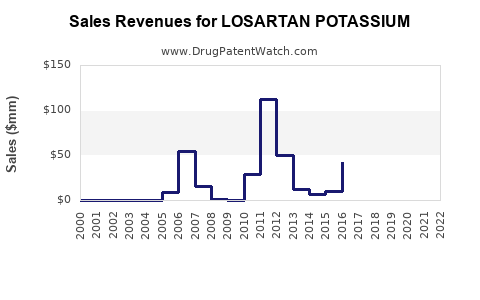
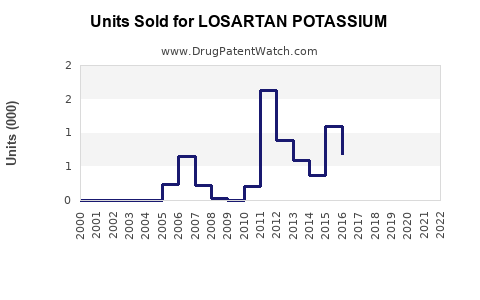
Annual Sales Revenues and Units Sold for LOSARTAN POTASSIUM
| Drug Name | Revenues (USD) | Units | Year |
|---|---|---|---|
| LOSARTAN POTASSIUM | ⤷ Start Trial | ⤷ Start Trial | 2022 |
| LOSARTAN POTASSIUM | ⤷ Start Trial | ⤷ Start Trial | 2021 |
| LOSARTAN POTASSIUM | ⤷ Start Trial | ⤷ Start Trial | 2020 |
| LOSARTAN POTASSIUM | ⤷ Start Trial | ⤷ Start Trial | 2019 |
| LOSARTAN POTASSIUM | ⤷ Start Trial | ⤷ Start Trial | 2018 |
| >Drug Name | >Revenues (USD) | >Units | >Year |
Losartan Potassium Market Analysis, Sales Projections, Patent Status, and Generic Competition
Losartan potassium is a mature, off-patent angiotensin II receptor blocker (ARB) with high prescription volume, low pricing, and limited manufacturer differentiation. The U.S. market is dominated by generic tablets supplied by multiple manufacturers. Branded Cozaar has no meaningful exclusivity, and no biosimilar pathway applies because losartan is a chemically synthesized small molecule.
The commercial outlook is stable in volume but weak in value. U.S. losartan sales are likely to remain in the hundreds of millions of dollars annually at retail-market level, while manufacturer net sales are materially lower. Global revenue should decline gradually as generic price competition intensifies, partly offset by population aging, hypertension prevalence, and continued use in diabetic nephropathy and cardiovascular-risk management.
What is the current FDA and commercial status of losartan potassium?
Losartan potassium is an FDA-approved oral ARB marketed originally as Cozaar by Merck. It is approved for hypertension, reduction of stroke risk in certain hypertensive patients with left ventricular hypertrophy, and treatment of diabetic nephropathy in patients with type 2 diabetes and hypertension [1].
Losartan is available primarily as immediate-release tablets in 25 mg, 50 mg, and 100 mg strengths. The losartan/hydrochlorothiazide combination is marketed in several strengths, including the branded product Hyzaar.
| Item | Status |
|---|---|
| Active ingredient | Losartan potassium |
| Drug class | Angiotensin II receptor blocker |
| Original brand | Cozaar |
| Original sponsor | Merck & Co. |
| FDA dosage forms | Immediate-release oral tablets |
| Common strengths | 25 mg, 50 mg, 100 mg |
| Main indications | Hypertension, diabetic nephropathy, selected stroke-risk reduction |
| U.S. regulatory status | Approved; multiple abbreviated new drug applications |
| Biosimilar exposure | None |
| Generic status | Mature, highly competitive |
| Reference product exclusivity | Expired |
| Orange Book status | Listed patents for the reference product are expired or no longer commercially limiting |
FDA labeling identifies losartan potassium as a prescription oral tablet and warns of fetal toxicity, hyperkalemia, renal-function changes, and interaction risks with renin-angiotensin system medicines [1].
How large is the losartan potassium market?
The market has two distinct economic layers:
- Retail or payer spending, which includes pharmacy dispensing margins and reimbursement.
- Manufacturer net sales, which exclude much of the retail and payer spread.
Public sources do not provide a single authoritative global revenue figure for losartan potassium across all manufacturers. Generic manufacturers generally do not disclose product-level sales. Market estimates therefore vary based on whether they include combination products, hospital sales, distributor revenue, or retail reimbursement.
A reasonable commercial assessment is:
| Segment | 2024 estimated annual range | Market condition |
|---|---|---|
| U.S. retail and payer spending for losartan monotherapy | $350 million-$650 million | High volume, low unit prices |
| U.S. manufacturer net sales for losartan monotherapy | $150 million-$300 million | Fragmented generic supply |
| U.S. losartan/hydrochlorothiazide retail spending | $150 million-$300 million | Smaller than monotherapy |
| Global manufacturer sales, monotherapy and combinations | $700 million-$1.3 billion | Broad geographic use, low prices |
| Branded Cozaar contribution | De minimis relative to the historical peak | No practical exclusivity |
These ranges are analytical estimates, not reported consolidated sales. Prescription volume remains substantial because hypertension is chronic, losartan is familiar to prescribers, and generic availability supports low copayments. IQVIA, CMS, and commercial claims databases can produce materially different values depending on channel and counting methodology [2][3].
What are the sales projections for losartan potassium?
The base case is a gradual decline in nominal manufacturer revenue, driven by generic price erosion and substitution toward other ARBs. Prescription volume should remain comparatively resilient.
Base-case projection
| Year | U.S. retail-market value | U.S. manufacturer net sales | Global manufacturer sales |
|---|---|---|---|
| 2024A / estimated | $350M-$650M | $150M-$300M | $700M-$1.3B |
| 2025E | $340M-$630M | $145M-$290M | $680M-$1.25B |
| 2026E | $330M-$610M | $138M-$278M | $660M-$1.20B |
| 2027E | $320M-$595M | $132M-$267M | $640M-$1.16B |
| 2028E | $310M-$580M | $126M-$256M | $620M-$1.12B |
| 2029E | $300M-$565M | $120M-$245M | $600M-$1.08B |
| 2030E | $292M-$550M | $115M-$235M | $580M-$1.04B |
The base case assumes annual prescription volume declines by roughly 0.5% to 1.5%, while average manufacturer net price declines by about 2% to 4%. The resulting annual revenue decline is approximately 2% to 4%.
Scenario analysis
| Scenario | Volume assumption | Price assumption | 2025-2030 revenue outcome |
|---|---|---|---|
| Upside | Stable or modestly rising use | Limited price erosion | Flat to low-single-digit growth |
| Base case | Low-single-digit volume decline | Moderate generic erosion | 2%-4% annual decline |
| Downside | Conversion to other ARBs and consolidation | Severe price compression | 5%-8% annual decline |
The upside case would require stronger use in emerging markets, stable prescribing in older patients, or supply disruptions affecting competing ARBs. The downside case would follow additional generic entrants, large-payer contract pressure, or increased use of valsartan, irbesartan, candesartan, or combination therapies.
Why does losartan retain significant prescription volume?
Losartan has several commercial advantages despite its age:
- It is a low-cost generic with broad pharmacy coverage.
- It is familiar to primary-care physicians.
- It has a long clinical history in hypertension and diabetic nephropathy.
- It is available in multiple tablet strengths.
- It has established fixed-dose combination use with hydrochlorothiazide.
- It provides an alternative for patients who develop cough with ACE inhibitors.
The main commercial constraint is therapeutic substitutability. ARBs are generally managed as a class, and payers can shift utilization among losartan, valsartan, irbesartan, candesartan, olmesartan, and telmisartan based on formulary terms, supply, and physician preference.
How does losartan compare with competing ARBs?
Losartan is often the lowest-cost ARB, but it is not the most convenient ARB for every patient. Its once-daily use is established, although some patients require twice-daily dosing based on response and prescribing judgment.
| Drug | Commercial position | Differentiating factor | Generic pressure |
|---|---|---|---|
| Losartan | High-volume, low-cost standard | Long clinical history; diabetic nephropathy indication | Very high |
| Valsartan | High-volume ARB | Broad cardiovascular and combination-product use | Very high |
| Irbesartan | Established generic | Diabetic nephropathy positioning | High |
| Candesartan | Established generic | Heart-failure and hypertension use | High |
| Olmesartan | Established generic | Potency and once-daily positioning | High |
| Telmisartan | Established generic | Long half-life and cardiovascular-risk positioning | High |
Losartan’s main competitive advantage is price and familiarity. Its main weakness is the absence of meaningful product differentiation after generic entry.
What patents protect losartan potassium?
The original losartan compound patent was U.S. Patent No. 5,138,069, assigned to E. I. du Pont de Nemours and later associated with Merck’s Cozaar product. The patent covered losartan and related compounds and expired in the United States in 2010 after patent-term adjustments and regulatory exclusivity considerations were exhausted.
| Patent or protection | Subject matter | Commercial status |
|---|---|---|
| U.S. Patent No. 5,138,069 | Losartan compound and related ARB chemistry | Expired |
| Cozaar regulatory exclusivity | Reference-product approval protection | Expired |
| Losartan tablet patents | Product and formulation claims | Expired or non-blocking |
| Losartan/hydrochlorothiazide patents | Combination product claims | Expired or non-blocking |
| Generic manufacturers’ patents | Usually limited to manufacturing or formulation improvements | Generally not a barrier to standard tablets |
The key patent risk is not current molecule exclusivity. It is the possibility that a manufacturer claims a narrow formulation, process, or combination-product improvement. Those rights generally do not prevent standard losartan potassium tablets from being marketed if the relevant claims are expired, invalid, or avoided.
When did losartan lose U.S. exclusivity?
Generic competition began after the expiry of the core U.S. compound patent and associated regulatory protections. FDA records list numerous approved abbreviated new drug applications for losartan potassium tablets and losartan/hydrochlorothiazide products [4].
Losartan is therefore not a patent-protected growth product. A new entrant typically competes through:
- Low-cost active pharmaceutical ingredient sourcing.
- Reliable FDA-compliant manufacturing.
- Wholesale-distribution access.
- Contracting with pharmacy benefit managers.
- Product availability during supply disruptions.
- Combination-product breadth.
Are there Paragraph IV challenges involving losartan?
Paragraph IV litigation was commercially relevant during the initial generic-entry period, when applicants challenged listed patents covering Cozaar and related products. Those disputes are no longer the central market issue because the core patents have expired and multiple generic suppliers are established.
Current entry risk is therefore ordinary ANDA competition rather than a fresh Paragraph IV event. A new applicant would face abbreviated approval requirements, bioequivalence testing, manufacturing validation, and commercial contracting rather than meaningful branded patent opposition.
What is the Orange Book status of losartan?
The Orange Book identifies FDA-approved reference products and patent information submitted by sponsors. For losartan, the relevant branded products are Cozaar and combination products such as Hyzaar. The commercial significance of those listings is limited because the principal exclusivity periods have ended and multiple generics are approved [4].
Potential Orange Book relevance remains for:
- Strength-specific tablet products.
- Combination products.
- Late-listed formulation patents.
- Use codes attached to method-of-use claims.
- Patent certifications submitted in ANDA applications.
A generic manufacturer must still review current Orange Book listings and make the appropriate patent certification. Expired core patents do not eliminate the need for accurate ANDA certifications.
What formulations are protected by losartan patents?
The commercially important formulations are immediate-release tablets and losartan/hydrochlorothiazide tablets. These formulations are technically straightforward compared with extended-release products, long-acting injectables, or complex delivery systems.
Possible formulation claim categories include:
- Tablet composition.
- Particle-size distribution.
- Excipients and dissolution profile.
- Manufacturing process.
- Stability and impurity control.
- Fixed-dose combination ratios.
- Packaging and moisture protection.
These categories may support narrow patents, but they are unlikely to create durable market exclusivity for standard losartan tablets unless the patent covers a clinically necessary product characteristic that competitors cannot readily design around.
Which companies compete in the losartan market?
The U.S. generic market has included large manufacturers such as Teva, Sandoz, Lupin, Torrent Pharmaceuticals, Dr. Reddy’s Laboratories, Zydus, Aurobindo, Mylan/Viatris, and various contract and specialty suppliers. Manufacturer participation changes over time because of price pressure, supply economics, FDA inspections, product discontinuations, and wholesaler contracting.
The most important competitive variables are:
- Cost of active pharmaceutical ingredient.
- FDA manufacturing compliance.
- Reliable supply and inventory.
- Wholesale and group-purchasing access.
- Ability to offer both losartan and combination products.
- Exposure to product recalls or quality actions.
What manufacturing and IP barriers affect losartan?
Losartan has low technical barriers relative to complex pharmaceuticals. Its principal barriers are operational:
- Consistent API quality.
- Control of impurities and degradation products.
- Tablet uniformity and dissolution.
- Bioequivalence performance.
- Validation of commercial-scale production.
- Compliance with current good manufacturing practice requirements.
- Supply-chain resilience.
Manufacturing know-how can support commercial advantage without producing strong exclusionary patent rights. A supplier with lower costs and dependable delivery can gain share, but the position is vulnerable to aggressive generic pricing.
Does losartan have biosimilar risk?
No. Losartan is a small-molecule chemical drug, not a biologic. It is subject to the generic drug pathway under Section 505(j) of the Federal Food, Drug, and Cosmetic Act, not the biosimilar pathway under the Public Health Service Act.
The relevant competitive risk is generic substitution, not biosimilar entry.
What litigation or settlement agreements affect losartan?
Historical litigation involved generic challenges to Cozaar and related patents during the period before full generic penetration. No active branded patent dispute is known to impose a broad market barrier on standard losartan potassium tablets.
Settlement agreements from the original generic-entry period may have affected launch timing, but they do not restore current exclusivity. The present litigation profile is more likely to involve product liability, manufacturing quality, recalls, antitrust allegations, or ordinary ANDA matters than molecule-patent enforcement.
What generic launch scenarios exist for losartan?
A new manufacturer has three practical launch paths:
Standard losartan tablets
This is the lowest-risk regulatory route but also the most competitive. A new entrant would likely need a cost or supply advantage to obtain durable share.
Losartan/hydrochlorothiazide combination
Combination products may provide better commercial positioning, particularly where a manufacturer already has a cardiovascular portfolio. The market remains generic and price sensitive.
Differentiated dosage or distribution strategy
Opportunities may exist in institutional supply, mail-order pharmacy, international markets, or packaging designed for adherence. These are commercial differentiation strategies rather than strong patent positions.
What is the revenue exposure for manufacturers?
Revenue exposure is concentrated in volume rather than margin. A manufacturer dependent on losartan alone faces substantial price risk. A manufacturer with a broader hypertension portfolio can use losartan to support distribution, formulary access, and combination-product sales.
The highest-risk business model is a single-product supplier with:
- High-cost API sourcing.
- Limited manufacturing scale.
- Dependence on one wholesaler.
- No combination-product portfolio.
- Weak ability to absorb price reductions.
The stronger model pairs losartan with other cardiovascular generics and maintains multiple API sources.
Key Takeaways
- Losartan potassium is a mature, high-volume generic ARB.
- Core U.S. patent protection and regulatory exclusivity have expired.
- Cozaar has no meaningful current exclusivity-based pricing power.
- U.S. retail-market spending is likely in the approximate range of $350 million to $650 million annually for losartan monotherapy, with manufacturer net sales materially lower.
- Global manufacturer revenue for losartan monotherapy and combinations is estimated at roughly $700 million to $1.3 billion annually.
- Base-case revenue is expected to decline 2% to 4% annually through 2030.
- Prescription volume should remain relatively stable because of chronic hypertension use and low generic prices.
- No biosimilar risk applies.
- Generic competition, supply reliability, API cost, and payer contracting determine commercial performance.
- The strongest remaining IP opportunities are narrow formulation, process, or combination claims rather than molecule patents.
FAQs About Losartan Potassium Market and Exclusivity
Is losartan potassium still profitable for generic manufacturers?
Yes, but profitability depends on manufacturing scale, API costs, supply reliability, and payer contracts. Standard tablets are low-margin products in highly competitive markets.
Does Cozaar still have brand value?
Cozaar retains clinical recognition, but its commercial value is limited because generic losartan is widely available and therapeutically substitutable.
Can a company obtain new patents on losartan potassium?
A company may obtain narrow patents on a formulation, manufacturing process, impurity-control method, or combination product if the claims satisfy patentability requirements. Those patents would not automatically block standard generic tablets.
Which ARB is the closest commercial competitor to losartan?
Valsartan is the closest large-scale commercial comparator because it is widely prescribed, available generically, and sold in several cardiovascular combinations. Irbesartan and candesartan are also direct therapeutic competitors.
Is losartan potassium a good licensing target?
It is generally a weak licensing target as a standalone molecule because core exclusivity has expired. Licensing may make commercial sense only when tied to a differentiated formulation, a combination product, a regulated market-access strategy, or a reliable low-cost manufacturing platform.
References
- U.S. Food and Drug Administration. (2023). Cozaar (losartan potassium) prescribing information.
- IQVIA. (2024). The use of medicines in the U.S. 2024: Usage and spending trends and outlook to 2028.
- Centers for Medicare & Medicaid Services. (2024). Medicare Part D drug spending dashboard.
- U.S. Food and Drug Administration. (2024). Approved drug products with therapeutic equivalence evaluations: Orange Book.
- U.S. Patent and Trademark Office. (1988). U.S. Patent No. 5,138,069: Substituted imidazole-5-acetic acids.
More… ↓
