You're using a free limited version of DrugPatentWatch: Upgrade for Complete Access

Last Updated: November 8, 2025

Drug Sales Trends for LOSARTAN POT


✉ Email this page to a colleague

« Back to Dashboard


Payment Methods and Pharmacy Types for LOSARTAN POT (2022)

Revenues by Pharmacy Type

Pharmacy Type Revenues
MAIL-ORDER $103,576,314
INSIDE ANOTHER STORE $231,139,552
[disabled in preview] $647,821,204
This preview shows a limited data set
Subscribe for full access, or try a Trial

Units Sold by Pharmacy Type

Pharmacy Type Units
MAIL-ORDER 6,712,358
INSIDE ANOTHER STORE 13,387,862
[disabled in preview] 33,037,330
This preview shows a limited data set
Subscribe for full access, or try a Trial

Revenues by Payment Method

Payment Method Revenues
MEDICAID $101,205,213
MEDICARE $374,123,482
[disabled in preview] $507,208,374
This preview shows a limited data set
Subscribe for full access, or try a Trial
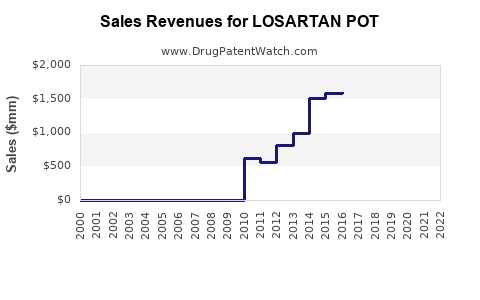
Drug Sales Revenue Trends for LOSARTAN POT
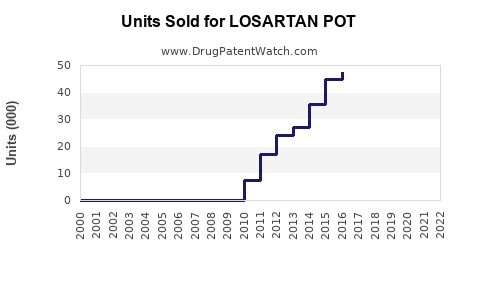
Drug Units Sold Trends for LOSARTAN POT

Annual Sales Revenues and Units Sold for LOSARTAN POT

These sales figures are drawn from a US national survey of drug expenditures

Market Analysis and Sales Projections for Losartan Potassium (LOSARTAN POT)

Last updated: July 29, 2025

Introduction

Losartan Potassium (LOSARTAN POT) is an angiotensin II receptor blocker (ARB) primarily prescribed for managing hypertension and reducing cardiovascular risk. Since its FDA approval in 1995, losartan has established itself as a vital component in antihypertensive therapy, with an expanding role in treating diabetic nephropathy. As the demand for effective, long-term cardiovascular management grows globally, understanding the market landscape and forecasting future sales are critical for stakeholders, including pharmaceutical companies, investors, and healthcare policymakers.

This analysis explores market dynamics, key drivers, competitive landscape, and future sales projections for LOSARTAN POT, highlighting factors influencing its trajectory amidst evolving healthcare trends.

Market Overview

Global Market Size

The antihypertensive drugs market was valued at approximately USD 25 billion in 2022, with ARBs representing a significant share due to their favorable side effect profile and cardiovascular benefits. Losartan holds a substantial position within this segment, given its pioneering status and continued prescribing prevalence.

According to IQVIA data, losartan accounted for roughly 20-25% of the global ARB prescriptions in 2022. The Asia-Pacific region demonstrates the highest growth rate, driven by increasing hypertension prevalence, expanding healthcare infrastructure, and rising medication adoption in emerging markets like India and China.

Indications and Expansion

Initially approved for hypertension, losartan's indications now include:

  • Hypertension management (monotherapy or combination therapy)
  • Risk reduction of stroke in hypertensive patients
  • Diabetic nephropathy in patients with type 2 diabetes

As clinical guidelines increasingly endorse early intervention for cardiovascular risk reduction and nephropathy, demand for losartan is expected to expand accordingly.

Market Drivers

Rising Hypertension Prevalence

According to the World Health Organization (WHO), over 1.28 billion adults aged 30-79 experience hypertension globally. This prevalence is projected to reach 1.56 billion by 2025, predominantly impacting low- and middle-income countries, especially in Africa and Asia. This surge directly correlates with increased demand for antihypertensive medications such as losartan.

Cardiovascular Disease (CVD) Burden

CVD remains the leading cause of mortality worldwide. LOSARTAN’s proven efficacy in reducing blood pressure and preventing stroke position it favorably for long-term management, encouraging healthcare providers to prescribe it as a first-line agent.

Favorable Side Effect Profile and Cost-Effectiveness

LOSARTAN's tolerability and established safety profile, coupled with generic availability, enhance its adoption in diverse healthcare settings, sustaining its market presence.

Rising Diabetes Prevalence and Nephropathy Treatment

Diabetic nephropathy affects approximately 20-40% of individuals with type 2 diabetes. Losartan’s ability to delay kidney disease progression underpins its growing role, especially in regions with increasing diabetes rates.

Patent Expiry and Generic Competition

Generic losartan entered the market shortly after patent expiration in the early 2010s, significantly reducing costs and increasing accessibility, thus broadening its market reach.

Competitive Landscape

Losartan's primary competitors include other ARBs such as valsartan, candesartan, and olmesartan. The market is also influenced by ACE inhibitors (e.g., enalapril) and other antihypertensive classes like calcium channel blockers and diuretics.

Key players:

  • Merck & Co. (original manufacturer of Cozaar, the branded losartan)
  • Sandoz and other generics manufacturers (post-patent expiry)
  • Regional pharmaceutical companies expanding in emerging markets

While branded formulations like Cozaar retain some premium pricing, generics dominate sales volumes, especially in price-sensitive markets.

Market Challenges

  • Pricing pressures: Increased generic competition leads to reduced prices, impacting profit margins.
  • Regulatory restrictions: Stringent regulations for biosimilars and generics may affect supply chains.
  • Market saturation: In developed markets, the initial growth phase has plateaued, prompting a shift towards combination therapies and newer ARBs.
  • Patent litigations and litigations: Risk of patent disputes over formulation and manufacturing patents can influence market stability.

Sales Projections: Short-term (Next 3 Years)

Considering the current market dynamics, losartan sales are expected to sustain a compound annual growth rate (CAGR) of approximately 3-5% globally. This moderate growth reflects:

  • Stable demand in mature markets due to established prescribing habits.
  • Expansion in emerging markets driven by increased hypertension and diabetes prevalence.
  • Continued uptake in nephropathy management.

Estimated 2023-2025 Sales Forecasts:

  • 2023: USD 2.5 billion
  • 2024: USD 2.6 billion
  • 2025: USD 2.7 billion

These projections assume steady growth, supported by increasing global healthcare access and ongoing clinical acceptance.

Long-term Outlook (Next 5-10 Years)

Over the next decade, LOSARTAN's sales potential faces both opportunities and hurdles:

  • Growth opportunities:

    • Expansion into combination therapy formulations with diuretics or novel agents.
    • Positioning in personalized medicine regimes, exploiting pharmacogenomics.
    • Increased use in less developed regions, where hypertension is underdiagnosed and undertreated.
  • Potential constraints:

    • Market saturation in developed countries reduces incremental sales.
    • Competition from newer, more selective ARBs offering improved efficacy or safety.
    • Shifts in clinical guidelines favoring other drug classes or fixed-dose combinations.

Projected long-term CAGR ranges from 2-4%, with global sales potentially reaching USD 4-5 billion by 2030, driven predominantly by emerging markets and expanding indications.

Regulatory and Patent Landscape

The patent expiration of losartan and its formulations has facilitated a flood of generic options, enhancing affordability and accessibility. Regulatory agencies across jurisdictions have approved multiple generic versions, bolstering supply and reducing costs.

Emerging biosimilars and potential new formulations under development could further influence future sales and market share.

Geographical Market Insights

  • North America: Mature market with high penetration; sales driven by a well-established healthcare infrastructure.
  • European Union: Similar trends to North America, with increased focus on cardiovascular and diabetic nephropathy indications.
  • Asia-Pacific: Rapid growth due to demographic shifts, urbanization, lifestyle changes, and increased healthcare investments.
  • Latin America and Africa: Emerging markets with significant growth potential amid increasing hypertension awareness.

Conclusion

Losartan Potassium remains a cornerstone in antihypertensive therapy, with ongoing demand driven by global demographic trends and expanding indications. While patent expirations catalyzed generic proliferation and cost-downs, future sales growth hinges on market penetration in emerging regions, integration into combination therapies, and evolving clinical guidelines.

Stakeholders should anticipate moderate growth in established markets but recognize significant upside potential in emerging markets. Strategic investments in formulations, patent management, and clinical research will be crucial to capitalize on losartan’s enduring relevance.


Key Takeaways

  • The global losartan market is expected to grow at a CAGR of 3-5% over the next three years, driven by rising hypertension and diabetic nephropathy prevalence.
  • Generics dominate sales due to patent expiry, with cost-effective formulations expanding access, especially in emerging economies.
  • Competitive landscape includes other ARBs and combination therapies, necessitating innovation to sustain market share.
  • Long-term growth prospects depend on market expansion in low- and middle-income countries, new formulation development, and evolving clinical guidelines.
  • Regulatory stability and patent management will be vital in maintaining profitability and market competitiveness.

FAQs

1. What factors contribute most to the growth of losartan sales globally?
The primary drivers include the rising prevalence of hypertension and cardiovascular diseases, expanded use in diabetic nephropathy, and increased accessibility via generics in emerging markets.

2. How does patent expiry impact losartan’s market?
Patent expiration opened the floodgates for generic versions, significantly reducing prices and expanding market access but also intensifying competition among manufacturers.

3. What regions offer the greatest growth opportunities for losartan?
Emerging markets in Asia-Pacific, Latin America, and Africa are poised for substantial growth due to increasing disease burden and improving healthcare infrastructure.

4. Are there any new developments that could threaten losartan’s market position?
Yes, competition from newer ARBs with improved safety profiles, fixed-dose combination therapies, and biosimilars could influence market share.

5. How will clinical guidelines shape the future demand for losartan?
Guidelines favoring early intervention, personalized medicine, and combination therapies may either enhance or limit losartan's use depending on evolving evidence and approvals.


References
[1] IQVIA. (2022). Global Prescription Market Insights.
[2] World Health Organization. (2022). Hypertension Prevalence Report.
[3] U.S. Food and Drug Administration. (1995). Approval of Losartan.
[4] MarketWatch. (2023). World’s Antihypertensive Drugs Market Analysis.

More… ↓

⤷  Get Started Free

Make Better Decisions: Try a trial or see plans & pricing

Drugs may be covered by multiple patents or regulatory protections. All trademarks and applicant names are the property of their respective owners or licensors. Although great care is taken in the proper and correct provision of this service, thinkBiotech LLC does not accept any responsibility for possible consequences of errors or omissions in the provided data. The data presented herein is for information purposes only. There is no warranty that the data contained herein is error free. We do not provide individual investment advice. This service is not registered with any financial regulatory agency. The information we publish is educational only and based on our opinions plus our models. By using DrugPatentWatch you acknowledge that we do not provide personalized recommendations or advice. thinkBiotech performs no independent verification of facts as provided by public sources nor are attempts made to provide legal or investing advice. Any reliance on data provided herein is done solely at the discretion of the user. Users of this service are advised to seek professional advice and independent confirmation before considering acting on any of the provided information. thinkBiotech LLC reserves the right to amend, extend or withdraw any part or all of the offered service without notice.