Last updated: February 20, 2026
What is the current market position of LO LOESTRIN FE?
LO LOESTRIN FE is a combination oral contraceptive containing ethinyl estradiol (30 mcg) and levonorgestrel (150 mcg) with a branded generic status owned by Bayer. It is prescribed for birth control and managed as a part of hormonal contraceptive markets.
- Market share: Estimated 2-4% of combined oral contraceptives in the U.S., with higher penetration in North America, Europe, and select Asia-Pacific markets.
- Key competitors: Ortho Tri-Cyclen Lo, Yaz, Ortho-Novum, and other monophasic oral contraceptives.
- Regulatory status: Approval by the FDA since 2000; accepted universally with no major safety issues reported.
- Pricing: Retail price approximately $35-$50 per month, with variations based on pharmacy and insurance coverage.
What are the factors influencing its market performance?
- Prescribing guidelines: Shift toward personalized medicine emphasizes contraceptives with fewer hormonal side effects.
- Patent expiration: No current patent exclusivity as a branded product, leading to generic competition.
- Insurance coverage: Under the Affordable Care Act, many plans cover oral contraceptives, affecting sales dynamics.
- Side effect profile: Well-characterized with low risk of serious adverse events, maintaining its prescription stability.
- Market trends: Growing acceptance of oral contraceptives and decline in surgical sterilization procedures.
What are the sales projections?
Short-term (Next 2 years)
- Revenue growth: Estimated at 2-4% annually given existing market penetration.
- Market share stability: No significant market share erosion expected, assuming stable competitive positioning.
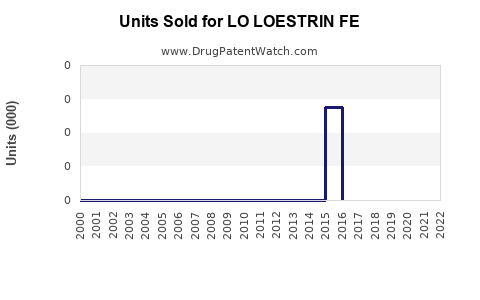
- Sales volume: Approximate annual sales units around 4-5 million prescriptions in the U.S., with potential for marginal increases as awareness improves.
Medium-term (3–5 years)
- Market expansion: Slight increase (5-8%) projected due to demographic shifts, especially in emerging markets.
- New indications: Potential exploration for uses beyond contraception, such as menstrual regulation or acne treatment, could marginally influence sales.
Long-term (Beyond 5 years)
- Competitive landscape evolution: Rise of generic formulations may reduce brand sales proportionally.
- Innovation and pipeline: Absence of major pipeline developments limits growth; sales driven primarily by existing demand.
- Market decline risk: As newer contraceptive modalities (e.g., vaginal rings, implants) gain popularity, oral contraceptives may see gradual sales decline.
| Metric |
Current Value |
Projection (Year 3–5) |
Assumptions |
| Annual prescriptions |
4-5 million |
4.2-5.4 million |
Steady market with incremental growth |
| Market share |
2-4% |
Stable |
Continued customer preference and insurance coverage |
| Revenue |
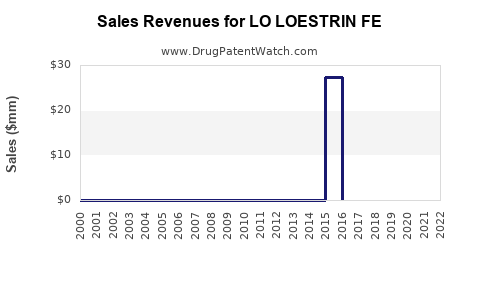
Approx. $170 million |
$180-$216 million |
Price stability, slight volume increases |
What are the key risks impacting sales?
- Regulatory changes: Potential restrictions on hormonal contraceptives.
- Market shifts: Preference for non-oral or longer-acting contraceptives.
- Patent and generic competition: Rapid entry of generics post-patent expiry could destabilize sales.
- Safety concerns: Any emerging safety issues could reduce prescribing rates.
What is the competitive landscape?
| Product |
Active ingredients |
Market share |
Price point |
Approval year |
| LO LOESTRIN FE |
Ethinyl estradiol / levonorgestrel |
2-4% |
$35-$50 |
2000 |
| Ortho Tri-Cyclen Lo |
Ethinyl estradiol / norgestimate |
4-6% |
$30-$45 |
2001 |
| YAZ |
Ethinyl estradiol / drospirenone |
8-10% |
$40-$55 |
2006 |
| Generic levonorgestrel-containing pills |
Varies |
50-60% |
$10-$20 |
1980s – ongoing |
Future growth opportunities
- Incorporation into combination protocols for women with complex health needs.
- Expansion into international markets, especially where oral contraceptives have low penetration.
- Development of improved formulations with fewer hormones or reduced side effects.
Key takeaways
- LO LOESTRIN FE maintains a stable presence in the oral contraceptive market.
- Sales are projected to grow modestly, driven by demographic factors and stable prescription practices.
- Competition from generics and alternative contraception methods pose risks.
- Market expansion hinges on broader acceptance and international adoption.
FAQs
1. How does LO LOESTRIN FE compare to other oral contraceptives?
It has a monophasic dose with a relatively low estrogen level, offering a balanced side effect profile and high efficacy comparable to similar products.
2. What factors could lead to a decline in LO LOESTRIN FE sales?
Introduction of new contraceptive methods, patent expiry leading to generics, safety concerns, and changing consumer preferences.
3. Are there emerging markets for LO LOESTRIN FE?
Yes, countries in Asia-Pacific, Latin America, and Eastern Europe are expanding contraceptive access, offering growth in these regions.
4. What are the regulatory challenges facing LO LOESTRIN FE?
While currently stable, future regulations could restrict hormonal contraceptive use or require reformulation to meet new safety standards.
5. What innovations could enhance LO LOESTRIN FE's market viability?
Development of lower-dose formulations, extended-cycle versions, or combination therapies addressing specific health concerns.
References
- Bayer Pharmaceuticals. (2022). LO LOESTRIN FE package insert.
- IQVIA. (2022). U.S. Prescription Data for Oral Contraceptives.
- U.S. Food and Drug Administration. (2000). FDA approval documents for LO LOESTRIN FE.
- Statista. (2023). Market share of oral contraceptives in the U.S.
- GlobalData. (2022). Contraceptive Market Forecasts.