Drug Sales Trends for LO LOESTRIN
Payment Methods and Pharmacy Types for LO LOESTRIN (2022)
Revenues by Pharmacy Type
Units Sold by Pharmacy Type
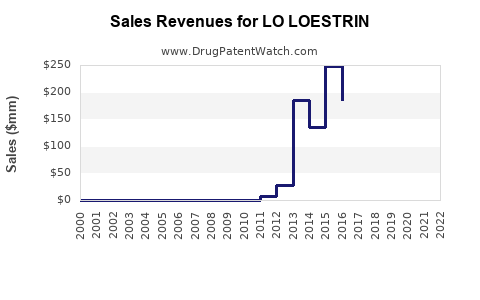
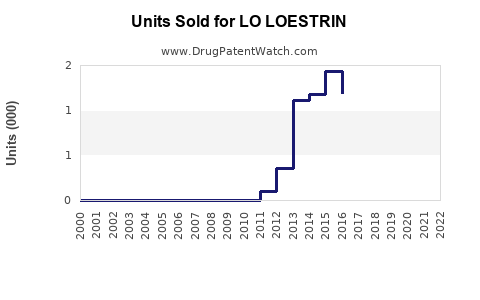
Annual Sales Revenues and Units Sold for LO LOESTRIN
| Drug Name | Revenues (USD) | Units | Year |
|---|---|---|---|
| LO LOESTRIN | ⤷ Start Trial | ⤷ Start Trial | 2022 |
| LO LOESTRIN | ⤷ Start Trial | ⤷ Start Trial | 2021 |
| LO LOESTRIN | ⤷ Start Trial | ⤷ Start Trial | 2020 |
| >Drug Name | >Revenues (USD) | >Units | >Year |
Lo Loestrin Fe Market Analysis, Sales Forecast, Patent Risk, and Generic Entry Outlook
Lo Loestrin Fe is a low-dose combined oral contraceptive marketed by AbbVie through its legacy Allergan women’s health portfolio. The product contains norethindrone acetate and ethinyl estradiol and has differentiated itself through an ultra-low estrogen regimen, 24 active tablets, two estrogen-only tablets, and two ferrous fumarate tablets.[1] AbbVie does not separately disclose Lo Loestrin Fe revenue, so the forecast below uses a scenario model rather than reported product sales.
The commercial outlook remains positive in the near term because of brand recognition, physician familiarity, and demand for lower-estrogen oral contraception. The principal risks are generic substitution, payer pressure, the availability of other low-dose oral contraceptives, and migration to long-acting reversible contraceptives such as intrauterine systems and implants.
What is Lo Loestrin Fe and how does it compete?
Lo Loestrin Fe is indicated to prevent pregnancy in females of reproductive potential. Each 28-day pack contains:
| Component | Quantity per tablet | Tablets per pack |
|---|---|---|
| Norethindrone acetate | 1 mg | 24 |
| Ethinyl estradiol | 10 mcg | 24 |
| Ethinyl estradiol alone | 10 mcg | 2 |
| Ferrous fumarate | 75 mg | 2 |
The product’s main commercial distinction is its 10-microgram ethinyl estradiol dose in the active combination tablets. Competitors such as Loestrin 24 Fe, Minastrin 24 Fe, Generess Fe, Junel Fe, and generic norethindrone acetate/ethinyl estradiol products generally use higher estrogen doses or different delivery formats.
Lo Loestrin Fe competes on perceived tolerability, prescribing continuity, brand familiarity, and convenience. It competes less effectively on price because most oral contraceptives are available as low-cost generics.
How does Lo Loestrin Fe compare with competing oral contraceptives?
| Product or category | Key ingredients or technology | Estrogen dose | Commercial position |
|---|---|---|---|
| Lo Loestrin Fe | Norethindrone acetate/ethinyl estradiol | 10 mcg | Branded ultra-low-dose oral contraceptive |
| Loestrin 24 Fe generics | Norethindrone acetate/ethinyl estradiol | Usually 20 mcg | Low-cost generic substitute |
| Junel Fe generics | Norethindrone acetate/ethinyl estradiol | Usually 20 mcg | High-volume generic category |
| Yaz and generics | Drospirenone/ethinyl estradiol | Usually 20 mcg | Branded and generic competitor |
| NuvaRing and generics | Etonogestrel/ethinyl estradiol vaginal ring | Continuous delivery | Non-oral hormonal option |
| Xulane and generics | Norelgestromin/ethinyl estradiol patch | Transdermal | Weekly delivery |
| Nexplanon | Etonogestrel implant | Progestin-only | Long-acting reversible contraception |
| Mirena, Kyleena, Liletta | Levonorgestrel intrauterine systems | Progestin-only | Long-acting reversible contraception |
The key distinction is the ultra-low estrogen dose, but this distinction does not eliminate therapeutic substitution. Physicians can move patients to generic norethindrone acetate/ethinyl estradiol or other branded contraceptives when cost, formulary access, or side effects dominate prescribing decisions.
How large is the Lo Loestrin Fe market?
The U.S. is the principal commercial market. AbbVie reports women’s health products within broader revenue disclosures and does not provide a separate Lo Loestrin Fe revenue line in its annual reports.[2] Public company reporting therefore cannot establish audited product-level sales.
An analytical estimate places U.S. Lo Loestrin Fe net sales in the approximate range of $800 million to $1.1 billion for the 2024 base year. The range reflects uncertainty over rebates, specialty pharmacy dispensing, Medicaid pricing, commercial payer discounts, and the share of prescriptions filled as brand.
The product’s gross sales are likely materially higher than net sales because oral contraceptives are subject to rebates and discounts. Net revenue is the relevant measure for AbbVie’s earnings exposure.
What drives Lo Loestrin Fe demand?
The principal demand drivers are:
- Continued use of oral contraception in the United States.
- Prescriber preference for low-dose estrogen regimens.
- Patient preference for a familiar branded product.
- Demand for monthly oral dosing rather than devices or procedures.
- Stable refill behavior among existing users.
The principal constraints are:
- Generic substitution.
- Payer formulary exclusion or higher tier placement.
- Contraceptive switching to intrauterine devices and implants.
- Clinical contraindications associated with combined hormonal contraception.
- Price sensitivity among uninsured and underinsured patients.
The Centers for Disease Control and Prevention identifies combined hormonal contraceptives as effective options for many patients but highlights cardiovascular and thrombotic risk factors that can restrict use, including smoking in women aged 35 years or older and a history of thrombosis or certain migraine conditions.[3]
What are the projected Lo Loestrin Fe sales through 2029?
The following forecast uses a 2024 estimated net-sales midpoint of $900 million. It assumes continued brand availability, gradual payer pressure, and generic entry during the forecast period. The figures are analytical projections, not AbbVie guidance.
| Year | Bear case | Base case | Upside case |
|---|---|---|---|
| 2024E | $800 million | $900 million | $1.1 billion |
| 2025E | $760 million | $855 million | $1.07 billion |
| 2026E | $600 million | $770 million | $1.02 billion |
| 2027E | $430 million | $660 million | $970 million |
| 2028E | $320 million | $555 million | $920 million |
| 2029E | $250 million | $460 million | $875 million |
What assumptions support the base-case forecast?
The base case assumes:
- Low-single-digit erosion before meaningful generic substitution.
- A generic or authorized-generic entrant with commercial availability during 2026 or 2027.
- A 15% to 25% annual decline after broad generic access.
- Continued retention of patients who value the 10-microgram estrogen dose.
- No major safety action, label restriction, or supply interruption.
- Continued reimbursement, but with increasing step edits and brand penalties.
Under this model, Lo Loestrin Fe remains a substantial product through 2027 but loses approximately half of its modeled 2024 net sales by 2029.
The upside case assumes delayed generic commercialization, weaker substitution because of the ultra-low-dose formulation, and continued brand preference. The bear case assumes an early generic launch, aggressive payer substitution, and faster migration to lower-cost contraceptives.
When does Lo Loestrin Fe lose exclusivity?
Lo Loestrin Fe’s commercial exclusivity depends on several separate protections:
- FDA regulatory exclusivity.
- Listed Orange Book patents.
- Patent term adjustment or patent term extension.
- Pediatric exclusivity, if granted.
- Formulation or dosing patents.
- Potential litigation settlements affecting generic launch dates.
The original FDA approval date was October 22, 2010.[1] Standard five-year new chemical entity exclusivity would not remain the principal barrier today. The relevant commercial issue is patent protection and the timing of any Paragraph IV litigation.
A definitive launch date cannot be inferred from the product’s approval date alone. Patent expiration dates must be evaluated against current Orange Book listings, terminal disclaimers, patent-term adjustments, litigation outcomes, and any settlement agreements.
What is the Orange Book status of Lo Loestrin Fe?
Lo Loestrin Fe is an approved prescription drug product listed in the FDA’s Orange Book framework under AbbVie’s legacy women’s health business. Orange Book analysis should distinguish between:
- The branded NDA product.
- Approved ANDAs for equivalent norethindrone acetate and ethinyl estradiol products.
- Different strengths, packaging configurations, and ferrous fumarate presentations.
- Patents that claim the active ingredients versus patents that claim the regimen or formulation.
A generic product with the same active ingredients may not automatically be substitutable for every Lo Loestrin Fe presentation if the strength, dosage regimen, inactive ingredients, or FDA approval designation differs.
The Orange Book is the controlling reference for listed patents and exclusivity status. FDA’s Orange Book database should be reviewed against the current product entry before making a launch, licensing, or litigation decision.[4]
Which companies are challenging Lo Loestrin Fe?
The relevant challengers are generic manufacturers with ANDA filings for norethindrone acetate and ethinyl estradiol products. Potential participants in the category include large U.S. generic companies such as Teva, Lupin, Dr. Reddy’s Laboratories, Amneal, Glenmark, and Endo or legacy Par Pharmaceutical entities.
A Paragraph IV certification alleges that a listed patent is invalid, unenforceable, or not infringed. If the NDA holder files suit within the statutory period, FDA approval may be subject to a 30-month stay, subject to court action and statutory exceptions.[5]
The commercial importance of any Paragraph IV case depends on:
- The specific patent challenged.
- Whether the generic seeks approval for the exact Lo Loestrin Fe strength.
- Whether the product qualifies for 180-day first-filer exclusivity.
- Whether the litigation settles before trial.
- Whether the settlement permits an authorized generic.
- Whether the generic launches at risk.
No single ANDA filing should be treated as a confirmed commercial launch. FDA approval, patent resolution, manufacturing readiness, state substitution rules, and payer contracts all affect actual market entry.
What patents protect Lo Loestrin Fe?
The likely protection strategy for a product of this type includes patent claims directed to:
- The low-dose norethindrone acetate and ethinyl estradiol combination.
- The 10-microgram ethinyl estradiol regimen.
- The 24-day active-tablet schedule.
- The two estrogen-only tablets.
- The ferrous fumarate tablets.
- Packaging and sequential administration.
- Manufacturing and formulation controls.
Formulation and regimen patents can have greater commercial relevance than broad composition claims because the active ingredients are established contraceptive compounds. Their strength depends on written description, enablement, claim construction, prosecution history, and whether a generic can design around the specific tablet sequence.
How strong is the Lo Loestrin Fe patent estate?
The estate is commercially meaningful but unlikely to be impenetrable. The core active ingredients are old, which limits the scope of new chemical entity protection. The strongest remaining positions are likely to be narrow formulation, dosing, and regimen claims.
Patent strength is reduced when:
- The claims cover a predictable combination of known ingredients.
- Prior art discloses similar low-dose contraceptive regimens.
- The generic can omit or alter nonessential iron tablets.
- The generic can use a different packaging sequence.
- The asserted patent does not cover the exact ANDA product.
Patent strength improves when:
- The claims require a specific low-dose combination.
- The formulation has demonstrated unexpected clinical or stability benefits.
- The patent covers the full commercial regimen rather than one component.
- The claims survive inter partes review or district court scrutiny.
- The product’s substitution pathway depends on exact pharmaceutical equivalence.
What patent litigation and settlement risks affect generic entry?
Lo Loestrin Fe faces the standard litigation risk associated with branded oral contraceptives. A Paragraph IV dispute could produce three principal outcomes:
| Outcome | Commercial effect |
|---|---|
| Brand wins before launch | Generic entry is delayed until patent expiry or settlement date |
| Generic wins or patent is invalidated | Early launch and rapid price erosion |
| Settlement permits later entry | Predictable erosion beginning on the agreed date |
A settlement may include a permitted launch date, an authorized-generic commitment, supply terms, or restrictions on promotional conduct. Settlement terms can materially change the value of the patent estate even when the brand wins the initial district-court case.
No settlement should be assumed without a publicly filed agreement, court docket, or regulatory record.
Does Lo Loestrin Fe face biosimilar risk?
No. Lo Loestrin Fe is a chemically synthesized oral tablet, not a biologic. Biosimilar rules under the Biologics Price Competition and Innovation Act do not apply. The relevant competitive pathway is the abbreviated new drug application, or ANDA, for a generic equivalent.[5]
This distinction matters because generic entry can occur through pharmaceutical equivalence and bioequivalence rather than the more complex biosimilar interchangeability pathway.
What formulations are protected by Lo Loestrin Fe?
The commercial formulation is a multi-tablet 28-day pack. Protection may extend to the sequence and composition of the pack rather than only to the active ingredients.
The formulation’s commercial advantages are:
- Ultra-low-dose estrogen exposure.
- A 28-day packaging format.
- Reduced patient decision-making during the cycle.
- Brand familiarity.
- A dosing structure that differs from many standard 21-day or 24-day combined oral contraceptives.
These advantages may support brand retention but do not guarantee FDA substitution protection. Generic manufacturers can seek approval for a therapeutically equivalent product with different packaging or inactive ingredients if the FDA determines that the product meets applicable requirements.
What licensing deals involve Lo Loestrin Fe?
Lo Loestrin Fe originated in the Warner Chilcott women’s health portfolio. Actavis acquired Warner Chilcott in 2013, and AbbVie acquired Allergan in 2020, bringing the product into AbbVie’s portfolio.[6][7]
No separately disclosed, product-specific licensing transaction is required to explain current ownership. The material ownership events are corporate acquisitions rather than an independently reported Lo Loestrin Fe license.
What generic launch scenarios exist?
Delayed-entry scenario
A generic entrant receives approval but cannot launch until patent expiry or a settlement date. Brand revenue declines gradually as payers anticipate entry but maintain coverage.
Single-generic scenario
One first filer launches with limited competition. Net prices fall, but the brand retains a meaningful share because of physician and patient preference.
Multi-generic scenario
Several ANDA holders launch within a short period. Prices decline rapidly, payer substitution intensifies, and brand revenue can fall by 50% or more within two to three years.
Authorized-generic scenario
AbbVie or a commercial partner markets an authorized generic. This protects some volume and captures value from price-sensitive patients but can accelerate erosion of the branded product.
What is AbbVie’s revenue exposure?
Lo Loestrin Fe is strategically important as a durable branded women’s health asset, but its revenue contribution is small relative to AbbVie’s immunology, oncology, neuroscience, and aesthetics businesses. AbbVie’s annual reports aggregate product-level information and do not provide a standalone Lo Loestrin Fe revenue figure.[2]
The key financial exposure is therefore not company solvency or portfolio concentration. It is the rate at which a high-margin branded contraceptive converts into lower-margin generic volume. A $500 million annual decline in Lo Loestrin Fe net sales would be material to the women’s health franchise but modest relative to AbbVie’s consolidated revenue base.
Key Takeaways
- Lo Loestrin Fe is a branded ultra-low-dose oral contraceptive containing norethindrone acetate and ethinyl estradiol.
- AbbVie does not separately report product revenue, so sales projections require a scenario model.
- Estimated 2024 U.S. net sales are approximately $800 million to $1.1 billion.
- Base-case net sales decline from about $900 million in 2024 to $460 million in 2029.
- Generic entry is the primary commercial risk.
- The most relevant patent protections are likely formulation, dosing, regimen, and packaging claims rather than new chemical entity claims.
- Lo Loestrin Fe is not exposed to biosimilar competition.
- AbbVie’s ownership results from the Allergan acquisition and the earlier Warner Chilcott-Actavis transaction.
- A delayed generic launch could preserve substantial value; multi-generic entry would produce rapid price and share erosion.
- Current Orange Book listings, ANDA approvals, Paragraph IV certifications, and settlement terms control the precise entry forecast.
FAQs About Lo Loestrin Fe Market and Patent Risk
Is Lo Loestrin Fe still a branded product?
Yes. Lo Loestrin Fe is marketed as a branded prescription oral contraceptive by AbbVie’s legacy Allergan women’s health business.
Is there a generic version of Lo Loestrin Fe?
Generic norethindrone acetate and ethinyl estradiol products exist in the broader contraceptive market, but exact substitutability depends on strength, formulation, regimen, FDA approval, and Orange Book status.
What is the expected price erosion after generic entry?
A single generic may reduce net brand revenue gradually, while multi-generic entry can produce 50% or greater erosion within two to three years.
Does Lo Loestrin Fe have market exclusivity based on its low estrogen dose?
Low estrogen content alone does not establish perpetual exclusivity. Commercial protection depends on enforceable patents, FDA exclusivity, and the scope of approved generic products.
Is Lo Loestrin Fe more exposed to IUDs or generic pills?
Generic pills create the more immediate pricing threat. IUDs and implants create a longer-term utilization threat by shifting patients away from daily oral contraception.
References
- U.S. Food and Drug Administration. (2024). Lo Loestrin Fe prescribing information.
- AbbVie Inc. (2024). Annual report pursuant to Section 13 or 15(d) of the Securities Exchange Act of 1934.
- Centers for Disease Control and Prevention. (2024). U.S. medical eligibility criteria for contraceptive use.
- U.S. Food and Drug Administration. (2024). Approved drug products with therapeutic equivalence evaluations, Orange Book.
- U.S. Food and Drug Administration. (2024). ANDA submissions: Paragraph IV certifications.
- Actavis plc. (2013). Actavis completes acquisition of Warner Chilcott.
- AbbVie Inc. (2020). AbbVie completes acquisition of Allergan.
More… ↓
