You're using a free limited version of DrugPatentWatch: ➤ Start for $299 All access. No Commitment.

Last Updated: April 4, 2026

Drug Sales Trends for LITHIUM CARBONATE


✉ Email this page to a colleague
« Back to Dashboard


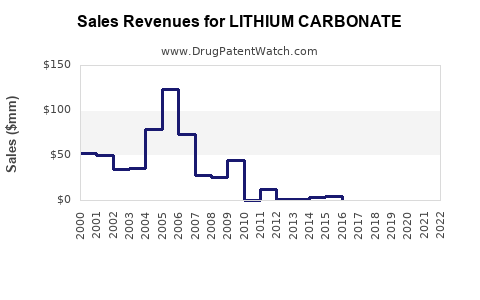
Drug Sales Revenue Trends for LITHIUM CARBONATE
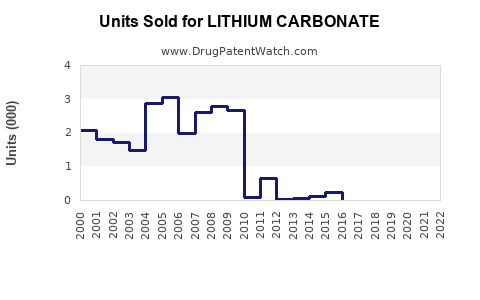
Drug Units Sold Trends for LITHIUM CARBONATE

Annual Sales Revenues and Units Sold for LITHIUM CARBONATE

These sales figures are drawn from a US national survey of drug expenditures
Drug Name Revenues (USD) Units Year
LITHIUM CARBONATE ⤷  Start Trial ⤷  Start Trial 2022
LITHIUM CARBONATE ⤷  Start Trial ⤷  Start Trial 2021
LITHIUM CARBONATE ⤷  Start Trial ⤷  Start Trial 2020
LITHIUM CARBONATE ⤷  Start Trial ⤷  Start Trial 2019
>Drug Name >Revenues (USD) >Units >Year

Market Analysis and Sales Projections for Lithium Carbonate

Last updated: February 16, 2026

Lithium carbonate is a chemical compound primarily used in the manufacturing of lithium-ion batteries, which power electric vehicles (EVs), portable electronics, and energy storage systems. The drug is also used in psychiatric treatment for bipolar disorder, but its market is now largely driven by industrial applications.


Market Size and Key Drivers

The global lithium carbonate market was valued at approximately USD 3.3 billion in 2022. It is expected to grow at a compound annual growth rate (CAGR) of around 10% between 2023 and 2030, reaching USD 6.8 billion by 2030.

Key drivers:

  • Electric vehicle (EV) adoption: EV sales surged from 3.2 million units in 2020 to 10.5 million in 2023, according to the International Energy Agency (IEA). Lithium-ion batteries account for nearly 75-80% of EV battery packs.
  • Energy storage systems: Increased deployment of utility-scale storage projects, driven by renewable energy sources, boosts demand.
  • Battery manufacturing expansion: Major OEMs and battery producers announced multi-billion-dollar investments, including Tesla, CATL, LG Chem, and BYD.
  • Government policies: Many governments, including the U.S., EU, and China, have set EV adoption targets, incentivizing lithium supply.

Market Segmentation

Segment Share in 2022 Key Characteristics
Battery-grade lithium carbonate ~85% Pure form suitable for lithium-ion battery manufacturing
Pharmaceutical-grade lithium carbonate ~15% Used in psychiatric medication; market share shrinking due to pricing and competition

Battery-grade lithium carbonate dominates the market, with production capacity largely aligned with battery manufacturing growth.


Leading Producers and Supply Dynamics

Major producers include:

  • Albemarle Corporation
  • Ganfeng Lithium
  • SQM (Sociedad Química y Minera)
  • Tianqi Lithium

These companies control about 70% of global supply, which is concentrated in Australia, Chile, and China.

Supply constraints:

  • Limited lithium extraction capacity expansions in the near term.
  • Environmental and regulatory restrictions in key mining regions.
  • Growing geopolitical concerns affecting supply chains.

Expected supply shortages could influence prices upward, benefiting existing producers.


Pricing Trends

The average price of battery-grade lithium carbonate was around USD 22,000 per metric ton in 2022, up from USD 14,000 in 2020. Prices are volatile, influenced by:

  • Mining output levels.
  • Lithium spot market demand.
  • Battery manufacturers’ procurement strategies.

Projections for 2025 suggest prices could stabilize around USD 25,000–30,000 per ton if supply chain constraints persist.


Sales Projections and Market Shares

Annual global sales volume:

  • Estimated at 150,000–180,000 metric tons in 2022.
  • Projected to grow at roughly 12% CAGR from 2023 to 2030.

Forecasted volume:

Year Estimated Sales (metric tons) Notes
2023 180,000 Slight recovery from 2022
2025 255,000 Expansion fueled by EV and battery demand
2030 350,000 Market maturation and heightened EV adoption

Revenue Projections:

Year Estimated Revenue (USD billions) Assumptions
2023 USD 3.96 billion USD 22,000 per ton, 180,000 tons sold
2025 USD 7.65 billion USD 30,000 per ton, 255,000 tons sold
2030 USD 10.5–12 billion Price stabilization at USD 30,000–35,000, 350,000+ tons

Competitive Landscape

Growth has attracted new entrants, including international mining companies and chemical producers. Existing players are expanding capacity and investing in processing technology to reduce costs. Companies developing alternative battery chemistries, such as solid-state or lithium iron phosphate (LFP), may impact long-term demand.

Risks and Challenges

  • Environmental impact: Lithium extraction faces scrutiny; potential regulation could limit supply.
  • Market volatility: Prices fluctuate based on supply-demand dynamics.
  • Substitution: Adoption of alternative chemistries reduces lithium dependency.
  • Supply chain disruptions: Geopolitical conflicts and logistic issues could hinder delivery.

Consolidated Outlook

Lithium carbonate market prospects remain positive, driven by the rapid growth of EVs and renewable energy projects. Price increases and supply constraints could extend profit margins for existing producers. However, moderate oversupply risks and technological shifts pose long-term uncertainties.


Key Takeaways

  • The lithium carbonate market is set for a CAGR of approximately 10% through 2030.
  • Demand growth is primarily propelled by EV battery production and energy storage systems.
  • Supply is concentrated among a few large producers, with capacity expansions slow to meet rising demand.
  • Prices have increased notably since 2020, with projections indicating continued upward movement.
  • Market risks include environmental regulations, technological competition, and geopolitical tensions.

FAQs

1. What is driving the growth in lithium carbonate demand?
The rise in electric vehicle sales and renewable energy integration increases demand for lithium-ion batteries, which rely heavily on lithium carbonate.

2. Who are the dominant producers of lithium carbonate?
Albemarle, Ganfeng Lithium, SQM, and Tianqi Lithium lead the supply chain, controlling significant market share primarily from Australia, Chile, and China.

3. How are prices expected to evolve?
Prices surged from around USD 14,000 per ton in 2020 to USD 22,000 in 2022. Projections suggest USD 25,000–30,000 per ton by 2025, with potential stabilization thereafter.

4. What are primary challenges facing the lithium carbonate market?
Environmental concerns, supply chain disruptions, geopolitical tensions, and technological shifts toward alternative battery chemistries.

5. How does the pharmaceutical market compare to the industrial market?
Pharmaceutical-grade lithium carbonate accounts for about 15% of the market and has significantly smaller sales volumes compared to the industrial segment used in batteries.


Sources

[1] International Energy Agency (IEA). "Global EV Outlook 2023."
[2] BloombergNEF. "Lithium Market Outlook 2023."
[3] MarketWatch. "Lithium Carbonate Market Size, Share & Trends Analysis."
[4] Albermarle Corporation annual reports.
[5] Ganfeng Lithium Annual Report 2022.

More… ↓

⤷  Start Trial

Make Better Decisions: Try a trial or see plans & pricing

Drugs may be covered by multiple patents or regulatory protections. All trademarks and applicant names are the property of their respective owners or licensors. Although great care is taken in the proper and correct provision of this service, thinkBiotech LLC does not accept any responsibility for possible consequences of errors or omissions in the provided data. The data presented herein is for information purposes only. There is no warranty that the data contained herein is error free. We do not provide individual investment advice. This service is not registered with any financial regulatory agency. The information we publish is educational only and based on our opinions plus our models. By using DrugPatentWatch you acknowledge that we do not provide personalized recommendations or advice. thinkBiotech performs no independent verification of facts as provided by public sources nor are attempts made to provide legal or investing advice. Any reliance on data provided herein is done solely at the discretion of the user. Users of this service are advised to seek professional advice and independent confirmation before considering acting on any of the provided information. thinkBiotech LLC reserves the right to amend, extend or withdraw any part or all of the offered service without notice.