Last updated: February 13, 2026
What is the current market size for levothyroxine sodium?
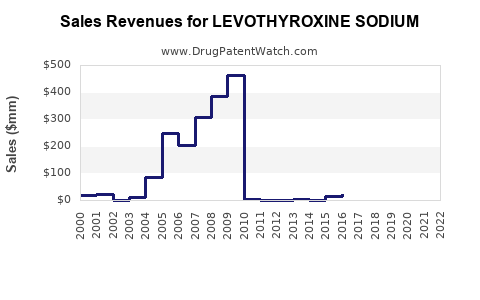
The global market for levothyroxine sodium was valued at approximately $2.1 billion in 2022. It targets a broad patient base with hypothyroidism, affecting 4-8% of the population worldwide. Key regions include North America, Europe, and Asia-Pacific, representing 60%, 20%, and 15% of sales, respectively. North America leads due to high diagnosis rates and established healthcare infrastructure.
How is the market expected to grow?
The compound annual growth rate (CAGR) for the levothyroxine sodium market is projected at approximately 4.2% from 2023 to 2030. Drivers include:
- Increasing prevalence of thyroid disorders, driven by aging populations and iodine deficiency.
- Greater awareness and screening leading to earlier diagnosis.
- Expanding insulin and hormone replacement therapy markets.
Emerging markets such as China and India are anticipated to see faster growth due to improving healthcare access and rising healthcare expenditure.
What are the major competitors and their market shares?
The market is concentrated among a few pharmaceutical giants. Key players include:
| Company |
Market Share (2022) |
Notable Products |
| Merck & Co. |
35% |
Synthroid, Levoxyl |
| Pfizer |
20% |
Euthyrox (marketed outside the US) |
| Mylan (now part of Viatris) |
15% |
Euthyrox, generic levothyroxine formulations |
| Others |
30% |
Multiple regional brands |
The U.S. market predominantly relies on branded and generic levothyroxine formulations. Patent expirations in the past decade have increased generic market penetration.
What are safety, regulatory, and patent considerations?
Levothyroxine sodium formulations are approved by regulatory agencies such as the FDA and EMA. Patent exclusivities expired for most formulations years ago, leading to a highly competitive generic market. Recent regulatory updates emphasize bioequivalence and manufacturing quality, with FDA's Tablets and Capsules guideline published in 2014 reinforcing these standards.
What are sales projections for the next five years?
Sales are expected to grow steadily, reaching approximately $2.7 billion by 2027, representing a CAGR of 4%. The growth is driven by:
- Increased diagnosis rates.
- Generic drug market expansion.
- Greater global healthcare spending.
Regional growth patterns show North America maintaining dominance, with Asia-Pacific expected to grow at a CAGR of above 5%, fueled by rising disposable incomes and improved healthcare access.
What are potential market risks and barriers?
Key risks include:
- Price competition due to widespread generic availability.
- Regulatory changes that may favor or restrict certain formulations.
- Manufacturing challenges if quality standards are not upheld.
- Shifts toward alternative therapies or combination drugs.
Supply chain disruptions could also impact manufacturing and distribution.
Key takeaways
- The global levothyroxine sodium market was valued at $2.1 billion in 2022.
- Projected CAGR is approximately 4.2% from 2023-2030.
- North America leads market share; Asia-Pacific shows high growth potential.
- Major competitors are Merck, Pfizer, and Viatris.
- Patent expirations have increased generic market penetration, intensifying competition.
- Sales are forecasted to reach $2.7 billion by 2027.
FAQs
1. How fast is the market for levothyroxine sodium expected to grow?
It is projected to grow at a CAGR of around 4.2% from 2023 to 2030.
2. Which regions will see the highest growth?
Asia-Pacific is expected to experience the fastest growth, exceeding 5% CAGR, driven by increasing healthcare access.
3. Who are the leading companies in the levothyroxine sodium market?
Merck & Co., Pfizer, and Viatris (formerly Mylan) dominate the market, controlling over 70% of sales collectively.
4. What factors influence the market’s future?
Factors include rising disease prevalence, generic drug competition, regulatory standards, and manufacturing quality.
5. Are patent protections still relevant for levothyroxine formulations?
Most patents expired years ago, resulting in a saturated generic market; regulatory standards now favor bioequivalence and manufacturing quality.
References
- MarketWatch. "Global Thyroid Disorder Drugs Market." 2023.
- Allied Market Research. "Thyroid Disorder Drugs Market by Type and Region." 2023.
- U.S. Food and Drug Administration. "Bioequivalence Guidance." 2014.
- World Health Organization. "Thyroid Disease Fact Sheets." 2022.
- IQVIA. "Global Prescriptions Trends." 2022.