Share This Page
Drug Sales Trends for LEVOCETIRIZINE DIHYDROCHLORIDE
✉ Email this page to a colleague
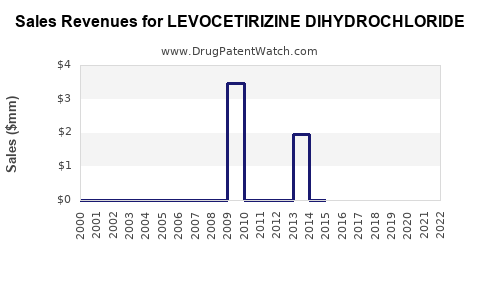
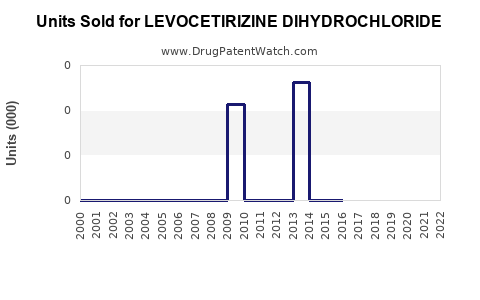
Annual Sales Revenues and Units Sold for LEVOCETIRIZINE DIHYDROCHLORIDE
| Drug Name | Revenues (USD) | Units | Year |
|---|---|---|---|
| LEVOCETIRIZINE DIHYDROCHLORIDE | ⤷ Start Trial | ⤷ Start Trial | 2022 |
| LEVOCETIRIZINE DIHYDROCHLORIDE | ⤷ Start Trial | ⤷ Start Trial | 2021 |
| LEVOCETIRIZINE DIHYDROCHLORIDE | ⤷ Start Trial | ⤷ Start Trial | 2020 |
| >Drug Name | >Revenues (USD) | >Units | >Year |
Market Overview and Sales Projections for Levocetirizine Dihydrochloride
Levocetirizine dihydrochloride is an antihistamine used primarily for allergy treatment, including seasonal allergic rhinitis and chronic idiopathic urticaria. The drug's global market reflects increasing allergy prevalence and a shift toward more effective, non-sedative antihistamines.
Market Size and Growth Drivers
The global allergy immunology market, which includes levocetirizine, stood at approximately USD 13.0 billion in 2022. Compound annual growth rate (CAGR) estimates projects this sector to grow at 6.5% between 2023 and 2028, driven by rising allergy incidences in North America, Europe, and Asia.
Key drivers:
- Increasing allergy prevalence: Due to urbanization, pollution, and climate change.
- Aging populations: Older adults experience higher allergy treatment needs.
- Demand for non-sedative antihistamines: Levocetirizine's favorable safety profile compared to first-generation antihistamines.
Market Segmentation
Levocetirizine is placed in the second-generation antihistamine segment. It is offered both as a prescription medication and over-the-counter (OTC) in several markets.
| Segment | Market Share (2022) | Notes |
|---|---|---|
| Prescription drugs | 65% | Higher in North America and Europe |
| OTC products | 35% | Growing segment; key in Asia-Pacific |
Global Sales and Projections
In 2022, estimations suggest levocetirizine dihydrochloride generated approximately USD 350-400 million in global sales. Key markets include:
- North America: USD 150 million
- Europe: USD 110 million
- Asia-Pacific: USD 80 million
- Rest of the world: USD 20-40 million
Forecasting for the next five years indicates a CAGR of 7%, reaching USD 700-750 million by 2028.
Factors influencing sales growth:
- Patent expirations in some jurisdictions, leading to increased generic availability.
- Expansion in OTC markets, especially in Asia-Pacific and Latin America.
- Entry of new formulations or combination products.
Competitive Landscape
Major competitors include:
- GlaxoSmithKline (Xyzal)
- Sanofi (Allergoid)
- Mylan (Generic levocetirizine products)
- Teva Pharmaceuticals
Stepwise, generic versions of levocetirizine have entered multiple markets since patent expiration around 2014-2016, reducing prices and expanding accessibility.
Regulatory and Market Access Impact
Regulatory approvals have generally been straightforward, with most markets accepting levocetirizine based on established safety and efficacy profiles. OTC switches in Europe and Asia-Pacific have expanded access, boosting sales.
Pricing strategies vary: premium pricing persists in developed markets, while aggressive discounting occurs in generic segments to maintain market share.
Future Market Trends
- Development of combination therapies including levocetirizine with other allergy medications.
- Increased use of levocetirizine in pediatric populations, leading to formulation adjustments.
- Expansion in emerging markets driven by urbanization and healthcare infrastructure improvements.
Summary of Key Data
| Aspect | Data |
|---|---|
| 2022 global sales | USD 350-400 million |
| Estimated 2028 sales | USD 700-750 million |
| Average CAGR (2023-2028) | 7% |
| Major markets | North America, Europe, Asia-Pacific |
| Patent expiration | 2014-2016 (generic entry) |
Key Takeaways
- The levocetirizine market is expanding, driven by allergy prevalence increases and OTC availability.
- Sales are expected to double from 2022 to 2028, with a 7% CAGR.
- Market growth hinges on patent expirations, price competition, and formulations adapted for specific populations.
- The presence of leading pharmaceutical companies sustains competitive pricing and innovation.
- Regional expansion, especially in emerging markets, is critical for future growth.
FAQs
1. What factors influence levocetirizine sales in emerging markets?
Growing allergy awareness, increased healthcare spending, and regulatory approvals for OTC availability in countries like India and China drive sales.
2. How do patent expirations affect the levocetirizine market?
They facilitate generic entry, reducing prices and expanding access but can lead to revenue decline for innovator companies.
3. Are there significant regulatory hurdles for OTC conversion?
Generally, no. Regulatory agencies assess safety profiles; levocetirizine has favorable data, easing OTC approvals in many regions.
4. What are the main competitors in the levocetirizine market?
Generic manufacturers dominate due to patent expirations. Brand leaders include GSK's Xyzal and Sanofi's Allergoid.
5. How might combination therapies impact future sales?
Adding levocetirizine to multi-ingredient allergy formulations could expand indications and increase sales, especially in pediatric and chronic allergy treatments.
Sources:
- MarketWatch, "Global Allergy Immunology Market Size, Share & Trends Analysis," 2023.
- GlobalData, "Pharmaceuticals Market Report," 2023.
- European Medicines Agency, "Levocetirizine (Xyzal) Summary of Product Characteristics," 2022.
- IMS Health, "2019-2022 Prescription and OTC Data," 2022.
- IQVIA, "Global Market Trends in Allergy Medications," 2023.
More… ↓
