Share This Page
Drug Sales Trends for KEPPRA XR
✉ Email this page to a colleague
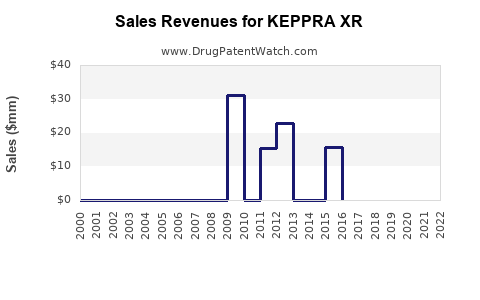
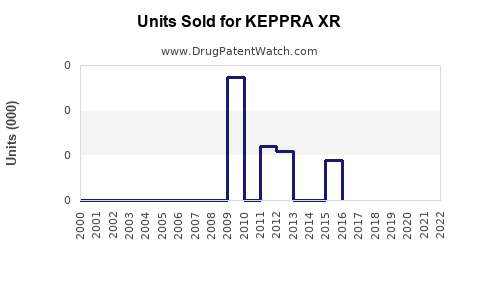
Annual Sales Revenues and Units Sold for KEPPRA XR
| Drug Name | Revenues (USD) | Units | Year |
|---|---|---|---|
| KEPPRA XR | ⤷ Start Trial | ⤷ Start Trial | 2022 |
| KEPPRA XR | ⤷ Start Trial | ⤷ Start Trial | 2021 |
| KEPPRA XR | ⤷ Start Trial | ⤷ Start Trial | 2020 |
| KEPPRA XR | ⤷ Start Trial | ⤷ Start Trial | 2019 |
| KEPPRA XR | ⤷ Start Trial | ⤷ Start Trial | 2018 |
| KEPPRA XR | ⤷ Start Trial | ⤷ Start Trial | 2017 |
| KEPPRA XR | ⤷ Start Trial | ⤷ Start Trial | 2016 |
| >Drug Name | >Revenues (USD) | >Units | >Year |
Keppra XR Market Analysis, Patent Expiration, Generic Competition and Sales Projections
Keppra XR, UCB’s once-daily extended-release levetiracetam product, is a mature central nervous system medicine with limited branded growth potential. The commercial market is driven by generic substitution, low pricing, and conversion from twice-daily immediate-release levetiracetam. U.S. branded sales are likely in the low tens of millions of dollars annually, while the broader extended-release levetiracetam market is larger but remains a niche segment of the epilepsy market.
A reasonable U.S. base-case projection is for total Keppra XR and generic levetiracetam extended-release sales to remain broadly stable or decline modestly through 2029, with the branded product losing share. The principal commercial risks are generic price erosion, formulary substitution, and limited clinical differentiation from immediate-release levetiracetam.
What is Keppra XR and how large is its addressable market?
Keppra XR is an extended-release formulation of levetiracetam, an antiseizure medication. The product is administered once daily and was approved by the U.S. Food and Drug Administration as adjunctive therapy for partial-onset seizures in patients 16 years and older.[1]
Levetiracetam is widely used because of its broad prescribing base, limited drug-drug interaction profile, oral and intravenous formulations, and availability at low generic prices. The market is split among:
- Immediate-release levetiracetam tablets and oral solution.
- Extended-release levetiracetam tablets.
- Intravenous levetiracetam.
- Branded products, including Keppra and Keppra XR.
- Generic levetiracetam products from multiple manufacturers.
Keppra XR addresses patients who benefit from once-daily dosing, including patients with adherence problems, complex medication schedules, or a clinical preference for extended-release therapy. Its addressable market is constrained because immediate-release levetiracetam is inexpensive and clinically established.
U.S. market structure
| Segment | Commercial position | Main competitive factor |
|---|---|---|
| Generic immediate-release levetiracetam | Largest volume segment | Lowest acquisition cost |
| Generic extended-release levetiracetam | Niche but established | Once-daily dosing |
| Keppra immediate-release | Mature branded product | Residual brand loyalty |
| Keppra XR | Small branded segment | Prescriber and patient preference |
| Intravenous levetiracetam | Hospital and acute-care use | Formulary access and supply |
The most important market metric is prescription volume rather than list-price revenue. Generic competition has reduced the economic value of each prescription, particularly for immediate-release products.
What are Keppra XR sales and revenue projections?
UCB does not generally disclose standalone global net sales for Keppra XR in its public financial reporting. Reported Keppra revenue is typically aggregated or presented within broader product disclosures, limiting direct verification of brand-specific XR sales.[2]
The following projection is an analyst scenario for the U.S. market. It is not reported company guidance.
U.S. Keppra XR market projection
| Year | Branded Keppra XR net sales | Total XR levetiracetam market | Generic share of XR volume |
|---|---|---|---|
| 2024 estimated | $20 million-$35 million | $70 million-$110 million | 70%-80% |
| 2025 projected | $17 million-$30 million | $68 million-$105 million | 75%-83% |
| 2026 projected | $14 million-$26 million | $66 million-$102 million | 80%-86% |
| 2027 projected | $11 million-$22 million | $64 million-$100 million | 83%-88% |
| 2028 projected | $9 million-$19 million | $62 million-$98 million | 85%-90% |
| 2029 projected | $7 million-$17 million | $60 million-$96 million | 87%-92% |
The base case assumes:
- No major new indication.
- Continued availability of generic extended-release levetiracetam.
- Stable or declining seizure-drug utilization in the mature U.S. market.
- Annual branded price increases that do not offset prescription-volume losses.
- Continued payer preference for generic levetiracetam.
Under this scenario, branded Keppra XR revenue declines at approximately 8%-15% annually. Total extended-release market revenue declines more slowly because lower generic prices increase utilization while compressing revenue per prescription.
Upside and downside scenarios
| Scenario | 2029 branded sales | Main assumptions |
|---|---|---|
| Upside | $20 million-$30 million | Improved adherence data, limited generic access, stronger conversion from immediate-release therapy |
| Base case | $7 million-$17 million | Continued generic erosion and stable clinical demand |
| Downside | Below $7 million | Broad payer exclusion, aggressive generic pricing, brand withdrawal or supply reduction |
The most likely outcome is continued brand contraction rather than a complete disappearance. Some neurologists and patients may retain Keppra XR because of established tolerability, once-daily administration, or reluctance to change a stable regimen.
When did Keppra XR lose exclusivity?
Keppra XR lost practical market exclusivity after generic extended-release levetiracetam entered the U.S. market. The precise commercial loss-of-exclusivity date depends on the approved ANDA, patent certifications, litigation outcomes, and any authorized generic arrangements.
The underlying levetiracetam molecule has been off patent for many years. Protection for Keppra XR depended primarily on formulation and extended-release technology rather than composition-of-matter rights.
| Regulatory element | Status |
|---|---|
| Active ingredient | Levetiracetam |
| U.S. approval | 2008 |
| New chemical entity protection | Expired |
| Immediate-release product exclusivity | Expired |
| Extended-release formulation protection | Mature and subject to generic challenge |
| Generic ER availability | Established in the U.S. |
| Current commercial protection | Brand recognition, prescriber loyalty, and formulation preference |
The FDA Orange Book should be used to confirm the current listed patents, expiration dates, and any exclusivity codes for the relevant Keppra XR NDA.[3] Patent expiration must be distinguished from commercial protection. A formulation patent may expire on a different date from regulatory exclusivity, and an ANDA applicant may enter after a Paragraph IV settlement or patent invalidation.
What patents protect Keppra XR?
Keppra XR’s protection was based on the extended-release formulation, dosing profile, and related pharmaceutical technology. The relevant patent estate is materially weaker than a composition-of-matter estate because generic manufacturers can challenge formulation claims, design around release characteristics, or rely on alternative excipient systems.
The key patent categories are:
Extended-release formulation patents
These claims generally cover levetiracetam tablets that release the active ingredient over a specified period. Claim scope may include:
- Matrix-forming excipients.
- Release-rate profiles.
- Tablet composition.
- Once-daily dosing.
- Pharmacokinetic parameters.
- Manufacturing steps used to produce the dosage form.
Method-of-use patents
Keppra XR labeling covers adjunctive treatment of partial-onset seizures. Method-of-use protection is narrower than composition protection and is vulnerable to label-skinny strategies when generic products avoid protected indications.
Manufacturing and process protection
Process patents may cover granulation, compression, coating, dissolution performance, or excipient combinations. These patents can create technical barriers, but they generally have less commercial impact after multiple generic manufacturers develop noninfringing processes.
A definitive patent-by-patent claim chart requires review of the current Orange Book, FDA patent listings, USPTO records, and relevant district-court or Federal Circuit decisions. Public commercial data do not support treating the Keppra XR patent estate as a significant remaining barrier to U.S. generic entry.
What is the Orange Book status of Keppra XR?
Keppra XR is associated with an FDA-approved NDA and Orange Book-listed product information. The Orange Book identifies patents submitted by the NDA holder and provides the regulatory framework for generic applicants to submit Paragraph IV certifications.[3]
The commercial significance of the listing is limited because generic extended-release levetiracetam products are already available. Current issues include:
- Whether any listed patent remains unexpired.
- Whether a listed patent is eligible for pediatric or other statutory extension.
- Whether generic applicants challenged listed patents under Paragraph IV.
- Whether settlements permitted earlier entry.
- Whether any patents were delisted, disclaimed, or found unenforceable.
For investment and litigation analysis, the current FDA Orange Book record is more reliable than older patent summaries because listed patents and marketing status can change.
Which companies are challenging Keppra XR?
Generic levetiracetam manufacturers have challenged the product through abbreviated new drug applications. The competitive field has included major U.S. and international generic companies active in central nervous system medicines, such as Teva, Amneal, Lupin, Zydus, and other ANDA sponsors.
Generic competition is not limited to one challenger. Once several extended-release products are approved, pricing generally moves toward commodity economics. The most relevant competitive advantages are:
- FDA approval and therapeutic equivalence.
- Reliable active pharmaceutical ingredient supply.
- Pharmacy benefit manager access.
- Manufacturing scale.
- Ability to maintain inventory during shortages.
- Contracting with wholesalers and retail pharmacies.
The presence of several generic suppliers materially reduces the probability that Keppra XR can preserve premium pricing.
What generic entry risks exist for Keppra XR?
Generic entry risk is high and largely realized. The key risks are commercial rather than legal.
Price erosion
Generic extended-release levetiracetam can be priced substantially below the branded product. Discounts increase as additional suppliers enter and pharmacy benefit managers consolidate purchasing.
Formulary exclusion
Payers can require generic substitution, apply higher copay tiers to the branded product, or exclude Keppra XR except when a prescriber documents medical necessity.
Therapeutic substitution
Although extended-release and immediate-release products are not identical dosage forms, payers and clinicians may move patients to immediate-release levetiracetam where cost is the dominant consideration.
Reference pricing
Large pharmacy networks can use generic levetiracetam prices as a benchmark in negotiations. This limits UCB’s ability to raise the branded price without accelerating volume loss.
Supply competition
Generic manufacturers with multiple levetiracetam presentations can bundle or cross-subsidize products across immediate-release, extended-release, and intravenous formulations.
How does Keppra XR compare with competing epilepsy drugs?
Keppra XR competes with branded and generic antiseizure therapies, not only with generic levetiracetam.
| Product | Active ingredient | Dosing advantage | Generic pressure | Market position |
|---|---|---|---|---|
| Keppra XR | Levetiracetam ER | Once daily | High | Mature niche brand |
| Generic levetiracetam ER | Levetiracetam ER | Once daily | Direct substitute | Primary price competitor |
| Keppra | Levetiracetam IR | Usually twice daily | Very high | Legacy brand |
| Vimpat | Lacosamide | Twice daily or IV | High after loss of exclusivity | Alternative mechanism |
| Briviact | Brivaracetam | Twice daily | Lower than levetiracetam | Branded alternative |
| Lamictal | Lamotrigine | Variable | High | Broad clinical use |
| Topamax | Topiramate | Variable | High | Broad generic competition |
Keppra XR’s strongest differentiation is convenience. It does not have a clear efficacy advantage over immediate-release levetiracetam established in the product label. Briviact may compete for patients requiring an alternative levetiracetam-related therapy, while lacosamide and lamotrigine compete based on mechanism, efficacy, tolerability, and physician preference.[1,4]
What FDA regulatory status does Keppra XR have?
Keppra XR is FDA-approved for adjunctive treatment of partial-onset seizures in patients 16 years and older. The product is not a biologic, so biosimilar regulation does not apply. Generic competition proceeds through the ANDA pathway, with applicants required to demonstrate pharmaceutical equivalence, bioequivalence, and compliance with applicable quality standards.[1,5]
The regulatory factors affecting future sales are:
- Continued approval of the NDA.
- Maintenance of manufacturing and supply compliance.
- Generic approvals and therapeutic-equivalence designations.
- Labeling changes affecting age groups or indications.
- Product recalls or supply interruptions.
- FDA action on extended-release bioequivalence standards.
A new indication would be difficult to justify commercially unless supported by meaningful clinical differentiation, because levetiracetam is already widely used at low generic cost.
What licensing deals affect Keppra XR?
Keppra XR is associated with UCB’s levetiracetam franchise. No major recent licensing transaction is required to explain the current U.S. market position. The product’s commercial value is primarily tied to UCB’s retained brand rights, manufacturing arrangements, and distribution network.
Any assessment of regional licensing must distinguish:
- U.S. NDA ownership.
- Local marketing authorization holders.
- Distribution agreements.
- Authorized generic arrangements.
- Patent settlements.
- Rights to levetiracetam formulations outside the United States.
Keppra XR licensing is unlikely to create a major new revenue catalyst unless a partner can expand access in markets where once-daily formulations remain underpenetrated.
What patent litigation and settlement issues affect Keppra XR?
The most material litigation risk arose from ANDA Paragraph IV challenges to formulation patents. Once generic products enter the market, remaining litigation tends to affect damages, launch timing, patent validity, or settlement economics rather than determine whether the market will eventually become generic.
Relevant issues include:
- Invalidity challenges against formulation claims.
- Noninfringement arguments based on different release mechanisms.
- Patent-term calculations.
- 30-month stays triggered by Paragraph IV litigation.
- Authorized generic provisions in settlement agreements.
- At-risk generic launches.
- Antitrust scrutiny of delayed-entry settlements.
The current market evidence indicates that patent litigation has not preserved a durable branded monopoly for Keppra XR.
How strong is the Keppra XR patent estate?
The estate is commercially weak to moderate.
| Patent-estate factor | Assessment |
|---|---|
| Composition-of-matter protection | Weak or expired |
| Formulation protection | Limited and mature |
| Method-of-use protection | Narrow |
| Manufacturing barriers | Moderate for initial development, low after scale-up |
| Design-around risk | High |
| Generic entry exposure | High |
| Remaining pricing power | Low |
The strongest residual protection is likely technical know-how involving dissolution performance, manufacturing consistency, and product quality. Those barriers may delay an individual applicant but are unlikely to prevent broad generic competition.
What are the global market and geographic opportunities?
The United States is the most commercially important market for assessing Keppra XR patent risk and generic substitution. Europe and other developed markets also have mature levetiracetam competition, often with stronger generic penetration and national price controls.
Growth opportunities are more likely in:
- Emerging markets with increasing epilepsy diagnosis.
- Countries where once-daily formulations are not widely available.
- Private-pay markets with weak generic substitution.
- Hospitals and clinics seeking simplified discharge regimens.
These opportunities are constrained by local reimbursement, regulatory registration, compulsory price reductions, and competition from low-cost immediate-release levetiracetam.
Key Takeaways
- Keppra XR is a mature branded extended-release levetiracetam product with limited remaining exclusivity value.
- Generic extended-release levetiracetam competition is established, making high U.S. brand growth unlikely.
- Estimated U.S. branded sales are in the low tens of millions of dollars annually; UCB does not publicly isolate Keppra XR revenue.
- Base-case branded sales are projected to decline to approximately $7 million-$17 million by 2029.
- The broader U.S. extended-release levetiracetam market is projected to remain near $60 million-$100 million annually through 2029.
- The patent estate is formulation-based, mature, and vulnerable to design-around and Paragraph IV challenges.
- Biosimilar risk does not apply because Keppra XR is a small-molecule drug.
- The principal commercial risks are generic pricing, formulary exclusion, and substitution with immediate-release levetiracetam.
- Keppra XR’s remaining value is concentrated in adherence, once-daily dosing, brand familiarity, and stable-patient retention.
FAQs
Is Keppra XR still protected by patents?
Keppra XR’s meaningful protection was based on extended-release formulation and related patents rather than an active ingredient patent. Generic competition is already established, so remaining patents do not provide durable market exclusivity.
Is there a generic version of Keppra XR?
Yes. Generic extended-release levetiracetam products are available in the U.S. Availability and manufacturer participation can vary by strength, pharmacy channel, and supply conditions.
Can patients switch from Keppra XR to generic levetiracetam?
Patients may be switched to generic extended-release levetiracetam when the product is therapeutically equivalent and clinically appropriate. Conversion to immediate-release levetiracetam involves a different dosing schedule and should be managed by the treating clinician.
Does Keppra XR have biosimilar competition?
No. Keppra XR contains the small-molecule active ingredient levetiracetam. Competition is regulated through the generic drug pathway, not the biosimilar pathway.
What is the main investment risk for Keppra XR?
The main risk is continued revenue erosion from generic substitution. The product has limited clinical differentiation, mature patent protection, and low potential for major price or volume expansion.
References
- U.S. Food and Drug Administration. (2008). Keppra XR prescribing information. FDA.
- UCB. (2024). Annual report 2023. UCB S.A.
- U.S. Food and Drug Administration. (2024). Approved drug products with therapeutic equivalence evaluations: Orange Book. FDA.
- U.S. Food and Drug Administration. (2024). Keppra and Keppra XR product information. FDA.
- U.S. Food and Drug Administration. (2024). Abbreviated new drug application guidance and generic drug approvals. FDA.
More… ↓
