Share This Page
Drug Sales Trends for IRBESARTAN
✉ Email this page to a colleague
Payment Methods and Pharmacy Types for IRBESARTAN (2022)
Revenues by Pharmacy Type
Units Sold by Pharmacy Type
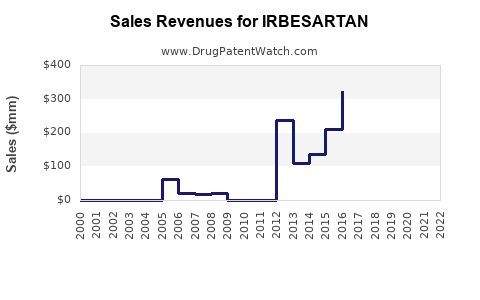
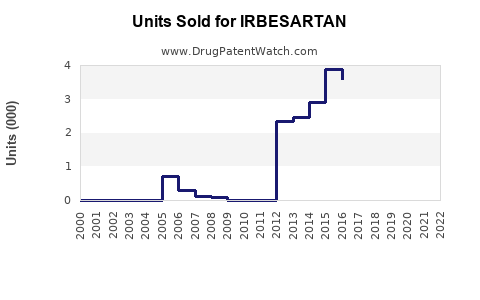
Annual Sales Revenues and Units Sold for IRBESARTAN
| Drug Name | Revenues (USD) | Units | Year |
|---|---|---|---|
| IRBESARTAN | ⤷ Start Trial | ⤷ Start Trial | 2022 |
| IRBESARTAN | ⤷ Start Trial | ⤷ Start Trial | 2021 |
| IRBESARTAN | ⤷ Start Trial | ⤷ Start Trial | 2020 |
| IRBESARTAN | ⤷ Start Trial | ⤷ Start Trial | 2019 |
| IRBESARTAN | ⤷ Start Trial | ⤷ Start Trial | 2018 |
| >Drug Name | >Revenues (USD) | >Units | >Year |
Irbesartan Market Analysis, Sales Projections, Patent Status, and Competitive Outlook
Irbesartan is a mature, low-cost angiotensin II receptor blocker (ARB) with broad generic availability and limited branded revenue. The market is driven by hypertension, diabetic nephropathy, combination products with hydrochlorothiazide, and procurement economics rather than product differentiation. Global irbesartan sales are unlikely to grow materially in value through 2030, although prescription volume should remain stable or increase modestly in emerging markets.
A reasonable planning range for the global irbesartan market is approximately $250 million to $450 million in annual manufacturer revenue in the mid-2020s, excluding distributor markups and retail margins. A base-case model indicates low-single-digit annual volume growth but flat to declining revenue because of generic price erosion.
What is irbesartan used for, and how large is its addressable market?
Irbesartan is an oral ARB marketed principally for:
- Hypertension
- Hypertension associated with type 2 diabetes and diabetic nephropathy
- Fixed-dose treatment with hydrochlorothiazide
- Combination antihypertensive regimens when monotherapy is inadequate
The original branded products were Avapro in the United States and Aprovel in several international markets. Avalide and CoAprovel combined irbesartan with hydrochlorothiazide.
The United States, Western Europe, Japan, China, India, Brazil, and other middle-income markets represent the principal commercial regions. The United States has high prescription volume but low pricing because irbesartan is generic. Emerging markets have stronger population growth and expanding hypertension treatment, but lower average selling prices.
The commercial market has four demand pools:
| Market segment | Commercial profile | Growth outlook |
|---|---|---|
| Irbesartan tablets | Generic hypertension treatment | Stable to low growth |
| Irbesartan/hydrochlorothiazide | Combination therapy | Stable |
| Hospital and institutional supply | Tender-driven, price-sensitive | Flat to modest growth |
| Retail branded generics | Higher prices in selected markets | Low to moderate growth |
Hypertension remains a large and underdiagnosed global condition. The World Health Organization estimates that 1.28 billion adults aged 30 to 79 have hypertension globally, with a substantial portion untreated or undertreated (World Health Organization, 2023). Irbesartan competes for only a fraction of this population because losartan, valsartan, candesartan, telmisartan, and ACE inhibitors are also widely used.
What are the current irbesartan market trends?
The main market trend is substitution from branded products to generic irbesartan. Price competition is strongest in the United States and European tender markets. Commercial performance depends on manufacturing cost, supply reliability, regulatory approvals, and distribution access.
Prescription demand is stable
Irbesartan has several clinical attributes that support continued use:
- Once-daily dosing
- Established efficacy in hypertension
- Use in diabetic nephropathy
- No cough-related intolerance associated with ACE inhibitors
- Availability in multiple tablet strengths
- Combination products with hydrochlorothiazide
The product has limited ability to command a premium because most clinical differentiation has been incorporated into guideline-based treatment algorithms. Physicians generally select among ARBs based on formulary status, price, prior patient response, and combination availability.
Combination products support volume retention
Irbesartan/hydrochlorothiazide products remain commercially relevant because fixed-dose combinations can improve adherence and simplify prescribing. Combination products face the same generic pricing pressure as single-ingredient tablets, but they can produce better retention within specific pharmacy and tender channels.
Supply-chain control is commercially important
Irbesartan is a chemically synthesized small molecule. Manufacturing barriers are lower than for biologics, but regulatory scrutiny of active pharmaceutical ingredient suppliers, nitrosamine contamination, and manufacturing changes can affect availability.
In 2018 and later years, regulators investigated nitrosamine impurities across several ARB products, including valsartan, losartan, and irbesartan supply chains. These events increased the value of qualified suppliers, validated analytical methods, and redundant manufacturing capacity (U.S. Food and Drug Administration, 2024a).
What are the irbesartan sales projections through 2030?
The following projection is a modeled estimate for global manufacturer revenue, not a reported company sales figure. It assumes a mature generic market, low-single-digit prescription growth, and continuing price erosion.
Base-case global sales projection
| Year | Estimated global revenue | Annual change | Primary driver |
|---|---|---|---|
| 2024 | $335 million | Baseline | Mature generic market |
| 2025 | $332 million | -0.9% | Price erosion offsets volume |
| 2026 | $330 million | -0.6% | Stable demand |
| 2027 | $329 million | -0.3% | Emerging-market volume growth |
| 2028 | $331 million | 0.6% | Combination-product and access growth |
| 2029 | $334 million | 0.9% | Higher treatment rates |
| 2030 | $338 million | 1.2% | Volume growth exceeds price decline |
The base case implies a 2024-2030 revenue CAGR of approximately 0.1%. This reflects a mature generic product in which prescription growth does not automatically translate into revenue growth.
Scenario analysis
| Scenario | 2030 revenue | 2024-2030 CAGR | Assumptions |
|---|---|---|---|
| Downside | $245 million | -4.9% | Accelerated price erosion, supplier consolidation, substitution by other ARBs |
| Base case | $338 million | 0.1% | Stable volume, modest emerging-market growth |
| Upside | $470 million | 5.8% | Strong expansion in untreated hypertension, improved tender access, supply disruptions affecting competitors |
The upside case is more plausible for individual manufacturers than for the total market. A company can gain share through a shortage, a low-cost API position, or a major contract even while total irbesartan market revenue remains flat.
How much did Avapro and Aprovel sales contribute historically?
Irbesartan was commercially important before generic erosion. Sanofi and Bristol-Myers Squibb developed and commercialized Avapro/Aprovel, with Sanofi reporting the product in its cardiovascular portfolio. Branded sales declined after loss of market exclusivity and generic entry.
Public company reporting does not consistently disclose current global irbesartan revenue as a separate line item. Historical sales were often reported within broader cardiovascular categories or grouped with Avalide and regional products. As a result, standalone global brand sales should not be treated as directly comparable with current generic market estimates.
The commercial inflection point was generic entry after expiration of the principal U.S. composition-of-matter patent and associated regulatory exclusivity. Once multiple suppliers entered, average selling prices declined sharply.
When did irbesartan lose exclusivity?
Irbesartan lost meaningful U.S. market exclusivity in the early 2010s. The original U.S. product, Avapro, received FDA approval in 1997. The principal composition-of-matter patent, U.S. Patent No. 5,270,317, was associated with irbesartan and had an expiration date in the early 2010s after patent-term adjustment and pediatric considerations were applied.
The practical commercial result was generic competition for irbesartan tablets and irbesartan/hydrochlorothiazide products. Exact launch timing differed by applicant, dosage form, settlement terms, and regulatory approval date.
| Exclusivity element | Commercial impact |
|---|---|
| Original composition patent | Protected the active ingredient during the branded period |
| Pediatric exclusivity | Extended certain regulatory protections by six months where applicable |
| Orange Book-listed patents | Created potential barriers for abbreviated new drug applications |
| Formulation and combination patents | Could delay specific products but did not preserve broad brand control |
| Generic approvals | Initiated rapid price competition |
The original brand estate is no longer a meaningful barrier to ordinary generic irbesartan tablets.
What is the Orange Book status of irbesartan?
The FDA Orange Book identifies approved drug products, therapeutic equivalence ratings, and patent or exclusivity information for eligible products. Avapro and Avalide are legacy products, while multiple generic irbesartan and irbesartan/hydrochlorothiazide products have received FDA approval.
For commercial diligence, the relevant conclusion is that irbesartan is an established generic market rather than an active branded-exclusivity market. Orange Book review remains important for confirming:
- Approved strengths
- Dosage forms
- Therapeutic equivalence ratings
- Remaining listed patents, if any
- Reference listed drug status
- Combination-product approvals
FDA-approved generic products are generally rated therapeutically equivalent when they meet applicable requirements, allowing substitution under state pharmacy law and payer policy (U.S. Food and Drug Administration, 2024b).
Which companies compete in the irbesartan market?
Competition is fragmented and includes multinational generic companies, regional pharmaceutical manufacturers, and contract manufacturing organizations.
Major competitive groups
- Viatris and legacy Mylan operations
- Teva Pharmaceutical Industries
- Sandoz
- Dr. Reddy’s Laboratories
- Zydus Lifesciences
- Torrent Pharmaceuticals
- Cipla
- Sun Pharmaceutical Industries
- Lupin
- Hikma Pharmaceuticals
- Regional European and Asian generic suppliers
Market share varies significantly by country. In the United States, pharmacy benefit contracting and wholesaler access are critical. In Europe, national reimbursement systems and tender awards often determine volume. In India and other branded-generic markets, physician promotion, retail availability, and local brand recognition are more influential.
A manufacturer with a low-cost supply base can compete effectively, but the market has limited room for premium pricing unless the product has superior supply reliability, a differentiated combination, or strong local distribution.
What formulations are protected by irbesartan patents?
The commercially relevant formulations include:
- Irbesartan immediate-release tablets
- Irbesartan/hydrochlorothiazide tablets
- Multiple tablet strengths, commonly including 75 mg, 150 mg, and 300 mg irbesartan
- Regional branded-generic presentations
The original patent estate centered on the active compound and related pharmaceutical compositions. Later patents and regulatory filings could cover combinations, manufacturing processes, crystalline forms, or specific formulations. These rights generally have narrower commercial scope than the original compound patent.
Formulation patents have limited strategic value in the current market unless they protect a product with:
- A meaningful bioavailability advantage
- A distinct fixed-dose combination
- A new delivery profile
- A difficult-to-design-around manufacturing process
- Regulatory exclusivity linked to a clinically differentiated product
For standard immediate-release tablets, manufacturing and regulatory execution are more important than patent exclusivity.
Are there Paragraph IV challenges to irbesartan?
Paragraph IV litigation was relevant during the original generic-entry period, when applicants challenged listed patents covering Avapro or Avalide. Paragraph IV certification allows an ANDA applicant to assert that a listed patent is invalid, unenforceable, or not infringed.
The principal commercial significance of those challenges has passed because broad generic competition is established. Any current Paragraph IV activity would likely concern a specific formulation, combination product, or newly listed patent rather than ordinary irbesartan tablets.
A diligence review should distinguish between:
- Historical Paragraph IV litigation linked to first generic entry.
- Current litigation involving a specific manufacturer.
- Patent disputes involving related products rather than irbesartan itself.
- State-law, antitrust, supply, or commercial disputes that do not affect FDA approval.
What patent litigation affects irbesartan?
Irbesartan has had the type of patent disputes common to high-value branded medicines approaching generic entry. The principal risks involved:
- Validity challenges to the compound patent
- Infringement claims against ANDA applicants
- Settlement agreements affecting generic launch timing
- Patent-term calculations
- Regulatory exclusivity and pediatric extensions
The litigation risk for a new manufacturer today is materially different. A company seeking approval for ordinary irbesartan tablets faces low risk from the expired core compound patent but must manage:
- FDA application requirements
- Bioequivalence
- Current manufacturing standards
- API qualification
- Nitrosamine controls
- Labeling and safety compliance
- Contracting and channel access
No biosimilar risk exists because irbesartan is a small-molecule chemical drug, not a biologic. The relevant competitive threat is generic substitution.
What generic launch scenarios exist for irbesartan?
Scenario 1: Standard low-cost generic launch
A manufacturer enters with approved tablets and competes through price, wholesaler access, and supply reliability. This is the most common strategy and produces low margins once several suppliers are active.
Scenario 2: Combination-product expansion
A company builds share through irbesartan/hydrochlorothiazide strengths or adjacent cardiovascular products. This approach can improve account economics but does not eliminate price competition.
Scenario 3: Emerging-market branded generic
A manufacturer markets irbesartan under a regional brand, using physician promotion and local distribution. This can support higher prices than U.S. commodity generic sales but requires commercial infrastructure.
Scenario 4: Contract and tender strategy
A supplier wins institutional or government tenders through low manufacturing cost and reliable delivery. Revenue can scale quickly, but margins are vulnerable to rebidding and raw-material volatility.
How does irbesartan compare with other ARBs?
| Drug | Market position | Differentiation | Generic pressure |
|---|---|---|---|
| Irbesartan | Established ARB, diabetic nephropathy use | Clinical familiarity and combination products | Very high |
| Losartan | Broadest low-cost ARB competitor | Strong availability and extensive use | Very high |
| Valsartan | Broad cardiovascular use | Large combination portfolio | Very high |
| Candesartan | Often positioned on efficacy and tolerability | Physician preference in some markets | High |
| Telmisartan | Long half-life and broad combination use | Commercial strength in selected markets | High |
| Olmesartan | Strong branded-generic presence in some countries | Local market positioning | High |
Irbesartan’s strongest commercial advantage is established use in diabetic nephropathy and broad availability. Its main weakness is the absence of meaningful patent protection or premium differentiation.
What is the revenue exposure for manufacturers?
For a diversified generic company, irbesartan revenue is usually immaterial as a standalone growth driver. It can still contribute to portfolio economics through manufacturing utilization, basket pricing, and cross-selling.
Revenue exposure is highest for:
- Manufacturers concentrated in cardiovascular generics
- Companies with strong hospital or tender businesses
- Suppliers with proprietary API capacity
- Regional branded-generic companies
- Firms holding strong pharmacy or wholesaler contracts
Revenue exposure is lower for companies that depend on branded specialty products, biologics, or complex generics.
A practical investment view is that irbesartan is a cash-flow maintenance product, not a high-growth asset. Upside depends on market share capture, manufacturing efficiency, and geographic expansion rather than patent value.
How strong is the irbesartan patent estate?
The current patent estate is weak from a broad market-exclusivity perspective. The core composition protection expired, and generic substitution is established. Remaining patents, where present, are more likely to relate to specific formulations, combinations, processes, or regional rights.
| Patent factor | Current assessment |
|---|---|
| Core compound protection | Expired |
| Broad branded exclusivity | Expired |
| Formulation protection | Narrow and product-specific |
| Method-of-use protection | Limited commercial effect for standard labeling |
| Manufacturing barriers | Moderate, driven by quality and supply controls |
| Biosimilar barriers | Not applicable |
| Generic entry risk | High |
Geographic coverage also varies. Patent expiration, regulatory approval, and market launch dates differ by country. A global commercial assessment should therefore use country-level patent registers, regulatory databases, and reimbursement rules rather than rely on the U.S. position alone.
Key Takeaways
- Irbesartan is a mature generic ARB with stable prescription demand and limited pricing power.
- Global manufacturer revenue is best modeled in the $250 million to $450 million range in the mid-2020s.
- Base-case revenue is approximately flat through 2030 because modest volume growth is offset by generic price erosion.
- The original Avapro/Aprovel compound exclusivity has expired.
- Current competition is driven by cost, supply reliability, tenders, and local distribution.
- Irbesartan/hydrochlorothiazide remains commercially relevant but has limited premium potential.
- Paragraph IV and patent litigation were most important during the original generic-entry period.
- Biosimilar risk does not apply. Generic substitution is the principal competitive risk.
- The product has value as a portfolio and manufacturing asset, not as a standalone patent-protected growth franchise.
FAQs
Is irbesartan still profitable for generic drug companies?
Yes, but profitability depends on manufacturing cost, contract access, and market share. Standard U.S. tablet sales generally have lower margins than branded-generic sales in emerging markets.
Does irbesartan have market exclusivity in the United States?
No broad branded market exclusivity remains for ordinary irbesartan tablets. Generic products are widely approved and therapeutically equivalent products can be substituted under applicable law.
What is the commercial value of irbesartan/hydrochlorothiazide?
The combination has moderate commercial value because it supports adherence and prescription retention. Its value is constrained by multiple generic competitors and limited formulation differentiation.
Can a new company obtain premium pricing for irbesartan?
Premium pricing is difficult for standard tablets. A company may obtain better pricing through dependable supply, differentiated combinations, regional branding, or regulated-market tenders where competitors have supply constraints.
Is irbesartan a growth opportunity through 2030?
It is primarily a defensive or portfolio-stability opportunity. Growth is more likely to come from geographic expansion, combination products, or share gains than from expansion of the total mature-market revenue pool.
References
-
Sanofi. (Various years). Universal registration document and annual reports. Sanofi.
-
U.S. Food and Drug Administration. (2024a). FDA updates and actions relating to ARB and nitrosamine impurities. https://www.fda.gov
-
U.S. Food and Drug Administration. (2024b). Orange Book: Approved drug products with therapeutic equivalence evaluations. https://www.accessdata.fda.gov/scripts/cder/ob/
-
U.S. Food and Drug Administration. (1997). Avapro prescribing information and approval history. https://www.accessdata.fda.gov
-
World Health Organization. (2023). Global report on hypertension: The race against a silent killer. World Health Organization.
-
U.S. Patent and Trademark Office. (n.d.). Patent term adjustment and patent information for U.S. Patent No. 5,270,317. https://www.uspto.gov
More… ↓
