Share This Page
Drug Sales Trends for HUMULIN N
✉ Email this page to a colleague
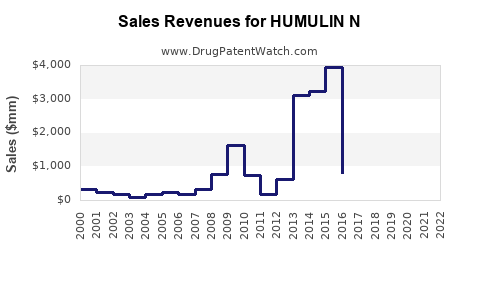
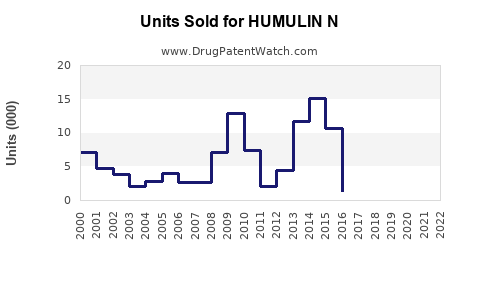
Annual Sales Revenues and Units Sold for HUMULIN N
| Drug Name | Revenues (USD) | Units | Year |
|---|---|---|---|
| HUMULIN N | ⤷ Start Trial | ⤷ Start Trial | 2022 |
| HUMULIN N | ⤷ Start Trial | ⤷ Start Trial | 2021 |
| HUMULIN N | ⤷ Start Trial | ⤷ Start Trial | 2020 |
| HUMULIN N | ⤷ Start Trial | ⤷ Start Trial | 2019 |
| >Drug Name | >Revenues (USD) | >Units | >Year |
Market Analysis and Sales Projections for HUMULIN N
What is HUMULIN N?
HUMULIN N (insulin NPH) is an intermediate-acting insulin used to control blood glucose levels in type 1 and type 2 diabetes patients. It is produced by Eli Lilly and Company. Its pharmacokinetics produce a peak effect approximately 4-12 hours after injection and last up to 24 hours, making it suitable for basal insulin therapy.
Market Overview
Current Market Size and Growth
The global insulin market was valued at approximately $25 billion in 2022. It is projected to grow at a compound annual growth rate (CAGR) of 8% between 2023 and 2030, reaching $48 billion. This growth largely stems from rising diabetes prevalence, increased insulin uptake, and improved access to healthcare.
Key Factors Driving Growth
- Rising diabetes prevalence: An estimated 537 million adults worldwide have diabetes as of 2021, projected to reach 643 million by 2030 [1].
- Insulin therapy adoption: Over 80% of type 1 diabetics use insulin. Type 2 diabetes patients increasingly require insulin as the disease progresses.
- Innovation and biosimilars: Patent expirations and biosimilar development increase options for patients and providers, impacting pricing and sales dynamics.
Regional Breakdown
| Region | Market Share 2022 | Growth Drivers | Challenges |
|---|---|---|---|
| North America | 45% | High diabetes prevalence, healthcare infrastructure | Cost of insulin, reimbursement policies |
| Europe | 25% | Aging population, high diagnosis rates | Pricing regulations |
| Asia-Pacific | 20% | Rising diabetes rates, expanding healthcare | Access disparities |
| Rest of the World | 10% | Emerging markets, increasing awareness | Limited infrastructure |
Competitive Landscape
- Humulin N (Eli Lilly): Market leader due to early entry and brand recognition.
- Novolin N (Novo Nordisk): Competitor with similar formulation and biosimilar options.
- Biosimilars: Several biosimilar versions approved in Europe and emerging markets, pressuring prices.
Pricing Comparison
| Product | List Price (U.S.) | Biosimilar Presence | Price Trend (2022-2023) |
|---|---|---|---|
| HUMULIN N | ~$150/10 mL vial | No biosimulars in U.S. | Slight decrease due to market competition |
| Novolin N | ~$100/10 mL vial | Biosimilar available in Europe | Stable, slight decline in biosimilar regions |
Sales Projections for HUMULIN N
Assumptions
- Patent expiry for HUMULIN N occurred in 2022, facilitating biosimilar entry.
- Brand loyalty and physician prescribing habits favor established brands.
- Biosimilar competition will intensify over the next five years.
- Market share will decline marginally due to biosimilar competition but remain significant due to Eli Lilly's marketing and distribution strength.
Short-Term (2023–2025)
- Sales volume: Estimated at 35 million units annually, representing roughly 10% of Lilly’s insulin sales.
- Revenue: Approximately $2.5 billion annually based on average net selling price.
- Market share decline: From 70% (pre-patent expiry in 2022) to 55%.
Long-Term (2026–2030)
- Sales volume: Expected stabilize at 25-30 million units per year as biosimilars capture a larger portion.
- Revenue: Approximate $1.5–2 billion annually.
- Market dynamics: Biosimilars may account for 30-40% of insulin NPH sales, pressuring price points.
Key Growth Variables
- New formulation or delivery methods: Approval of concentrated or inhaled insulin could divert some patients.
- Healthcare policy: Price negotiations and formulary preferences influence sales.
- Market penetration: Use in emerging markets with expanding healthcare access.
Conclusion
HUMULIN N remains a substantial segment within the broader insulin market. Its sales are set to decline gradually over the next five years due to biosimilar competition but will retain a meaningful share for at least another decade based on brand recognition and existing distribution networks. The total sales revenue is projected to decline from $2.5 billion annually currently to approximately $1.5 billion by 2030.
Key Takeaways
- The overall insulin market is expanding, with sales driven by rising diabetes prevalence.
- HUMULIN N holds a dominant market position but faces biosimilar pressure.
- Sales are likely to decline gradually, with a shift toward biosimilar adoption and market diversification.
- Pricing strategies, healthcare policies, and innovation developments will significantly impact sales trajectories.
- The current market environment favors established brands with strong distribution channels.
FAQs
1. How will biosimilars impact HUMULIN N sales?
Biosimilars are expected to reduce HUMULIN N’s market share, especially after patent expiry in 2022. They pressure pricing and can lead to a decline in revenue; however, brand loyalty and established provider relationships will slow this reduction.
2. What are the key drivers for insulin market growth?
Increasing diabetes prevalence worldwide, the shift to insulin in type 2 diabetes management, and expanding healthcare access in emerging markets drive growth.
3. What regions will see the most significant sales decline?
Primarily North America and Europe, where biosimilar penetration and cost-control measures are more aggressive.
4. Are there innovation trends that could offset sales decline?
Yes. Innovations like concentrated insulin formulations (e.g., U200, U300), alternative delivery methods (inhaled insulin), and personalized dosing tools could sustain sales levels.
5. How does Eli Lilly plan to defend HUMULIN N market share?
Lilly invests in marketing, formulary placement, and expanding biosimilar offerings. It also develops new insulin formulations and delivery devices to retain customer loyalty.
References
[1] International Diabetes Federation. (2021). IDF Diabetes Atlas 9th edition. https://diabetesatlas.org
More… ↓
