Share This Page
Drug Sales Trends for HALOPERIDOL LACTATE
✉ Email this page to a colleague
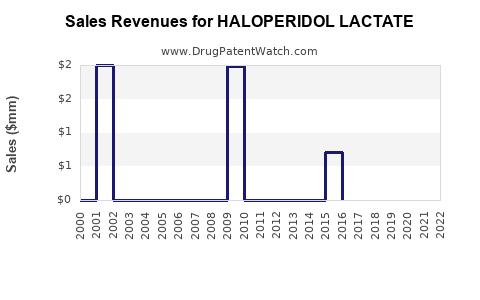
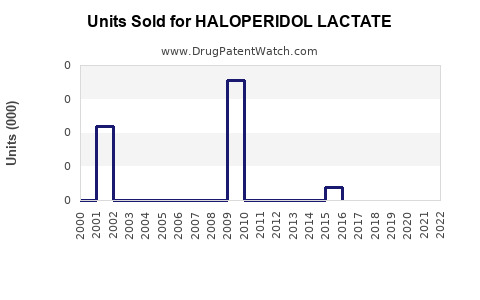
Annual Sales Revenues and Units Sold for HALOPERIDOL LACTATE
| Drug Name | Revenues (USD) | Units | Year |
|---|---|---|---|
| HALOPERIDOL LACTATE | ⤷ Start Trial | ⤷ Start Trial | 2022 |
| HALOPERIDOL LACTATE | ⤷ Start Trial | ⤷ Start Trial | 2021 |
| HALOPERIDOL LACTATE | ⤷ Start Trial | ⤷ Start Trial | 2020 |
| HALOPERIDOL LACTATE | ⤷ Start Trial | ⤷ Start Trial | 2019 |
| HALOPERIDOL LACTATE | ⤷ Start Trial | ⤷ Start Trial | 2018 |
| HALOPERIDOL LACTATE | ⤷ Start Trial | ⤷ Start Trial | 2017 |
| >Drug Name | >Revenues (USD) | >Units | >Year |
Haloperidol Lactate Market Analysis and Sales Projections, 2025-2029
Haloperidol lactate is a mature, generic injectable antipsychotic with low patent risk, broad hospital use, and limited pricing power. Revenue is concentrated in emergency departments, inpatient psychiatry, correctional health, long-term care, and perioperative settings. Public sources do not disclose product-level sales for haloperidol lactate, so the most defensible projection is an indexed market model rather than a fabricated dollar estimate.
The base case is a flat-to-low-growth market through 2029. Volume should remain relatively stable, while revenue depends on hospital purchasing contracts, shortages, supplier concentration, and generic price movements.
What is haloperidol lactate and how is it used?
Haloperidol lactate is the water-soluble injectable salt of haloperidol. In the United States, it is marketed primarily as an intramuscular injection and is used for acute psychotic states, severe agitation, and selected behavioral emergencies. It is distinct from haloperidol decanoate, a long-acting intramuscular formulation used for maintenance treatment of schizophrenia.
| Attribute | Haloperidol lactate |
|---|---|
| Active ingredient | Haloperidol |
| Salt | Lactate |
| Primary dosage form | Injectable solution |
| Common strengths | 1 mg/mL and 5 mg/mL |
| Main routes | Intramuscular; intravenous use may be restricted by institutional policy |
| Therapeutic class | Typical antipsychotic |
| Principal settings | Emergency departments, inpatient hospitals, psychiatric facilities, long-term care |
| Regulatory status | FDA-approved generic injectable products |
| Reference product | Haldol injection |
| Biosimilar relevance | None |
The product has a rapid onset relative to oral treatment and remains useful when a patient cannot safely take an oral medicine. Its main clinical limitations are extrapyramidal symptoms, dystonia, akathisia, sedation, QT prolongation, and neuroleptic malignant syndrome. The FDA labeling emphasizes dose-related adverse reactions and cardiovascular monitoring considerations.[1]
How large is the haloperidol lactate market?
The market is best characterized as a small, mature hospital injectable segment rather than a large retail pharmaceutical market. Retail pharmacy demand is limited because haloperidol lactate is mainly purchased through institutional channels.
Market size is influenced by:
- Emergency department administration volume.
- Inpatient psychiatric admissions.
- Hospital formulary decisions.
- Generic injectable availability.
- Contract pricing with group purchasing organizations.
- Periodic manufacturing shortages.
- Substitution by olanzapine, ziprasidone, droperidol, midazolam, lorazepam, and oral or orally disintegrating antipsychotics.
Public company filings generally aggregate generic injectable revenue across broad portfolios. They do not isolate haloperidol lactate sales. A precise global revenue figure cannot be derived from FDA approval records, DailyMed labeling, or manufacturer filings alone.
What are the 2025-2029 sales projections for haloperidol lactate?
The following indexed projection uses 2025 market revenue as 100. It is a scenario model for the injectable haloperidol lactate market, not a reported manufacturer forecast.
| Year | Bear case | Base case | Bull case |
|---|---|---|---|
| 2025 | 100 | 100 | 100 |
| 2026 | 96 | 101 | 105 |
| 2027 | 92 | 102 | 110 |
| 2028 | 88 | 103 | 114 |
| 2029 | 84 | 104 | 118 |
| 2025-2029 CAGR | -4.3% | 1.0% | 4.2% |
The base case assumes stable clinical demand, modest price erosion, and no prolonged supply disruption. The bear case assumes increased substitution by newer emergency-department agents and additional generic competition. The bull case assumes recurring shortages from competing injectable suppliers, stronger hospital demand, and temporary price increases.
A dollar conversion can be applied to any validated 2025 baseline:
Projected revenue = 2025 baseline revenue x indexed projection / 100
For example, a verified 2025 market baseline of $20 million would produce base-case 2029 revenue of approximately $20.8 million. The baseline itself is not publicly established in the cited regulatory sources.
Which companies manufacture haloperidol lactate injection?
Haloperidol lactate is supplied by multiple generic manufacturers and contract manufacturers. Product availability can vary by strength, vial size, national market, and hospital contract.
The competitive supplier group has historically included companies such as:
- Hikma Pharmaceuticals
- Fresenius Kabi
- Sagent Pharmaceuticals and successor commercial organizations
- Teva Pharmaceuticals
- Major hospital-injectable and private-label suppliers
Manufacturer participation changes over time. Some companies retain FDA approval but do not actively market every strength or package configuration. DailyMed should be used to confirm currently marketed labels and package presentations.[2]
The principal commercial advantage is reliable supply rather than clinical differentiation. A supplier with two approved strengths, multiple manufacturing sites, and a stable hospital distribution network is better positioned than a supplier with a single vulnerable production line.
What is the FDA regulatory and Orange Book status of haloperidol lactate?
Haloperidol lactate is an established generic injectable. Its market position is not based on new chemical entity exclusivity, orphan-drug exclusivity, or biologic exclusivity.
| Regulatory issue | Status |
|---|---|
| New chemical entity exclusivity | Expired |
| Generic competition | Established |
| Biosimilar pathway | Not applicable |
| New-product launch exclusivity | Not expected for the established active ingredient |
| Orange Book relevance | Approved drug and patent-listing review remains product-specific |
| Paragraph IV exposure | Low commercial significance for a decades-old injectable |
| Method-of-use exclusivity | No material current barrier identified from the established product profile |
The Orange Book identifies approved drug products and, where applicable, patent and exclusivity information.[3] Haloperidol lactate does not present the type of active patent estate associated with recently approved drugs. Any current patent question must be evaluated by specific NDA, ANDA, strength, package, and manufacturer.
When does haloperidol lactate lose exclusivity?
Commercial exclusivity for haloperidol lactate was lost decades ago. Generic entry is already established, and the product is not approaching a future patent cliff.
The relevant commercial risks are therefore operational:
- Injectable manufacturing capacity.
- FDA inspection outcomes.
- Active pharmaceutical ingredient supply.
- Sterile-fill capacity.
- Hospital contracting.
- Product discontinuations.
- Drug-shortage events.
For investors and licensing teams, the market should be analyzed as a supply-and-contracting business rather than an exclusivity business.
What patents protect haloperidol lactate?
No commercially meaningful composition-of-matter patent protection should be expected for haloperidol lactate as an established generic injectable. Potential residual protection could arise from a particular formulation, container, manufacturing process, or device, but those rights would not normally prevent competition with a conventional haloperidol lactate injection.
Formulation and manufacturing barriers
The primary barriers are technical rather than patent-based:
- Sterile manufacturing validation.
- Particulate and endotoxin control.
- Container-closure integrity.
- Stability testing.
- Extractables and leachables assessment.
- Consistent fill volume and concentration.
- Compliance with current good manufacturing practice requirements.
A formulation patent would have limited value if competitors can market a conventional injectable with materially different excipients or packaging. Manufacturing reliability is more important than exclusivity.
What generic entry risks exist?
Generic entry risk is already realized. The question is not whether generic competition will begin, but whether additional suppliers will enter or leave.
| Risk | Commercial effect |
|---|---|
| Additional approved suppliers | Lower contract prices |
| Supplier discontinuation | Shortages and temporary price increases |
| Hospital consolidation | Greater buyer negotiating power |
| Substitution by droperidol or atypical antipsychotics | Lower unit demand |
| New safety restrictions | Reduced use in selected settings |
| Manufacturing inspection failure | Loss of supply and market share |
| API disruption | Broad impact across manufacturers |
A new supplier could gain share through reliable supply, competitive pricing, and inclusion in hospital formularies. Clinical differentiation would be limited.
Which drugs compete with haloperidol lactate?
Competition is based on indication, onset, route, safety profile, and hospital protocol.
| Competitor | Competitive position |
|---|---|
| Droperidol injection | Strong emergency-department competitor for acute agitation |
| Olanzapine injection | Alternative atypical antipsychotic with different adverse-effect profile |
| Ziprasidone injection | Alternative atypical injectable |
| Lorazepam injection | Common for agitation, withdrawal, and seizure-related indications |
| Midazolam injection | Rapid sedative option in emergency settings |
| Haloperidol decanoate | Competes only in longer-term maintenance, not acute treatment |
| Oral or orally disintegrating antipsychotics | Substitute when oral administration is feasible |
Haloperidol lactate retains an advantage where low acquisition cost, clinician familiarity, and formulary availability outweigh concerns about extrapyramidal effects and cardiac risk.
What litigation and licensing issues affect haloperidol lactate?
No major current patent litigation or settlement structure is central to the mature haloperidol lactate market. Paragraph IV litigation is unlikely to drive market access because generic competition already exists.
Licensing activity is more likely to involve:
- Private-label supply agreements.
- Contract manufacturing.
- Hospital distribution.
- Regional commercialization rights.
- Portfolio transactions involving injectable products.
The value of a licensing deal would depend on manufacturing access and distribution reach, not on patent exclusivity.
How strong is the haloperidol lactate patent estate?
The patent estate is weak from an exclusivity perspective but commercially durable as a product category.
| Patent factor | Assessment |
|---|---|
| Composition-of-matter protection | None of practical current value |
| Formulation protection | Limited and product-specific |
| Method-of-use protection | No material market barrier expected |
| Manufacturing know-how | Moderate operational value |
| Regulatory exclusivity | None of material current significance |
| Litigation leverage | Low |
| Supply-chain leverage | Moderate to high during shortages |
| Long-term pricing power | Low |
The strongest defensible assets are sterile manufacturing capability, validated supply, hospital contracts, and regulatory compliance history.
What is the revenue exposure for generic manufacturers?
Haloperidol lactate is unlikely to be a material revenue driver for a diversified generic manufacturer. It can still have strategic value because injectable products often carry higher operational barriers than standard oral tablets.
Revenue exposure is highest for:
- Small hospital-generic suppliers.
- Companies with concentrated injectable portfolios.
- Contract manufacturers with dedicated sterile capacity.
- Distributors dependent on a narrow hospital product range.
For large generic companies, the product is more likely to contribute incremental portfolio revenue than to affect group valuation independently.
Key Takeaways
- Haloperidol lactate is a mature, generic injectable with no meaningful remaining exclusivity.
- The market is driven by hospital demand, supply reliability, and purchasing contracts.
- A reasonable 2025-2029 base case is approximately 1% annual revenue growth on an indexed basis.
- Downside risk comes from price erosion, additional suppliers, and substitution by droperidol or atypical antipsychotics.
- Upside risk comes from injectable shortages, supplier exits, and temporary contract repricing.
- Patent litigation, Paragraph IV activity, and licensing exclusivity are not central market drivers.
- Manufacturing quality, sterile-fill capacity, and distribution access are more valuable than patent rights.
- Product-level sales are not publicly disclosed, so reported-dollar projections require a validated commercial baseline.
Frequently Asked Questions
Is haloperidol lactate still under patent?
No material composition-of-matter patent protection remains relevant for the established haloperidol lactate injectable market. Current product-specific patents, if any, would need to be assessed by manufacturer and package configuration.
Is haloperidol lactate listed in the Orange Book?
FDA-approved haloperidol products may appear in Orange Book records by application and product. The Orange Book should be checked by specific NDA or ANDA because listing status is product-specific.
Is haloperidol lactate a biologic or biosimilar?
No. Haloperidol lactate is a conventional small-molecule drug. Biosimilar competition does not apply.
What is the main commercial risk for haloperidol lactate?
The main risk is sterile injectable supply disruption. Manufacturing failures, API constraints, facility inspections, or supplier discontinuations can affect availability and pricing.
Can a new generic company enter the haloperidol lactate market?
Yes, subject to FDA approval, bioequivalence or applicable regulatory requirements, sterile manufacturing validation, and commercial access to hospital purchasing channels. Entry would face low patent barriers but meaningful manufacturing and contracting barriers.
References
-
U.S. Food and Drug Administration. (2024). Haloperidol lactate injection prescribing information. FDA-approved labeling.
-
National Library of Medicine. (2024). DailyMed: Haloperidol lactate injection. U.S. National Library of Medicine.
-
U.S. Food and Drug Administration. (2024). Approved drug products with therapeutic equivalence evaluations. FDA Orange Book.
More… ↓
