Share This Page
Drug Sales Trends for FINASTERIDE
✉ Email this page to a colleague
Payment Methods and Pharmacy Types for FINASTERIDE (2022)
Revenues by Pharmacy Type
Units Sold by Pharmacy Type
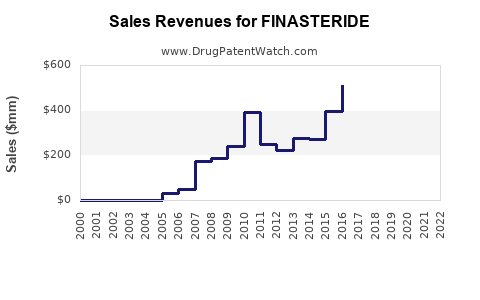
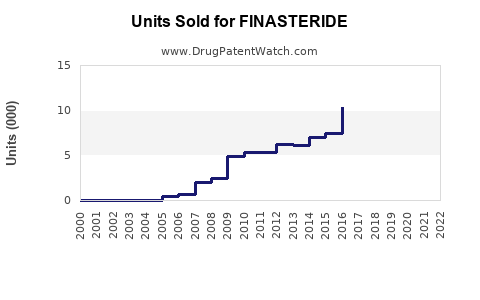
Annual Sales Revenues and Units Sold for FINASTERIDE
| Drug Name | Revenues (USD) | Units | Year |
|---|---|---|---|
| FINASTERIDE | ⤷ Start Trial | ⤷ Start Trial | 2022 |
| FINASTERIDE | ⤷ Start Trial | ⤷ Start Trial | 2021 |
| FINASTERIDE | ⤷ Start Trial | ⤷ Start Trial | 2020 |
| FINASTERIDE | ⤷ Start Trial | ⤷ Start Trial | 2019 |
| FINASTERIDE | ⤷ Start Trial | ⤷ Start Trial | 2018 |
| >Drug Name | >Revenues (USD) | >Units | >Year |
Finasteride Market Analysis, Sales Projections, Patent Expiration, and Generic Competition
Finasteride is a mature, low-cost generic drug with two FDA-approved oral strengths: 1 mg for male androgenetic alopecia and 5 mg for benign prostatic hyperplasia. The U.S. market has no meaningful remaining branded exclusivity, and generic competition controls pricing. Growth is shifting from branded tablets to online prescribing, cash-pay telehealth, international markets, and potential topical formulations. A base-case model projects global finasteride product revenue rising from approximately $500 million in 2025 to $610 million by 2029, driven by prescription volume growth rather than price expansion.
What is finasteride used for?
Finasteride inhibits type II 5-alpha reductase and reduces conversion of testosterone to dihydrotestosterone. The drug is marketed in two principal dose forms:
| Product | Dose | FDA indication | Original sponsor | Current market |
|---|---|---|---|---|
| Propecia | 1 mg | Male pattern hair loss | Merck | Generic-dominated |
| Proscar | 5 mg | Symptomatic benign prostatic hyperplasia | Merck | Generic-dominated |
| Generic finasteride | 1 mg and 5 mg | Same approved indications | Multiple manufacturers | Primary supply source |
| Compounded topical finasteride | Various | Generally not FDA-approved in the U.S. | Compounding pharmacies and telehealth providers | Emerging niche |
The FDA approved Proscar in 1992 and Propecia in 1997. FDA labeling states that finasteride is indicated for male patients and is not approved for use in women or children. Pregnant women should not handle crushed or broken tablets because of the risk to a male fetus [1].
Finasteride is also used off-label in some female hair-loss treatment protocols, but those uses do not have the same FDA approval status as male androgenetic alopecia.
How large is the finasteride market?
The market is fragmented across prescription pharmacies, mail-order distributors, telehealth platforms, international pharmacies, and compounding channels. Public companies generally do not report finasteride revenue separately, so market sizing requires a product-level model rather than direct company disclosures.
Global market estimate
The following estimate uses prescription volume, average net selling prices, geographic mix, and the contribution of branded, generic, and compounded products.
| Year | Low case | Base case | High case |
|---|---|---|---|
| 2024 | $390 million | $470 million | $570 million |
| 2025 | $405 million | $500 million | $610 million |
| 2026 | $420 million | $525 million | $665 million |
| 2027 | $435 million | $550 million | $720 million |
| 2028 | $450 million | $580 million | $775 million |
| 2029 | $465 million | $610 million | $835 million |
| 2025-2029 CAGR | 3.5% | 5.1% | 8.0% |
The base case assumes:
- Oral generic volume growth of about 3% to 5% annually.
- Continued erosion in tablet pricing of 1% to 3% annually.
- Increasing diagnosis and treatment of male pattern hair loss through telehealth.
- Stable or modestly expanding BPH demand.
- Higher revenue per patient for branded digital-care bundles and compounded topical products.
- No return of meaningful branded exclusivity.
The high case requires faster adoption of topical finasteride and continued expansion of subscription-based hair-loss services. The low case assumes severe generic price compression, greater use of minoxidil-only therapy, and regulatory restrictions on compounded topical products.
What are the main finasteride revenue segments?
Male pattern hair loss
The 1 mg segment is the highest-value part of the market because patients often pay cash for treatment and may obtain prescriptions through telehealth companies. The segment has greater pricing flexibility than 5 mg finasteride prescribed for BPH.
Key commercial characteristics include:
- High patient awareness and recurring monthly demand.
- Strong online acquisition through direct-to-consumer advertising.
- Frequent combination therapy with oral or topical minoxidil.
- Low drug acquisition cost but potentially high customer acquisition cost.
- Significant persistence risk because treatment benefits generally require continued use.
The branded Propecia market is small compared with generic finasteride. Revenue is increasingly captured by telehealth platforms, pharmacies, compounders, and private-label distributors rather than by the original brand owner.
Benign prostatic hyperplasia
The 5 mg segment has a larger clinical population but lower net pricing. It competes with generic dutasteride, alpha blockers such as tamsulosin, combination products, and procedural therapies.
BPH demand is more stable than hair-loss demand because it is tied to an aging male population and chronic treatment. Volume growth is likely to remain modest, while price declines will limit revenue growth.
Compounded and topical finasteride
Topical finasteride is a commercial growth area, but the regulatory position differs by country and product.
In the United States, compounded topical finasteride is generally not an FDA-approved finished drug. FDA-approved finasteride products are oral tablets. Compounded products can be marketed under applicable compounding rules, but they do not have the same premarket approval, manufacturing, labeling, and clinical evidence framework as an approved drug.
Topical finasteride may attract patients concerned about systemic exposure. Its commercial potential depends on:
- Demonstrated efficacy against oral finasteride.
- Consistent formulation and absorption.
- Physician willingness to prescribe.
- State pharmacy rules.
- FDA enforcement of compounding and promotional practices.
- Ability to obtain a differentiated approved product.
The FDA has warned that topical finasteride can be systemically absorbed and that exposure may create adverse effects associated with oral finasteride [2]. That warning creates both a regulatory risk and a barrier to unsupported claims that topical treatment eliminates systemic exposure.
When did finasteride lose exclusivity?
Finasteride lost its core U.S. small-molecule exclusivity years ago. The principal protection periods associated with Proscar and Propecia have expired, allowing multiple ANDA-approved generic products.
| Milestone | Date or status |
|---|---|
| Proscar FDA approval | 1992 |
| Propecia FDA approval | 1997 |
| Core compound and use patents | Expired |
| U.S. generic entry | Established for both 1 mg and 5 mg products |
| Current Orange Book position | No commercially meaningful unexpired brand exclusivity |
| Biosimilar exposure | None |
The key patent associated with Propecia was U.S. Patent No. 5,547,957, which covered finasteride-related use in treating androgenetic alopecia. Its term expired in 2016, including applicable patent-term adjustments or pediatric exclusivity effects where relevant. Earlier Proscar-related protection also expired before the current generic market was established.
Because finasteride is a small molecule, the relevant legal pathway is an abbreviated new drug application, or ANDA, rather than a biosimilar application.
What is the Orange Book status of finasteride?
The FDA Orange Book historically listed Propecia and Proscar patents and exclusivity information. Those protections no longer prevent ordinary generic competition.
Current commercial implications include:
- Generic manufacturers can rely on abbreviated clinical and bioequivalence pathways.
- New applicants do not need to wait for a meaningful brand patent barrier.
- A formulation or delivery-system patent could create a separate product-specific barrier.
- Method-of-use claims must be listed and enforceable to affect generic labeling.
- Authorized generic and pharmacy substitution dynamics are more important than patent strategy for oral tablets.
A company launching a new topical or combination product would need to build its own patent estate. It would not inherit meaningful protection from the expired Propecia or Proscar portfolio.
What patents protect finasteride products today?
The original oral finasteride patent estate has limited current commercial value. New protection is more likely to arise from formulation, delivery, combination, packaging, dosing, or manufacturing claims.
Formulation patents
Potentially valuable claim categories include:
- Topical gels, foams, sprays, or lotions.
- Reduced-systemic-exposure formulations.
- Micellar, liposomal, nanoparticle, or other delivery systems.
- Combinations with minoxidil or other hair-growth agents.
- Stability and preservative systems.
- Unit-dose applicators and metered delivery devices.
A formulation patent is strongest when it claims a technically narrow composition supported by comparative pharmacokinetic or clinical data. Broad claims covering “topical finasteride” are more vulnerable to written-description, enablement, and obviousness challenges.
Method-of-use patents
Potential claims may cover:
- Treatment of androgenetic alopecia using a specified topical concentration.
- Dosing schedules intended to reduce systemic exposure.
- Use in patients intolerant of oral finasteride.
- Combination treatment with minoxidil.
- Treatment of female pattern hair loss.
Method-of-use protection is commercially weaker when generic manufacturers can omit the patented indication from their labeling. It is stronger when the protected use dominates the product’s market or when the labeling and prescribing behavior make induced-infringement arguments credible.
Manufacturing patents
Manufacturing claims may cover:
- Purification and crystallization.
- Intermediate compounds.
- Particle-size control.
- Tablet processing.
- Impurity reduction.
- Continuous manufacturing or high-yield synthesis.
These patents can create supply-chain barriers if the process is difficult to design around, but they usually do not prevent generic entry where an alternative process is available.
Which companies compete in the finasteride market?
The market includes large generic manufacturers, regional pharmaceutical companies, retail pharmacies, online clinics, and compounders.
Generic manufacturers
Generic supply has historically included companies such as Teva Pharmaceutical Industries, Viatris, Dr. Reddy's Laboratories, Cipla, Aurobindo Pharma, Zydus Lifesciences, and other ANDA holders, depending on market and product availability.
The competitive basis is generally:
- Tablet cost.
- Wholesale acquisition price.
- Manufacturing reliability.
- Pharmacy contracting.
- Regulatory compliance.
- Ability to supply 1 mg and 5 mg strengths.
- International registration coverage.
No single generic manufacturer has durable control over the market because multiple suppliers can produce the same active ingredient and dosage strengths.
Telehealth and digital pharmacies
Telehealth companies have changed the commercial structure of the 1 mg market. They often bundle:
- Medical consultation.
- Prescription management.
- Finasteride tablets.
- Minoxidil.
- Dermatology services.
- Subscription fulfillment.
The drug itself may represent a small portion of total customer revenue. Margin is generated through recurring subscriptions, consultation fees, private-label packaging, and bundled treatment plans.
This channel is strategically more important for hair-loss products than for BPH products, where prescribing remains concentrated in conventional primary-care and urology channels.
What generic entry risks exist for finasteride?
For oral 1 mg and 5 mg finasteride, the principal generic entry risk has already materialized. The remaining risks concern price and channel competition rather than first generic launch.
Oral generic risk
| Risk | Impact |
|---|---|
| Additional ANDA approvals | Further price erosion |
| Pharmacy consolidation | Lower supplier margins |
| API oversupply | Lower tablet pricing |
| Manufacturing disruption | Temporary shortages and share shifts |
| Telehealth private-label products | Reduced brand visibility |
| Formulary substitution | Limited ability to maintain premium pricing |
A new oral finasteride entrant would face low technical barriers and limited differentiation. Commercial success would depend on cost, supply reliability, channel relationships, and regulatory execution.
Topical product risk
Topical products face a different risk profile. A new approved topical product could obtain patents and regulatory exclusivity, but compounders could compete on price if legally permitted. The approved product would need clear evidence of efficacy, safety, absorption, and manufacturing consistency.
Are biosimilars a risk for finasteride?
No. Finasteride is a synthetic small molecule, not a biologic. Biosimilar approval standards do not apply. Competition occurs through generic-drug pathways, primarily ANDAs in the United States and equivalent procedures in other jurisdictions.
What is the litigation and Paragraph IV status?
The major Propecia and Proscar patent disputes are historical. The expired patents no longer create a meaningful barrier to generic launch.
Paragraph IV certifications likely played a role in the original generic entry process, but current market economics are not defined by an active, high-value Paragraph IV campaign. A new Paragraph IV dispute would be more likely to involve:
- A novel topical formulation.
- A combination product.
- A new delivery device.
- A manufacturing patent.
- A newly approved method of use.
Litigation exposure for a new product depends on whether the innovator has obtained claims that are technically narrow, commercially relevant, and difficult to design around. Broad patent assertions against ordinary generic finasteride tablets would face substantial validity and exhaustion challenges given the age of the foundational estate.
How does finasteride compare with competing hair-loss drugs?
| Product | Primary mechanism | Patent position | Main commercial advantage | Main limitation |
|---|---|---|---|---|
| Finasteride 1 mg | Type II 5-alpha reductase inhibition | Generic | Low price and established efficacy | Sexual and psychiatric adverse-effect concerns |
| Dutasteride | Type I and II 5-alpha reductase inhibition | Generic in many markets | Greater DHT suppression | Often off-label for hair loss in the U.S. |
| Minoxidil | Hair-follicle growth stimulation | Generic | OTC availability and broad use | Variable adherence and efficacy |
| Oral minoxidil | Systemic vasodilator | Generic, off-label for hair loss | Low cost and increasing telehealth use | Cardiovascular monitoring concerns |
| Topical finasteride | Local DHT reduction, depending on formulation | Product-specific | Potential positioning around lower exposure | Regulatory and absorption questions |
Finasteride remains the reference low-cost oral antiandrogen for male pattern hair loss. Dutasteride may offer stronger pharmacologic activity but has less uniform regulatory status for hair loss. Minoxidil has broader consumer access and is often used in combination with finasteride.
What are the sales projections for finasteride through 2029?
The base-case outlook is moderate revenue growth with declining oral prices.
| Segment | 2025 estimate | 2029 estimate | Expected trend |
|---|---|---|---|
| Oral 1 mg hair-loss products | $260 million | $305 million | Volume growth, lower prices |
| Oral 5 mg BPH products | $175 million | $195 million | Stable clinical demand |
| Topical and compounded products | $45 million | $110 million | Fastest growth, regulatory risk |
| Other international formulations | $20 million | $0-20 million | Included within regional variation |
| Total modeled market | $500 million | $610 million | Approximately 5.1% CAGR |
The largest uncertainty is the size and legality of the compounded topical segment. If topical finasteride becomes widely accepted through approved products or favorable regulatory treatment, revenue could exceed the high case. If regulators restrict promotion or compounding, growth will remain concentrated in oral generic products.
What is the revenue exposure for major manufacturers?
Finasteride is unlikely to be a material standalone revenue driver for diversified pharmaceutical companies. Manufacturers generally report it within broad generic portfolios, preventing reliable product-level revenue attribution.
The most exposed commercial groups are:
- Specialty generic manufacturers with high exposure to dermatology or urology products.
- Telehealth providers whose subscription economics depend on hair-loss prescriptions.
- Compounding pharmacies selling topical formulations.
- API manufacturers supplying finasteride to multiple finished-dose companies.
- Pharmacies and wholesalers competing for low-cost generic volume.
Merck's current revenue exposure to Propecia and Proscar is not comparable with the products' historical importance. The commercial value of the original brands has largely shifted to generic suppliers and service providers.
What are the main investment and licensing implications?
Finasteride oral tablets offer limited licensing value because the core compound is off patent and price competition is intense. More attractive opportunities are concentrated in:
- FDA-approved topical delivery.
- Combination products with differentiated clinical data.
- International markets with less commoditized supply.
- Patient-adherence programs.
- Formulations that demonstrate lower systemic exposure.
- Devices that improve topical dosing accuracy.
- Digital-care platforms with strong patient retention.
A licensing transaction based only on oral finasteride would have weak strategic justification unless it includes manufacturing scale, distribution rights, or a larger dermatology portfolio. A formulation transaction may support premium economics, but the patent estate must be reviewed claim by claim and tested against compounding alternatives.
Key Takeaways
- Finasteride is a mature generic drug with no meaningful remaining core patent exclusivity in the United States.
- Propecia and Proscar have been commercially displaced by low-priced 1 mg and 5 mg generic tablets.
- The base-case global market is projected to grow from approximately $500 million in 2025 to $610 million in 2029.
- Growth will come primarily from higher prescription volume, telehealth distribution, and topical or compounded products.
- Oral tablet pricing will remain under pressure because multiple generic manufacturers can supply the market.
- Topical finasteride offers the strongest growth opportunity but carries FDA, compounding, absorption, and patent-validity risks.
- Finasteride has no biosimilar risk because it is a small-molecule drug.
- New commercial value depends on formulation, delivery, combination, manufacturing, or digital-channel differentiation rather than the expired core compound patents.
FAQs
Is finasteride still profitable for pharmaceutical manufacturers?
Yes, but profitability depends on manufacturing cost, supply reliability, and distribution scale. Standalone oral tablets have limited pricing power, while topical, combination, and subscription-based products can support higher margins.
Can a company patent a new finasteride formulation?
Yes. A new formulation may be patentable if it is novel, non-obvious, adequately described, and supported by evidence. The patent must claim a specific technical solution rather than merely restating the use of finasteride in a different commercial format.
Is topical finasteride FDA-approved in the United States?
FDA-approved finasteride products in the United States are oral tablets. Topical finasteride may be compounded or marketed in other jurisdictions, but a compounded product is not equivalent to an FDA-approved finished drug.
Will finasteride prices increase through 2029?
Broad price increases are unlikely for standard oral generics. Prices may increase in isolated channels during shortages, while branded digital-care packages and topical formulations may command higher total treatment revenue.
Which finasteride market has the strongest growth potential?
The strongest growth potential is in topical and digitally distributed hair-loss treatment. The 5 mg BPH market should remain stable but is unlikely to generate substantial price growth because of generic substitution.
References
-
U.S. Food and Drug Administration. (2023). Propecia (finasteride) prescribing information. https://www.accessdata.fda.gov/drugsatfda_docs/label/2023/020788s030s031lbl.pdf
-
U.S. Food and Drug Administration. (2024). FDA alerts health care professionals and compounders about risks associated with compounded topical finasteride. https://www.fda.gov/
-
U.S. Food and Drug Administration. (2024). Approved drug products with therapeutic equivalence evaluations: The Orange Book. https://www.accessdata.fda.gov/scripts/cder/ob/
-
U.S. Food and Drug Administration. (2023). Proscar (finasteride) prescribing information. https://www.accessdata.fda.gov/
-
U.S. Patent and Trademark Office. (1996). U.S. Patent No. 5,547,957: 4-aza-steroids as 5-alpha reductase inhibitors. https://patents.google.com/patent/US5547957
-
U.S. Food and Drug Administration. (2024). Drugs@FDA: FDA-approved drugs. https://www.accessdata.fda.gov/scripts/cder/daf/
More… ↓
