Drug Sales Trends for ENBREL
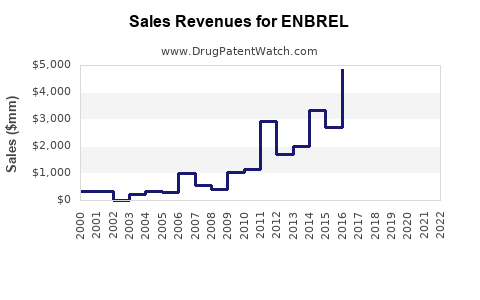
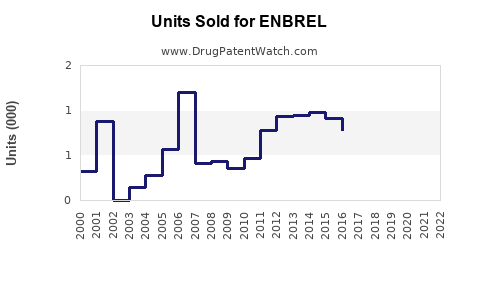
Annual Sales Revenues and Units Sold for ENBREL
| Drug Name | Revenues (USD) | Units | Year |
|---|---|---|---|
| ENBREL | ⤷ Start Trial | ⤷ Start Trial | 2022 |
| ENBREL | ⤷ Start Trial | ⤷ Start Trial | 2021 |
| ENBREL | ⤷ Start Trial | ⤷ Start Trial | 2020 |
| ENBREL | ⤷ Start Trial | ⤷ Start Trial | 2019 |
| >Drug Name | >Revenues (USD) | >Units | >Year |
ENBREL Market Analysis, Sales Forecast, Patent Exclusivity, and Biosimilar Risk
ENBREL (etanercept) remains a multibillion-dollar tumor necrosis factor inhibitor, but its commercial profile is mature. Amgen’s principal risks are volume erosion from biosimilars outside the United States, price pressure from payers, and potential U.S. biosimilar entry after the remaining patent and settlement protections expire. A base-case forecast places global ENBREL sales at approximately $3.7 billion in 2025, declining to about $2.3 billion by 2030. A faster U.S. biosimilar launch could reduce 2030 sales below $1.8 billion.
What is ENBREL and how does it generate revenue?
ENBREL is a recombinant tumor necrosis factor receptor fusion protein containing the extracellular ligand-binding portion of the human p75 TNF receptor linked to the Fc portion of human IgG1. It is marketed by Amgen in the United States and Canada and by Pfizer in several international markets under a commercialization arrangement.
The drug is approved for rheumatoid arthritis, juvenile idiopathic arthritis, psoriatic arthritis, ankylosing spondylitis, non-radiographic axial spondyloarthritis, and plaque psoriasis. The U.S. Food and Drug Administration first approved ENBREL in 1998 for rheumatoid arthritis. The product is administered by subcutaneous injection in prefilled syringes, autoinjectors, and multidose presentations.[1]
ENBREL competes primarily with:
- HUMIRA (adalimumab)
- REMICADE (infliximab)
- SIMPONI and SIMPONI ARIA (golimumab)
- CIMZIA (certolizumab pegol)
- COSENTYX (secukinumab)
- STELARA (ustekinumab)
- TALTZ (ixekizumab)
- JAK inhibitors, including XELJANZ and RINVOQ
Its commercial advantages are long clinical experience, established payer coverage, broad autoimmune indications, and extensive physician familiarity. Its disadvantages are an older mechanism, biosimilar competition, injection administration, and competition from newer interleukin inhibitors and oral therapies.
How much revenue does ENBREL generate?
Amgen reports ENBREL net product sales globally. Exact results vary by year, geography, foreign-exchange effects, gross-to-net adjustments, and changes in the company’s collaboration accounting.
| Year | Approximate global ENBREL sales | Primary commercial trend |
|---|---|---|
| 2021 | $4.7 billion | Mature product with emerging international biosimilar pressure |
| 2022 | $4.3 billion | Lower demand and pricing pressure |
| 2023 | $4.0 billion | Continued erosion outside the United States |
| 2024 | Approximately $3.8 billion | Ongoing international and payer pressure |
Amgen has identified ENBREL as a product facing declining demand because of competition from other therapies and biosimilar products in international markets.[2] The United States remains the most commercially important market because U.S. prices are materially higher than prices in most European markets and because biosimilar uptake has been delayed by patent litigation and settlement agreements.
A reasonable current estimate is that U.S. sales account for roughly three-quarters of global ENBREL revenue, although the precise proportion changes by year and reporting convention.
What are the ENBREL sales projections through 2030?
The following forecast is a scenario-based estimate rather than company guidance. It assumes stable treatment prevalence, gradual U.S. price concessions, continued ex-U.S. biosimilar substitution, and U.S. biosimilar launch activity beginning around 2029.
| Year | Base-case sales | Downside sales | Main assumption |
|---|---|---|---|
| 2024 | $3.8 billion | $3.8 billion | Reference year |
| 2025 | $3.7 billion | $3.6 billion | Low-single-digit decline |
| 2026 | $3.5 billion | $3.3 billion | Continued international erosion |
| 2027 | $3.2 billion | $2.9 billion | Higher payer pressure |
| 2028 | $2.9 billion | $2.5 billion | Pre-entry contracting and channel pressure |
| 2029 | $2.6 billion | $2.0 billion | Potential U.S. biosimilar entry |
| 2030 | $2.3 billion | $1.6 billion | Broader substitution and net-price decline |
The base case implies a compound annual decline of approximately 8% from 2024 through 2030. The downside case implies a decline of about 13% annually.
What could cause ENBREL sales to outperform?
ENBREL could outperform the base case if:
- U.S. patent settlements delay commercial biosimilar entry beyond 2029.
- Amgen secures favorable formulary positioning against newer biologics.
- Rheumatology and dermatology patients remain stable on ENBREL because of switching concerns.
- Biosimilar uptake remains slow in the United States.
- International price erosion is offset by volume growth in emerging markets.
What could cause ENBREL sales to underperform?
Sales could fall faster if:
- Multiple U.S. biosimilars launch in the same contracting cycle.
- Large pharmacy benefit managers use mandatory substitution or preferred formulary tiers.
- Amgen reduces net prices to defend volume.
- Rheumatologists shift new patients to interleukin inhibitors or JAK inhibitors.
- Payers impose step edits that favor lower-cost biosimilars.
- Competitors expand into earlier lines of treatment.
When does ENBREL lose exclusivity?
ENBREL does not have a single universally controlling expiration date. Its protection depends on the patent, jurisdiction, patent-term adjustment, pediatric exclusivity, settlement terms, and the specific biosimilar applicant.
The principal U.S. composition patent associated with etanercept is U.S. Patent No. 5,605,690, which covers soluble TNF receptor fusion proteins. The patent has been cited as an important part of the U.S. ENBREL patent estate and has an expiration date extending into 2029 after patent-term adjustment.[3]
Amgen also has asserted later patents covering formulations, methods of treatment, manufacturing, and product characteristics. The practical U.S. market-entry date therefore depends on litigation outcomes and settlements, not only on the earliest composition patent.
| Protection category | Commercial relevance |
|---|---|
| Etanercept composition patents | Protect the underlying fusion protein |
| Formulation patents | Cover stable liquid formulations and excipient combinations |
| Manufacturing patents | Can increase biosimilar development and launch risk |
| Method-of-use patents | Cover selected diseases, dosing, or patient populations |
| Regulatory exclusivity | Biologic reference-product exclusivity has already expired |
| Settlement agreements | May defer agreed biosimilar launch dates |
The key commercial date is generally treated as 2029 for unrestricted U.S. biosimilar entry, subject to the individual applicant’s agreement with Amgen and the scope of enforceable patents.
What is the FDA and Orange Book status of ENBREL?
ENBREL is a biologic licensed under a Biologics License Application, not a conventional small-molecule drug approved under a New Drug Application. It is therefore not protected through the standard Orange Book patent-listing system in the same manner as a tablet or capsule.
The relevant FDA reference-product and biosimilar framework is the Purple Book. ENBREL is the reference product for etanercept biosimilar applications under the Public Health Service Act.[4]
| Regulatory issue | ENBREL status |
|---|---|
| FDA product type | Biologic |
| Reference application | BLA |
| Approval date | 1998 |
| Orange Book status | Not the primary listing mechanism |
| Relevant biologic database | Purple Book |
| Biosimilar pathway | Section 351(k) |
| Reference-product exclusivity | Expired |
| Interchangeability | Depends on the individual biosimilar approval |
The distinction matters because Orange Book patent certifications, including Paragraph IV certifications, formally apply to abbreviated new drug applications. Etanercept biosimilar applicants instead file biosimilar applications and may litigate under the Biologics Price Competition and Innovation Act, including the patent-exchange process commonly called the patent dance.
Which companies are challenging ENBREL with biosimilars?
The principal U.S. and international etanercept biosimilar developers include Sandoz, Samsung Bioepis, and Biocon Biologics.
| Company | Biosimilar | Active ingredient | Regulatory position |
|---|---|---|---|
| Sandoz | ERELZI | Etanercept-szzs | FDA-approved in 2016 |
| Samsung Bioepis | ETICOVO | Etanercept-ykro | FDA-approved in 2019 |
| Biocon Biologics | Etanercept biosimilar programs | Etanercept | Commercial and regulatory activity varies by market |
| Biogen/Samsung Bioepis | BENEPALI | Etanercept | Commercially available in Europe |
ERELZI and ETICOVO received FDA approval, but approval did not result in immediate U.S. commercial launch. Patent disputes and settlement arrangements with Amgen limited the timing of entry.[5][6]
Europe has had substantially earlier competition. BENEPALI became one of the first widely marketed etanercept biosimilars in Europe, and ERELZI also received European approval. European biosimilar availability has increased tender pressure and reduced the branded product’s volume and price.
What patent litigation affects ENBREL?
Amgen has litigated against biosimilar applicants over patents covering etanercept and its formulations. The disputes have focused on whether later-issued patents validly cover the reference product or whether they improperly extend exclusivity beyond the original composition patent.
Major litigation and settlement themes include:
- Amgen’s patent litigation against Sandoz concerning ERELZI.
- Amgen’s disputes with Samsung Bioepis concerning ETICOVO.
- Challenges to the validity and enforceability of formulation patents.
- Claims involving liquid formulations, excipients, concentration, and stability.
- Settlement agreements permitting later entry rather than immediate launch.
The litigation risk is unusual because ENBREL has a large patent estate even though the principal biologic exclusivity period has expired. For biosimilar developers, the cost of launching at risk can be substantial because biologic manufacturing capacity, commercial contracting, and physician conversion programs require major investment.
What formulations are protected by ENBREL patents?
ENBREL formulation patents have been commercially important because the product is sold as a ready-to-use liquid biologic. Formulation protection can cover:
- Protein concentration
- Buffer systems
- Stabilizing excipients
- Surfactants
- pH ranges
- Reduced aggregation
- Storage stability
- Prefilled syringe and autoinjector presentations
The formulation estate can create practical barriers even when a biosimilar developer has demonstrated analytical and clinical similarity. A biosimilar may need to design around a formulation patent, challenge validity, or accept a delayed launch.
The commercial effect is greater for a biologic than for many small molecules because a formulation change can require additional comparability work, device testing, stability studies, and regulatory review.
How strong is the ENBREL patent estate?
The ENBREL patent estate is commercially strong through the late 2020s but weaker after the main U.S. settlement period expires.
| Factor | Assessment |
|---|---|
| Core composition protection | Strong historical protection; expiration extends into 2029 |
| Formulation protection | Significant and litigation-tested |
| Manufacturing protection | Potentially relevant, but design-around options exist |
| Regulatory exclusivity | No longer a major barrier |
| Biosimilar approvals | Multiple approvals already obtained |
| U.S. launch barrier | High before settlement dates; lower afterward |
| Ex-U.S. protection | Materially weaker because biosimilars are already marketed |
| Long-term durability | Limited after 2029 |
Patent strength should be separated from commercial durability. ENBREL has sufficient protection to delay U.S. competition, but the estate does not prevent international biosimilar competition and does not eliminate the eventual substitution risk.
What is the competitive outlook for ENBREL?
ENBREL is losing share in a therapeutic market that has shifted toward newer biologic classes. TNF inhibitors remain important, especially in rheumatoid arthritis and psoriatic arthritis, but treatment algorithms increasingly include IL-17, IL-23, IL-6, and oral targeted therapies.
| Competitive segment | Key products | Impact on ENBREL |
|---|---|---|
| TNF inhibitors | HUMIRA, REMICADE, SIMPONI, CIMZIA | Direct price and formulary competition |
| IL-17 inhibitors | COSENTYX, TALTZ | Pressure in psoriasis and spondyloarthritis |
| IL-23 inhibitors | TREMFYA, SKYRIZI | Pressure in psoriasis and psoriatic arthritis |
| IL-6 therapy | ACTEMRA | Pressure in rheumatoid arthritis |
| JAK inhibitors | RINVOQ, XELJANZ, OLUMIANT | Oral alternative, subject to safety restrictions |
| Biosimilars | ERELZI, ETICOVO, BENEPALI | Direct product substitution |
HUMIRA’s U.S. biosimilar entry has established a precedent for rapid contracting pressure after biologic competition begins. ENBREL may experience a slower decline because of settlement timing and its different payer dynamics, but the eventual pricing risk is similar.
What generic or biosimilar launch scenarios exist for ENBREL?
Delayed-entry scenario
Under this scenario, U.S. biosimilars remain commercially constrained until approximately 2029. Amgen preserves a high share of U.S. volume but offers increasing rebates to defend formulary access. Sales decline gradually before a larger reduction after entry.
Single-launch scenario
One biosimilar obtains favorable payer access and launches in 2029. ENBREL loses 15% to 25% of U.S. volume during the first two years, while net price declines by approximately 10% to 20%.
Multi-launch scenario
Two or more biosimilars enter within a short period. Payers use competing products to drive rebates, and ENBREL loses 30% to 45% of U.S. volume over three years. Global sales could fall below $2 billion by 2030.
Limited-substitution scenario
Biosimilars launch but achieve modest uptake because physicians and patients remain reluctant to switch stable patients. New-patient share shifts first, while the established ENBREL base declines more slowly.
How does ENBREL compare with HUMIRA?
HUMIRA has a larger historical revenue base and broader commercial exposure, but it also faces more intense U.S. biosimilar competition. ENBREL has fewer approved U.S. biosimilars and a later expected launch window.
| Metric | ENBREL | HUMIRA |
|---|---|---|
| Active ingredient | Etanercept | Adalimumab |
| Molecular class | TNF receptor fusion protein | Monoclonal antibody |
| U.S. approval | 1998 | 2002 |
| Biosimilar competition | Approved, delayed commercial entry | Multiple U.S. commercial launches |
| Main patent cliff | Approximately 2029 in the U.S. | U.S. competition began in 2023 |
| Key risk | Delayed but concentrated future erosion | Current high-intensity erosion |
| Delivery | Subcutaneous | Subcutaneous |
ENBREL’s near-term revenue durability is stronger than HUMIRA’s because its U.S. biosimilar market has not developed at the same speed. Its long-term outlook remains negative because the underlying therapeutic class is mature and international biosimilar erosion is already established.
What is the investment and commercial impact of ENBREL erosion?
ENBREL remains a significant contributor to Amgen’s revenue and operating cash flow. The principal value risk is a concentrated decline in a high-margin product after U.S. biosimilar entry.
The impact on Amgen will depend on:
- The proportion of sales generated in the United States.
- Amgen’s ability to retain preferred formulary status.
- The size of rebates paid to commercial insurers.
- The number of biosimilar entrants.
- Whether biosimilars receive interchangeable status.
- Patient switching rates.
- Growth from newer Amgen products, including REPATHA, OTEZLA, TEZSPIRE, and oncology products.
ENBREL is unlikely to be a long-term growth asset. Its value is better characterized as a cash-generating mature biologic with a multi-year erosion path.
Key Takeaways
- ENBREL generated approximately $4 billion in annual global sales around 2023 and remains one of Amgen’s largest mature products.
- Global sales are projected to decline from approximately $3.8 billion in 2024 to $2.3 billion by 2030 in the base case.
- U.S. sales remain the main source of value because international markets already face biosimilar competition.
- ERELZI and ETICOVO are FDA-approved etanercept biosimilars, but litigation and settlements have delayed U.S. commercial entry.
- The main U.S. exclusivity barrier extends into approximately 2029, subject to patent-specific and settlement-specific analysis.
- ENBREL is regulated as a biologic and is tracked through the Purple Book rather than the conventional Orange Book pathway.
- Formulation and manufacturing patents extend the commercial barrier beyond the core composition patent.
- The principal downside risk is simultaneous U.S. entry by multiple biosimilars after 2029.
- ENBREL’s patent estate is strong through the late 2020s but does not prevent long-term revenue erosion.
FAQs About ENBREL Market Forecasts and Patent Risk
Will ENBREL sales decline before U.S. biosimilar launch?
Yes. International biosimilars, payer pressure, newer biologics, and lower net pricing can reduce sales before U.S. biosimilar commercialization begins.
Is ERELZI interchangeable with ENBREL?
FDA approval of ERELZI does not by itself establish interchangeability. Interchangeability depends on the specific FDA designation and applicable substitution rules.
Does ENBREL have an Orange Book patent listing?
ENBREL is a biologic, so the Purple Book and BLA-related patent framework are more relevant than conventional Orange Book listings.
What is the largest ENBREL revenue risk for Amgen?
The largest risk is a U.S. biosimilar launch cycle in which multiple competitors obtain favorable payer contracts and replace ENBREL in new and existing patients.
Can formulation patents delay ENBREL biosimilars after 2029?
They can create litigation and design-around costs, but they are unlikely by themselves to prevent all U.S. biosimilar competition indefinitely once the principal composition and settlement barriers expire.
References
- U.S. Food and Drug Administration. (1998). ENBREL prescribing information.
- Amgen Inc. (2025). Annual report pursuant to Section 13 or 15(d) of the Securities Exchange Act of 1934 for the fiscal year ended December 31, 2024.
- U.S. Patent and Trademark Office. (1997). U.S. Patent No. 5,605,690: Soluble tumor necrosis factor receptor fusion proteins.
- U.S. Food and Drug Administration. (2024). Purple Book: Database of licensed biological products.
- U.S. Food and Drug Administration. (2016). FDA approves first biosimilar to treat rheumatoid arthritis and other diseases.
- U.S. Food and Drug Administration. (2019). FDA approves biosimilar etanercept product ETICOVO.
- European Medicines Agency. (2016). Benepali: EPAR - product information.
More… ↓
