Last updated: February 15, 2026
Econazole nitrate is an azole antifungal agent used topically for the treatment of fungal infections such as athlete’s foot, ringworm, and candidiasis. Its market landscape involves competitive positioning, regulatory considerations, and demand drivers rooted in dermatological fungal infection prevalence.
Market drivers and challenges
-
Prevalence of dermatophyte infections: Rising incidence of fungal skin infections worldwide maintains steady demand for topical antifungals. According to WHO, fungal infections affect over 1 billion people globally [1].
-
Market penetration of topical antifungals: Econazole nitrate competes with other azole antifungals, including clotrimazole, miconazole, and ketoconazole. Despite numerous options, local preferences and prescription habits influence sales volume.
-
Regulatory status: Approved in multiple markets, including the US (FDA), EU (EMA), and Asia-Pacific regions. Patent expiry or generic entry can significantly impact prices and sales volume.
-
Emergence of resistance: Growing antifungal resistance in some strains could limit efficacy, shifting prescriber preferences toward newer agents.
-
Market segmentation: Primarily used in OTC (over-the-counter) formulations for mild infections and prescription formulations for complicated cases, with a trend toward increased OTC sales in developed markets.
Current market size
The global topical antifungal market was valued at approximately USD 1.5 billion in 2022 and is projected to grow at a compound annual growth rate (CAGR) of 4.2% between 2023 and 2030 [2]. Econazole nitrate holds an estimated 10-12% share within this segment, owing to its established efficacy and formulary presence in various countries.
Regional distribution
| Region |
Market Share (%) |
Growth Rate (2023-2030) |
Notes |
| North America |
35 |
3.8% |
High OTC usage, regulatory stability |
| Europe |
27 |
4.0% |
Strong prescription market; moderate OTC sales |
| Asia-Pacific |
25 |
5.2% |
Rapidly growing demand, OTC expansion |
| Latin America/Africa |
13 |
4.5% |
Emerging markets, increasing dermatological cases |
Sales projection (2023–2030)
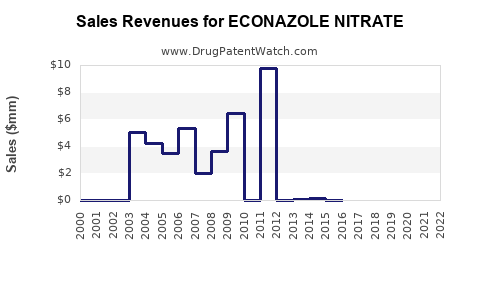
Based on growth rates and market share estimates, global sales volume for econazole nitrate are expected to grow from USD 180 million (based on 2022 estimated revenues) to approximately USD 250 million by 2030.
- 2023: USD 180 million
- 2025: USD 210 million
- 2027: USD 230 million
- 2030: USD 250 million
This reflects an average annual growth rate around 4%, aligning with the broader antifungal market's CAGR, though regional differences may cause variations.
Competitive landscape
Econazole nitrate faces competition from:
- Clotrimazole: Market leader owing to early entry and extensive OTC branding.
- Miconazole: Widely used in both prescription and OTC formulations.
- Ketoconazole: Used for both topical and systemic indications.
- Newer agents and formulations: Emerging antifungal agents with better resistance profiles or improved formulations.
Generic erosion is expected to reduce average selling prices (ASPs), impacting overall revenues.
Market outlook
The outlook depends on several factors:
- Continued rise in fungal infection prevalence.
- Growth in OTC sales channels.
- Regulatory shifts permitting higher OTC availability.
- Resistance concerns prompting newer drug formulations.
Given these factors, sales are projected to sustain moderate growth with a potential acceleration in emerging markets.
Key Takeaways
- Econazole nitrate is in a mature segment with stable demand driven by dermatophyte infections.
- Positioned within a USD 1.5 billion global antifungal market, holding a 10-12% share.
- Regional variations influence sales; Asia-Pacific exhibits the fastest growth.
- Projected revenues increase from USD 180 million in 2022 to USD 250 million in 2030.
- Competitive pressure from other azoles and resistance trends could affect future sales.
FAQs
1. What factors could influence econazole nitrate sales the most?
The expansion of OTC availability, rising fungal infection rates, and emergence of resistance or new formulations are primary factors impacting sales.
2. How does econazole nitrate compare with other topical antifungals?
It has similar efficacy but faces stiff competition from clotrimazole and miconazole, which are more widely marketed and available OTC.
3. What regulatory challenges could impact market growth?
Potential restrictions on OTC sales, patent cliff for branded products, or approval of alternative treatments can influence market dynamics.
4. Which regional markets offer the most growth potential?
Asia-Pacific and Latin America exhibit faster growth due to increasing dermatophyte infections and expanding OTC channels.
5. How might resistance development impact future sales?
Resistance could reduce product efficacy, leading prescribers to select alternative agents and potentially shrink econazole nitrate's market share.
References
[1] WHO. "Fungal Infections." World Health Organization. 2020.
[2] MarketsandMarkets. "Topical Antifungal Market by Type, Application, and Region – Global Forecast to 2030." 2022.