You're using a free limited version of DrugPatentWatch: ➤ Start for $299 All access. No Commitment.

Last Updated: January 1, 2026

Drug Sales Trends for CYANOCOBALAM


✉ Email this page to a colleague

« Back to Dashboard


Payment Methods and Pharmacy Types for CYANOCOBALAM (2022)

Revenues by Pharmacy Type

Pharmacy Type Revenues
MAIL-ORDER $2,652,136
INSIDE ANOTHER STORE $6,617,374
[disabled in preview] $26,367,314
This preview shows a limited data set
Subscribe for full access, or try a Trial

Units Sold by Pharmacy Type

Pharmacy Type Units
MAIL-ORDER 258,682
INSIDE ANOTHER STORE 560,535
[disabled in preview] 1,625,270
This preview shows a limited data set
Subscribe for full access, or try a Trial

Revenues by Payment Method

Payment Method Revenues
MEDICAID $12,189,496
MEDICARE $557,488
[disabled in preview] $22,889,841
This preview shows a limited data set
Subscribe for full access, or try a Trial
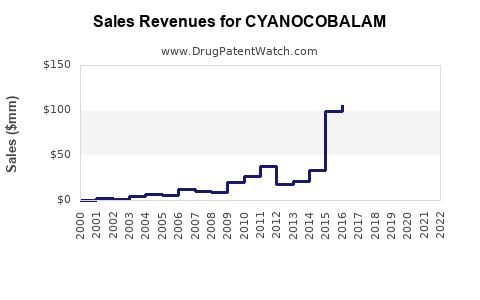
Drug Sales Revenue Trends for CYANOCOBALAM
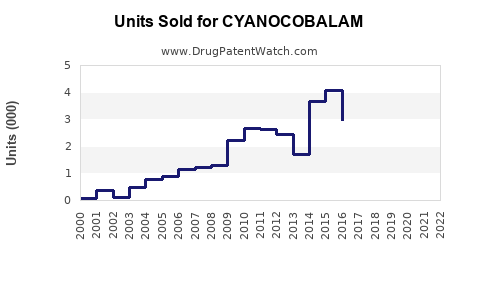
Drug Units Sold Trends for CYANOCOBALAM

Annual Sales Revenues and Units Sold for CYANOCOBALAM

These sales figures are drawn from a US national survey of drug expenditures
Drug Name Revenues (USD) Units Year
CYANOCOBALAM ⤷  Get Started Free ⤷  Get Started Free 2022
CYANOCOBALAM ⤷  Get Started Free ⤷  Get Started Free 2021
CYANOCOBALAM ⤷  Get Started Free ⤷  Get Started Free 2020
CYANOCOBALAM ⤷  Get Started Free ⤷  Get Started Free 2019
CYANOCOBALAM ⤷  Get Started Free ⤷  Get Started Free 2018
>Drug Name >Revenues (USD) >Units >Year

Market Analysis and Sales Projections for Cyanocobalamin

Last updated: July 29, 2025

Introduction

Cyanocobalamin, a synthetic form of vitamin B12, remains a cornerstone in the treatment of vitamin B12 deficiency, which can lead to anemia and neurological disorders. Its extensive application in both prescription and over-the-counter (OTC) markets positions it as a critical asset in global pharmaceutical portfolios. This report provides a comprehensive market analysis and sales projection for cyanocobalamin, considering market trends, competitive landscape, regulatory influences, and demographic factors.

Market Overview

Global Demand Drivers

The demand for cyanocobalamin primarily stems from increasing prevalence of B12 deficiency across diverse populations, driven by:

  • Aging Population: The elderly population is more susceptible to B12 deficiency due to malabsorption issues, leading to heightened demand.
  • Dietary Trends: Rising vegetarian and vegan diets due to health awareness and ethical considerations reduce natural B12 intake, fueling supplement sales.
  • Chronic Diseases: Conditions such as pernicious anemia, gastrointestinal disorders, and neurodegenerative diseases necessitate B12 supplementation.
  • Healthcare Infrastructure Expansion: Growth in healthcare access, particularly in Asia-Pacific regions, promotes diagnosis and treatment.

Market Segmentation

The cyanocobalamin market predominantly segments into:

  • Formulation Types: Injectable (parenteral), oral tablets, sublingual formulations, nasal sprays.
  • Application Areas: Prescription medications, dietary supplements, fortified foods.
  • End Users: Hospitals, clinics, retail pharmacies, online platforms, wellness centers.

Regional Market Dynamics

  • North America: Largest market owing to high awareness, robust healthcare infrastructure, and aging demographics.
  • Europe: Mature market with stable demand, regulations favoring supplement use.
  • Asia-Pacific: Fastest-growing, driven by rising health consciousness, manufacturing capacity, and improved healthcare access.
  • Latin America and Middle East & Africa: Emerging markets with increasing adoption rates.

Competitive Landscape

Major players include Pfizer, GlaxoSmithKline, Sanofi, Mylan, and emerging local manufacturers in Asia-Pacific. Competitive differentiation hinges on:

  • Formulation Innovation: Sustained-release injections, stable oral formulations.
  • Pricing Strategies: Competitive pricing in emerging markets.
  • Regulatory Approvals: Faster approval processes enhance market access.
  • Distribution Networks: Expansion into OTC channels and online sales.

Regulatory and Reimbursement Factors

Regulatory approvals influence market penetration:

  • In the US, cyanocobalamin is FDA-approved as a prescription drug and OTC supplement.
  • European regulators classify it as a medicinal product or supplement, depending on formulation.
  • Reimbursement policies significantly impact sales, especially in developed regions where coverage incentivizes physician prescriptions and consumer purchases.

Market Challenges

  • Market Saturation: Particularly in mature markets limits rapid growth.
  • Pricing Pressures: Generic competition drives prices downward.
  • Manufacturing Costs: Complex stability requirements for injectable forms increase costs.
  • Regulatory Variability: Differing regional standards create barriers to global expansion.

Sales Projections (2023-2030)

Assumptions

  • CAGR of 4.8% for global cyanocobalamin market (based on existing compound CAGR, accounting for growth in emerging markets).
  • Increased adoption of oral formulations due to convenience and improved bioavailability.
  • Growing penetration in OTC channels, especially via e-commerce.
  • Continued demographic shifts and chronic disease prevalence sustain demand.

Projection Overview

Year Estimated Global Sales (USD Million) Notes
2023 1,200 Baseline year; steady growth in developed regions
2024 1,260 Increased AI-driven marketing and online sales
2025 1,330 Expansion in Asia-Pacific markets
2026 1,410 New formulations and patent expirations
2027 1,490 Rise in self-medication and OTC sales
2028 1,580 Regulatory approvals in emerging markets
2029 1,680 Increased focus on preventive healthcare
2030 1,780 Strategic partnerships boost sales

Note: These projections assume no major regulatory disruptions or supply chain crises.

Market Opportunities

  • Novel Formulations: Development of sustained-release inhalable or nasal sprays.
  • Combination Products: Co-formulation with other vitamins or minerals (e.g., folic acid, iron).
  • Personalized Medicine: Diagnostics-driven targeted therapy.
  • E-commerce Expansion: Leveraging digital platforms for direct-to-consumer sales.
  • Emerging Markets: Capitalizing on increasing health awareness and improving healthcare infrastructure.

Market Risks

  • Pricing Pressure: Intensified generic competition could compress margins.
  • Regulatory Changes: Stricter quality and safety standards may delay product launches.
  • Supply Chain Disruptions: Raw material shortages or manufacturing bottlenecks.
  • Alternatives: Growing interest in plant-based B12 sources or novel delivery systems.

Strategic Recommendations

  • Investment in R&D: Innovate formulations to improve bioavailability and patient convenience.
  • Market Diversification: Tailor marketing strategies for regional differences.
  • Regulatory Navigation: Fast-track approvals and align with regional standards.
  • Partnerships: Collaborate with local manufacturers and distributors to expand reach.
  • Digital Promotion: Enhance online presence and e-commerce, especially in post-pandemic markets.

Key Takeaways

  • The global cyanocobalamin market is steady with a projected CAGR of approximately 4.8%, driven by demographic shifts, dietary changes, and chronic disease prevalence.
  • North America and Europe will maintain significant market shares, but Asia-Pacific is poised for rapid growth owing to economic development and increasing health awareness.
  • Innovation in formulations and delivery mechanisms offers growth avenues, especially in emerging markets.
  • Competitive pressures necessitate strategic differentiation through product development, partnerships, and digital channels.
  • Regulatory navigation and supply chain resilience remain critical success factors for sustained sales growth.

Conclusion

Cyanocobalamin's essential role in addressing vitamin B12 deficiency ensures ongoing demand across global markets. Companies focusing on innovation, regional expansion, and digital marketing are poised to capitalize on the projected growth trajectory through 2030. Strategic agility in regulatory compliance and supply chain management will be pivotal amid evolving market dynamics.


FAQs

1. What are the main drivers of demand for cyanocobalamin globally?
The primary drivers include rising vitamin B12 deficiency due to aging populations, dietary trends such as vegetarianism, increasing prevalence of conditions like anemia, and greater healthcare access worldwide.

2. How does the formulation type influence market growth?
Oral and sublingual formulations are gaining popularity due to convenience, driving sales in OTC channels. Injectable forms remain essential for severe deficiencies, primarily in medical settings.

3. What regional markets offer the highest growth potential?
Asia-Pacific offers significant growth prospects owing to expanding healthcare infrastructure, increasing awareness, and manufacturing capacity. Latin America and Middle East Africa also present emerging opportunities.

4. How might regulatory changes impact the cyanocobalamin market?
Stringent safety and quality standards could delay product approvals or increase compliance costs. Conversely, supportive policies promoting supplement use can stimulate sales.

5. What strategic moves can companies undertake to maximize cyanocobalamin sales?
Investing in formulation innovation, forging regional partnerships, expanding e-commerce channels, and tailoring marketing strategies to regional preferences are key strategies for growth.


Sources:

[1] MarketWatch, "Vitamin B12 Market Size, Share & Trends."
[2] Mordor Intelligence, "Global Vitamin B12 Market Analysis."
[3] WHO, "Micronutrient Deficiencies."
[4] Statista, "Dietary Supplement Market Revenue."
[5] IBISWorld, "Pharmaceuticals Market in Asia-Pacific."

More… ↓

⤷  Get Started Free

Make Better Decisions: Try a trial or see plans & pricing

Drugs may be covered by multiple patents or regulatory protections. All trademarks and applicant names are the property of their respective owners or licensors. Although great care is taken in the proper and correct provision of this service, thinkBiotech LLC does not accept any responsibility for possible consequences of errors or omissions in the provided data. The data presented herein is for information purposes only. There is no warranty that the data contained herein is error free. We do not provide individual investment advice. This service is not registered with any financial regulatory agency. The information we publish is educational only and based on our opinions plus our models. By using DrugPatentWatch you acknowledge that we do not provide personalized recommendations or advice. thinkBiotech performs no independent verification of facts as provided by public sources nor are attempts made to provide legal or investing advice. Any reliance on data provided herein is done solely at the discretion of the user. Users of this service are advised to seek professional advice and independent confirmation before considering acting on any of the provided information. thinkBiotech LLC reserves the right to amend, extend or withdraw any part or all of the offered service without notice.