Share This Page
Drug Sales Trends for COREG
✉ Email this page to a colleague
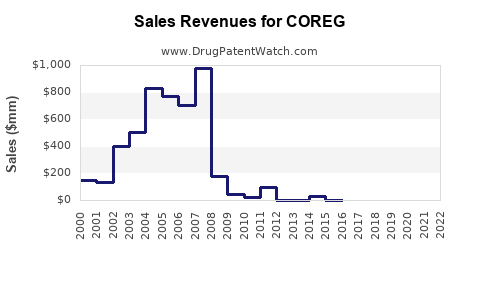
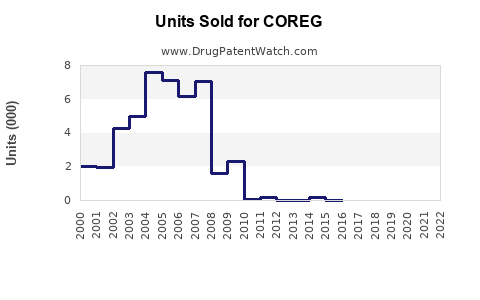
Annual Sales Revenues and Units Sold for COREG
| Drug Name | Revenues (USD) | Units | Year |
|---|---|---|---|
| COREG | ⤷ Start Trial | ⤷ Start Trial | 2022 |
| COREG | ⤷ Start Trial | ⤷ Start Trial | 2021 |
| COREG | ⤷ Start Trial | ⤷ Start Trial | 2020 |
| COREG | ⤷ Start Trial | ⤷ Start Trial | 2019 |
| >Drug Name | >Revenues (USD) | >Units | >Year |

Coreg: Patent Expirations and Market Dynamics
Coreg (carvedilol), a once-daily beta-blocker and alpha-1 blocker, has been a significant therapeutic option for heart failure and hypertension. Its patent landscape and market trajectory are critical for understanding future generic competition and the strategies of both innovator and generic manufacturers.
What is the Coreg Patent Status?
Coreg's composition of matter patent has long expired. The compound itself was first patented by SmithKline Beecham (now GlaxoSmithKline) in the late 1980s. The key patent, U.S. Patent No. 4,503,065, expired in 2007 [1]. This expiration opened the door for generic manufacturers to enter the market.
While the primary patent has lapsed, it is not uncommon for pharmaceutical companies to hold secondary patents related to specific formulations, methods of use, or manufacturing processes. However, these secondary patents have also faced challenges and expired, further facilitating generic market penetration. The U.S. Food and Drug Administration (FDA) Orange Book indicates no currently active Orange Book-listed patents for Coreg (carvedilol) that would prevent generic competition [2].
How Has Generic Entry Impacted Coreg Sales?
The expiration of Coreg's primary patents led to significant generic competition. This competition has a predictable and substantial impact on sales for the branded product.
Pre-Generic Entry (2005-2006): Prior to widespread generic availability, branded Coreg achieved peak annual sales. For example, in 2005, GSK reported Coreg sales of approximately $1.1 billion in the United States [3].
Post-Generic Entry (2007 onwards): Following patent expiry and the introduction of multiple generic carvedilol products, the sales of branded Coreg experienced a sharp decline. This decline is characteristic of the pharmaceutical market when originator drugs face generic challengers. By 2008, branded Coreg sales had fallen to approximately $500 million [3]. This downward trend continued as generic market share solidified.
Current Market Landscape: Today, the market for carvedilol is dominated by generic versions. Branded Coreg sales represent a very small fraction of the market. The vast majority of prescriptions are filled with lower-cost generic alternatives. This shift is driven by formulary placements by payers and the price sensitivity of healthcare systems and patients.
What Are the Market Projections for Carvedilol?
The market for carvedilol is now largely mature and driven by generic competition. Projections focus on the overall volume of carvedilol prescriptions and the aggregate revenue generated by all manufacturers, rather than branded product sales.
Market Size: The carvedilol market, encompassing all available generics, is substantial due to its established efficacy and broad prescribing for heart failure and hypertension. While precise real-time market value is subject to fluctuations in pricing and volume, the carvedilol generic market is estimated to be in the hundreds of millions of dollars annually in the U.S. alone. For instance, reports from data analytics firms suggest the carvedilol market is in the range of $200 million to $400 million annually [4].
Growth Drivers:
- Continued Demand for Heart Failure Treatment: Heart failure remains a prevalent chronic condition, ensuring sustained demand for effective and affordable medications like carvedilol.
- Hypertension Management: As a first- or second-line treatment option for hypertension, carvedilol continues to be widely prescribed.
- Cost-Effectiveness: The low cost of generic carvedilol makes it an attractive option for managed care formularies and uninsured patients.
Challenges:
- Newer Drug Classes: The development of novel therapies for heart failure and hypertension, such as SGLT2 inhibitors and ARNI agents, may gradually impact the market share of older classes of drugs, including beta-blockers, over the long term, though carvedilol's affordability provides a significant cushion.
- Pricing Pressure: Intense competition among multiple generic manufacturers exerts constant downward pressure on prices, limiting overall market value growth.
Projected Trajectory: The carvedilol market is expected to remain stable in terms of volume but may see modest declines in aggregate revenue due to ongoing price erosion. The market will continue to be characterized by intense generic competition, with several manufacturers vying for market share. Any significant shifts would likely be driven by major changes in clinical guidelines or the introduction of significantly disruptive new therapies, which are not currently anticipated to displace carvedilol rapidly given its established profile and cost.
Who Are the Key Generic Manufacturers?
Following the patent expirations, numerous pharmaceutical companies have entered the carvedilol market. The generic carvedilol market is fragmented, with several players holding significant market shares. Key manufacturers include:
- Teva Pharmaceuticals: A major global generic drug manufacturer with a substantial portfolio.
- Apotex: A significant Canadian-based generic pharmaceutical company.
- Mylan N.V. (now part of Viatris): Another large player in the generics space.
- Impax Laboratories (now Amneal Pharmaceuticals): A prominent U.S.-based generic manufacturer.
- Sun Pharmaceutical Industries: An Indian multinational pharmaceutical company.
These companies, among others, compete on price and market access. The availability of multiple AB-rated generic equivalents ensures a competitive pricing environment [5].
What is the Regulatory Pathway for Generic Carvedilol?
Generic carvedilol products must receive Abbreviated New Drug Application (ANDA) approval from the U.S. Food and Drug Administration (FDA). To gain approval, a generic drug manufacturer must demonstrate that its product is bioequivalent to the reference listed drug (RLD), which is branded Coreg.
The process involves:
- ANDA Submission: The generic company submits an ANDA to the FDA.
- Bioequivalence Studies: The ANDA must include data demonstrating that the generic product exhibits the same rate and extent of absorption as the RLD. This is typically achieved through pharmacokinetic studies.
- Manufacturing Standards: The manufacturing process and facilities must comply with Current Good Manufacturing Practices (cGMP) [6].
- Patent Certifications: The ANDA must include a certification regarding any unexpired patents listed in the FDA's Orange Book. This certification can be a Paragraph I (no patent information), Paragraph II (patent has expired), Paragraph III (will not market before patent expiration), or Paragraph IV (patent is invalid, unenforceable, or will not be infringed) [7]. For carvedilol, the key patents have expired, leading to Paragraph II certifications.
Once approved, generic carvedilol products are listed in the FDA's Approved Drug Products With Therapeutic Equivalence Evaluations (the "Orange Book") [2].
What are the Global Market Considerations for Carvedilol?
The market dynamics for carvedilol extend beyond the United States. Similar patent expiries and generic introductions have occurred in other major pharmaceutical markets.
European Union: Coreg (carvedilol) has been available in European countries for many years. Patent expiries in individual EU member states have led to the introduction of generic carvedilol products across the region. Regulatory approval processes vary by country, but the general trend of generic substitution following patent expiry is consistent.
Other Developed Markets: Countries such as Canada, Australia, and Japan have also seen the introduction of generic carvedilol following the expiry of relevant intellectual property rights.
Emerging Markets: In emerging markets, the timeline for patent expiry and subsequent generic entry can vary due to local patent laws, regulatory pathways, and market dynamics. However, the principle of generic availability at lower price points generally holds true once patents lapse, making carvedilol an accessible treatment option in these regions as well. The lower cost of generic carvedilol is particularly advantageous in healthcare systems with budget constraints.
Key Trends:
- Global Generic Penetration: Carvedilol is a widely available generic medication globally.
- Price Competition: Intense price competition is a universal characteristic of the generic carvedilol market across all regions.
- Therapeutic Recommendations: Carvedilol remains a recommended therapy in international guidelines for heart failure and hypertension, supporting continued demand.
Key Takeaways
- Coreg's composition of matter patent expired in 2007, allowing for widespread generic competition.
- Branded Coreg sales declined sharply from over $1 billion in 2005 to approximately $500 million by 2008 due to generic entry.
- The current carvedilol market is dominated by generics, with an estimated annual value of $200 million to $400 million in the U.S.
- The market is expected to remain stable in volume but may see modest revenue declines due to price erosion.
- Key generic manufacturers include Teva, Apotex, Viatris, Amneal Pharmaceuticals, and Sun Pharmaceutical Industries.
- Generic carvedilol requires FDA approval via the ANDA pathway, demonstrating bioequivalence to the reference listed drug.
- Global markets also exhibit strong generic penetration for carvedilol, driven by patent expiries and cost-effectiveness.
FAQs
-
Are there any remaining patents that could block generic carvedilol entry? No, the primary composition of matter patent for carvedilol expired in 2007. While secondary patents may have existed, they have also expired or been successfully challenged, permitting generic entry. The FDA's Orange Book lists no active patents that would prevent generic competition for carvedilol.
-
What is the current market share of branded Coreg versus generic carvedilol? Branded Coreg holds a negligible market share. The market is overwhelmingly dominated by generic carvedilol products, which constitute over 95% of prescriptions.
-
What factors will influence the future market size of carvedilol? The market size will primarily be influenced by the ongoing demand for heart failure and hypertension treatments, the continued cost-effectiveness of generic carvedilol, and the intensity of price competition among generic manufacturers. The emergence of significantly superior and affordable alternative therapies could also impact future market share.
-
What are the primary indications for carvedilol that sustain its market demand? Carvedilol is prescribed for the treatment of hypertension (high blood pressure) and to improve survival in patients with stable symptomatic left ventricular dysfunction (heart failure) following myocardial infarction. Its established efficacy in these widespread conditions underpins sustained demand.
-
How does bioequivalence testing ensure the safety and efficacy of generic carvedilol? Bioequivalence studies demonstrate that a generic drug reaches the bloodstream at the same rate and extent as the brand-name drug. This similarity in pharmacokinetic profiles ensures that the generic carvedilol will have the same therapeutic effect and safety profile as the original Coreg when used as prescribed.
Citations
[1] U.S. Patent 4,503,065. (1985). Method for treating cardiovascular diseases. Retrieved from USPTO database. (Specific patent details are publicly available through USPTO and other patent databases).
[2] U.S. Food and Drug Administration. (n.d.). Approved Drug Products With Therapeutic Equivalence Evaluations (Orange Book). Retrieved from https://www.accessdata.fda.gov/scripts/cder/ob/
[3] GlaxoSmithKline plc. (2006). Annual Report 2005. Retrieved from GSK investor relations archives. (Specific financial reporting documents are available through company investor relations and SEC filings).
[4] Pharmaceutical market data reports (e.g., IQVIA, Evaluate Pharma, Clarivate Analytics). (Proprietary market data on drug sales and market size. Specific reports vary by subscription and data provider).
[5] U.S. Food and Drug Administration. (n.d.). ANDA (Abbreviated New Drug Application) Pathway. Retrieved from https://www.fda.gov/drugs/abbreviated-new-drug-applications-andas/anda-abbreviated-new-drug-application-pathway
[6] U.S. Food and Drug Administration. (n.d.). Current Good Manufacturing Practice (CGMP) Regulations. Retrieved from https://www.fda.gov/drugs/guidance-compliance-regulatory-information/current-good-manufacturing-practice-cgmp-regulations
[7] U.S. Food and Drug Administration. (n.d.). Patent Certifications. Retrieved from https://www.fda.gov/drugs/abbreviated-new-drug-applications-andas/patent-certifications
More… ↓
