Drug Sales Trends for BISOPROL FUM
Payment Methods and Pharmacy Types for BISOPROL FUM (2022)
Revenues by Pharmacy Type
Units Sold by Pharmacy Type
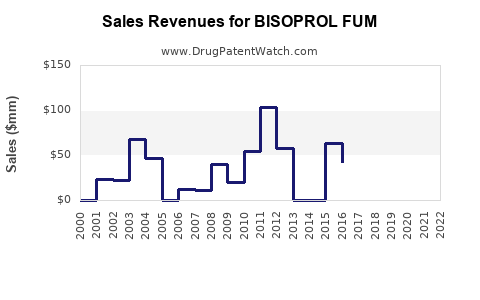
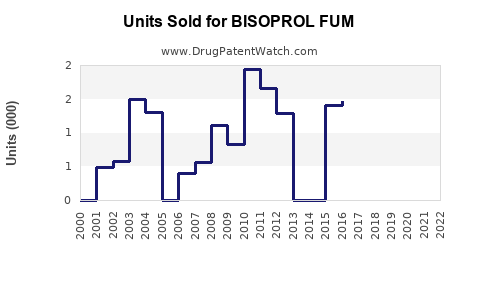
Annual Sales Revenues and Units Sold for BISOPROL FUM
| Drug Name | Revenues (USD) | Units | Year |
|---|---|---|---|
| BISOPROL FUM | ⤷ Start Trial | ⤷ Start Trial | 2022 |
| BISOPROL FUM | ⤷ Start Trial | ⤷ Start Trial | 2021 |
| BISOPROL FUM | ⤷ Start Trial | ⤷ Start Trial | 2020 |
| >Drug Name | >Revenues (USD) | >Units | >Year |
Bisoprolol Fumarate Market Analysis, Sales Forecast, Patent Risk and Competitive Outlook
Bisoprolol fumarate is a mature, low-cost beta-1 selective blocker used primarily for hypertension, chronic heart failure and coronary artery disease. The market is genericized, fragmented by country and dominated by price, distribution and prescribing access rather than exclusivity. A commercial entrant can achieve volume, but premium pricing and strong margins are difficult without a differentiated formulation, combination product or major institutional contract.
The following analysis treats “BISOPROL FUM” as bisoprolol fumarate immediate-release tablets and includes the bisoprolol/hydrochlorothiazide combination where relevant. Sales figures are modeled market estimates because manufacturers generally do not report global bisoprolol fumarate revenue as a separate line item.
What is bisoprolol fumarate and how is it used?
Bisoprolol fumarate is an oral, cardioselective beta-1 adrenergic blocker. It reduces heart rate, myocardial contractility and renin release.
| Attribute | Bisoprolol fumarate |
|---|---|
| Drug class | Selective beta-1 blocker |
| Main indications | Hypertension, chronic heart failure, coronary artery disease and angina |
| Common strengths | 5 mg and 10 mg; 2.5 mg is common in heart-failure titration |
| Common dosage | Once daily |
| Major reference brands | Zebeta, Concor and country-specific brands |
| Combination products | Bisoprolol/hydrochlorothiazide, including Ziac in the U.S. |
| Administration | Oral tablet |
| Primary competitors | Metoprolol, carvedilol, nebivolol, atenolol and combinations |
| Regulatory status | Long-established approved small molecule with extensive generic competition |
Bisoprolol is particularly established in Europe, Latin America, Asia and selected Middle Eastern markets. Concor remains a major branded reference product in several countries, while generic bisoprolol supplies most prescription volume in markets with mature generic substitution.
How large is the bisoprolol fumarate market?
The global bisoprolol fumarate market is best viewed as a high-volume, low-price market. Public financial reporting does not consistently separate bisoprolol from broader cardiovascular portfolios, and generic manufacturers rarely disclose ingredient-level revenue.
A reasonable 2024 global estimate for bisoprolol-containing products is:
| Market segment | Estimated 2024 annual sales | Main commercial characteristics |
|---|---|---|
| Bisoprolol fumarate monotherapy | $500 million-$900 million | Mostly generic; fragmented across national markets |
| Bisoprolol combination products | $150 million-$300 million | Higher average price and stronger formulation differentiation |
| Branded bisoprolol products | $300 million-$600 million | Concentrated in markets where Concor or local brands retain physician loyalty |
| Total bisoprolol-containing market | $650 million-$1.2 billion | Retail and institutional sales; broad geographic distribution |
These are modeled ranges rather than audited market totals. The largest value pools are likely in Europe, China, Japan, South Korea, Brazil, Mexico, Turkey and selected Middle Eastern markets. The United States is commercially important but highly commoditized.
Which regions offer the strongest growth?
Emerging markets offer greater unit growth, while developed markets offer more predictable reimbursement and regulatory pathways.
| Region | Market outlook | Commercial assessment |
|---|---|---|
| Europe | Stable to modest decline in value | High generic penetration; strong clinical familiarity |
| China | Moderate unit growth | Large population, hospital procurement and local manufacturing pressure |
| Japan | Stable | Mature reimbursement system and established domestic suppliers |
| Latin America | Moderate growth | Brand-generic coexistence; distributor strength matters |
| Middle East | Moderate value growth | Imported brands and local tenders both relevant |
| United States | Low value growth | Intense generic competition and limited pricing power |
| India | High unit competition | Large volume but aggressive pricing and crowded retail distribution |
What are the bisoprolol fumarate sales projections through 2030?
The base-case forecast assumes continued hypertension and heart-failure treatment demand, stable generic substitution and low annual price inflation. The forecast excludes a major new indication or a materially differentiated delivery system.
| Year | Base-case global sales | Low case | High case |
|---|---|---|---|
| 2024 | $850 million | $650 million | $1.2 billion |
| 2025 | $865 million | $635 million | $1.25 billion |
| 2026 | $880 million | $620 million | $1.30 billion |
| 2027 | $895 million | $605 million | $1.35 billion |
| 2028 | $910 million | $590 million | $1.40 billion |
| 2029 | $925 million | $575 million | $1.45 billion |
| 2030 | $940 million | $560 million | $1.50 billion |
The base case implies approximately 1.6% annual growth in nominal market value. Unit volume may grow faster, but price erosion offsets much of that increase.
What would drive upside?
Upside depends on products that compete on more than active-ingredient price. The strongest opportunities are:
- Fixed-dose combinations with hydrochlorothiazide, amlodipine or other cardiovascular agents.
- Extended-release or adherence-oriented products.
- Hospital and government procurement contracts.
- Markets with limited local competition.
- Pediatric or special-population formulations, subject to regulatory support.
- Co-marketing of bisoprolol with heart-failure treatment protocols.
- Local manufacturing that reduces tender and supply-chain costs.
A conventional 5 mg or 10 mg tablet launched in a mature generic market is unlikely to achieve premium pricing.
How does bisoprolol compare with competing beta blockers?
Bisoprolol competes primarily against metoprolol and carvedilol in heart failure, and against atenolol, nebivolol and calcium-channel-blocker regimens in hypertension.
| Drug | Main competitive advantage | Main disadvantage versus bisoprolol |
|---|---|---|
| Bisoprolol | Once-daily dosing, beta-1 selectivity, established heart-failure use | Mature generic pricing and limited differentiation |
| Metoprolol | Broad physician familiarity and multiple formulations | Greater formulation complexity; selectivity varies by product |
| Carvedilol | Alpha and beta blockade; strong heart-failure positioning | More frequent dosing and greater hypotension burden for some patients |
| Nebivolol | Beta-1 selectivity and nitric-oxide-mediated effects | Usually higher price; reimbursement constraints |
| Atenolol | Low cost and long market history | Less favorable pharmacokinetic and clinical positioning in some guidelines |
Bisoprolol’s strongest commercial position is in once-daily chronic therapy, particularly where prescribers value predictable titration and generic affordability.
What patents protect bisoprolol fumarate?
Bisoprolol fumarate itself is an old active pharmaceutical ingredient. The original composition and core therapeutic patents have expired in the major markets. The commercial opportunity is therefore not protected by a live compound patent.
| IP category | Current commercial significance |
|---|---|
| Core bisoprolol compound | Expired |
| Bisoprolol fumarate salt | Generally mature and no longer a meaningful exclusivity barrier |
| Immediate-release tablets | Usually protected only by expired or nonblocking formulation rights |
| Bisoprolol/hydrochlorothiazide combinations | Any relevant historical patents are generally expired or commercially weak |
| Manufacturing processes | Possible country-specific rights, but usually avoidable through process design |
| New formulations | Potentially patentable if clinically and technically differentiated |
| Method-of-use claims | Possible for narrow patient populations, but limited value for routine hypertension treatment |
Patent status must be confirmed by jurisdiction and product-specific review. For a standard bisoprolol fumarate tablet, the principal business risk is regulatory approval, price competition and supply reliability rather than patent infringement.
When did bisoprolol lose exclusivity?
Bisoprolol lost meaningful market exclusivity decades ago. The U.S. reference product Zebeta was approved by the FDA in 1992, and generic bisoprolol products subsequently entered the market. The original branded-product exclusivity period is no longer commercially relevant.
The active ingredient is therefore suitable for generic development without a conventional originator patent barrier. A product-specific freedom-to-operate review remains necessary for any controlled-release system, novel combination, manufacturing process or country-specific market.
What is the Orange Book status of bisoprolol fumarate?
The FDA Orange Book historically lists U.S. reference products and patents associated with approved products. Bisoprolol fumarate tablets are represented by generic approvals linked to the Zebeta reference product. The standard immediate-release product does not present a known, commercially significant current patent barrier comparable to protected small-molecule products.
The relevant U.S. regulatory pathway is an abbreviated new drug application, or ANDA, supported by bioequivalence to the reference listed drug. For a conventional immediate-release product, the main regulatory work involves:
- Active ingredient and excipient control.
- Comparative dissolution.
- Bioequivalence.
- Stability data.
- Current good manufacturing practice compliance.
- Labeling consistent with the reference product.
Are there Paragraph IV challenges for bisoprolol fumarate?
Paragraph IV litigation risk is low for standard bisoprolol fumarate tablets because the product is highly genericized and the core patents are expired. Any future Paragraph IV dispute would more likely concern:
- A newly listed formulation patent.
- A controlled-release dosage form.
- A combination product.
- A manufacturing process patent.
- A narrow method-of-use claim.
For an ordinary immediate-release ANDA, certification against unexpired listed patents is unlikely to be the central launch issue. Market-entry timing would depend more on ANDA approval, manufacturing readiness, state substitution rules and commercial contracting.
Are biosimilars relevant to bisoprolol fumarate?
No. Bisoprolol fumarate is a chemically synthesized small molecule, not a biologic. Biosimilar regulation does not apply. Competition occurs through conventional generic-drug pathways, including ANDAs in the United States and national generic procedures in other jurisdictions.
What formulations are protected or commercially attractive?
The immediate-release tablet is the least differentiated product. More defensible opportunities involve delivery, combination or patient-use improvements.
Immediate-release tablets
These are the largest-volume products but have the lowest barriers to entry. Competing manufacturers can generally offer 2.5 mg, 5 mg and 10 mg strengths, subject to local approvals.
Fixed-dose combinations
Bisoprolol/hydrochlorothiazide products can generate better margins because they reduce pill burden and may have fewer direct competitors in some markets. Combination products still face generic substitution, and their value depends on reimbursement and prescribing conventions.
Modified-release products
A controlled-release product could support patent protection if it delivers a clinically meaningful pharmacokinetic or adherence benefit. The technical challenge is proving consistent release, bioequivalence and manufacturing reproducibility.
Pediatric and special-population products
Liquid or dispersible forms could address administration problems, but the market is smaller. Commercial value would depend on regulatory exclusivity, hospital adoption and reimbursement.
What FDA regulatory status applies to bisoprolol fumarate?
Bisoprolol fumarate is FDA-approved as a prescription cardiovascular medicine. The United States has generic tablet approvals, and bisoprolol/hydrochlorothiazide is also an established combination category.
A new generic developer would normally pursue an ANDA rather than a full new drug application. A differentiated formulation could require additional clinical or pharmacokinetic evidence, depending on the product design and FDA classification.
The key regulatory risks are manufacturing observations, dissolution variability, nitrosamine or impurity controls where applicable, supply-chain documentation and bioequivalence failures.
Which companies compete in bisoprolol fumarate?
The competitive field includes the original or established branded suppliers and a broad group of generic manufacturers. Competitors vary by market, but commonly encountered categories include:
- Merck KGaA and associated regional licensees for Concor.
- Teva.
- Sandoz.
- Viatris.
- Zydus.
- Dr. Reddy’s Laboratories.
- Sun Pharmaceutical Industries.
- Cipla.
- Torrent Pharmaceuticals.
- Regional European, Chinese, Latin American and Middle Eastern manufacturers.
The most relevant competitive distinction is often not the tablet itself. It is whether a company controls physician promotion, pharmacy distribution, hospital tenders, local registration and reliable supply.
What generic launch scenarios exist?
Low-cost commodity launch
A standard 5 mg and 10 mg tablet enters a mature market at a 20%-40% discount to the leading generic. This strategy can generate volume but usually produces thin gross margins.
Regional distributor launch
A manufacturer uses an established local distributor in two or three underpenetrated markets. This reduces commercial infrastructure costs and can improve launch speed, but distributor dependence reduces control over pricing and demand generation.
Combination-product launch
A bisoprolol/hydrochlorothiazide or bisoprolol/amlodipine product targets prescribers seeking lower pill burden. This offers a better margin profile but requires additional registration work and may face formulation patents in selected markets.
Differentiated adherence product
A modified-release, orally disintegrating or liquid formulation seeks a premium position. Development cost and regulatory risk are higher, and commercial success depends on evidence that the product improves adherence or tolerability.
For a hypothetical new manufacturer, modeled annual sales could range from $1 million-$5 million in the first full year for a single-country generic launch to $20 million-$50 million after multiregional expansion. A differentiated combination product could exceed those figures, but the outcome depends on reimbursement, registration breadth and procurement access.
What litigation or settlement issues affect bisoprolol?
There is no major current global litigation event that defines the ordinary bisoprolol fumarate market. Historical disputes associated with beta-blocker products are more relevant to product liability, labeling, manufacturing quality or specific formulation rights than to core bisoprolol composition patents.
Settlement agreements are unlikely to create a material delayed-entry issue for a conventional bisoprolol generic because the original exclusivity period has expired. Any proposed acquisition or licensing transaction should still review:
- Unexpired formulation patents.
- Manufacturing know-how.
- Regional trademark rights.
- Distribution exclusivity.
- Product liability history.
- Regulatory warning letters and recalls.
- Supply agreements with active ingredient manufacturers.
How strong is the bisoprolol patent estate?
The patent estate is weak for standard immediate-release bisoprolol fumarate and potentially moderate for a genuinely differentiated formulation.
| Patent dimension | Assessment |
|---|---|
| Compound protection | Very weak; expired |
| Standard tablet protection | Weak |
| Combination products | Low to moderate, depending on jurisdiction |
| Modified release | Moderate if claims are technically narrow and clinically supported |
| Manufacturing process | Low to moderate; generally manageable through design-around |
| Method of use | Low for broad cardiovascular indications; higher only for narrow claims |
| Freedom to operate for generic tablets | Generally favorable |
| Protection for a new platform | Potentially meaningful |
The strongest defensible assets would be formulation patents supported by robust stability, dissolution and pharmacokinetic data. A patent covering only routine excipient substitutions would face validity and enforcement pressure.
What revenue exposure exists for originators and generic manufacturers?
Revenue exposure is distributed differently across the market.
- Originators with Concor-like brands face gradual erosion from generic substitution but can retain value through physician loyalty and country-specific brand recognition.
- Large generic manufacturers face price compression and tender losses if several suppliers enter simultaneously.
- Local manufacturers may have an advantage where government procurement favors domestic production.
- Combination-product owners have greater protection from direct tablet substitution but remain exposed to therapeutic substitution.
- Contract manufacturers face lower commercial risk but also capture less value per unit.
A single-country generic launch is unlikely to move global market pricing. A multi-country tender strategy can materially affect prices if the entrant has low-cost production and reliable supply.
What geographic coverage is needed for a viable product?
A viable commercial plan should prioritize markets according to registration burden, generic penetration, reimbursement and competitor density.
| Strategy | Suitable markets | Expected position |
|---|---|---|
| High-volume generic | China, India, Brazil, Mexico | Volume-led, low margin |
| Premium branded generic | Turkey, Middle East, selected Latin America | Brand and distributor dependent |
| Regulated-market generic | U.S., EU, Japan | Higher compliance cost, predictable substitution |
| Combination product | Europe, Latin America, Middle East | Better differentiation |
| Hospital/tender product | China, Eastern Europe, public-health systems | Contract-driven and price sensitive |
What manufacturing and IP barriers exist?
Manufacturing barriers are moderate rather than high. Bisoprolol fumarate is a conventional small-molecule product, but commercial success requires consistent control of assay, impurities, tablet hardness, dissolution and stability.
The principal manufacturing risks are:
- Dependence on a small number of active pharmaceutical ingredient suppliers.
- Batch-to-batch dissolution variability.
- Inadequate impurity characterization.
- Packaging failures affecting stability.
- Regulatory observations at the finished-dose facility.
- Tender penalties caused by supply interruptions.
The IP barrier is lower than the operational barrier. A company with approved capacity, validated analytical methods and reliable distribution can compete, but price discipline is essential.
Key Takeaways
- Bisoprolol fumarate is a mature generic cardiovascular market with estimated global sales of roughly $650 million-$1.2 billion in 2024.
- Base-case market value is projected to reach about $940 million by 2030, with limited growth because volume gains are offset by price erosion.
- Core compound and standard immediate-release tablet patents are expired or commercially weak.
- Paragraph IV and biosimilar risks are low for conventional bisoprolol fumarate tablets.
- The most attractive commercial opportunities are fixed-dose combinations, differentiated-release products and underserved regional markets.
- FDA entry generally uses the ANDA pathway for standard tablets.
- Competitive advantage depends on cost, supply reliability, distributor access and tender execution rather than basic molecule ownership.
- A conventional generic launch can generate volume but is unlikely to support premium margins without formulation or channel differentiation.
FAQs
Is bisoprolol fumarate still commercially attractive in 2025?
Yes, but mainly as a volume product or as part of a differentiated combination strategy. Standard tablets have limited pricing power.
Is Concor stronger than generic bisoprolol?
Concor can retain brand preference in markets with established physician familiarity, but generic bisoprolol is therapeutically substitutable in many reimbursement systems and usually sells at a lower price.
Can a company patent a new bisoprolol fumarate formulation?
Yes. A new formulation may be patentable if it provides a non-obvious technical or clinical benefit, such as controlled release, improved stability or better administration.
What is the main risk in launching bisoprolol fumarate?
The main risk is commercial commoditization. Multiple approved suppliers can force prices down quickly, particularly in tenders and pharmacy channels.
Does bisoprolol fumarate require a full clinical trial for approval?
A conventional generic tablet generally does not require a full efficacy trial. Approval typically relies on an abbreviated pathway with pharmaceutical equivalence, bioequivalence, quality data and manufacturing compliance.
References
-
European Medicines Agency. (2023). Bisoprolol: Product information and therapeutic use. EMA.
-
U.S. Food and Drug Administration. (1992). Zebeta (bisoprolol fumarate) prescribing information. FDA.
-
U.S. Food and Drug Administration. (2024). Approved drug products with therapeutic equivalence evaluations. FDA.
-
U.S. Food and Drug Administration. (2024). Generic drug user fees and abbreviated new drug application guidance. FDA.
-
Merck KGaA. (2023). Annual report 2023. Merck KGaA.
-
World Health Organization. (2023). WHO guideline for the pharmacological treatment of hypertension in adults. World Health Organization.
More… ↓
