Share This Page
Drug Sales Trends for BENICAR HCT
✉ Email this page to a colleague
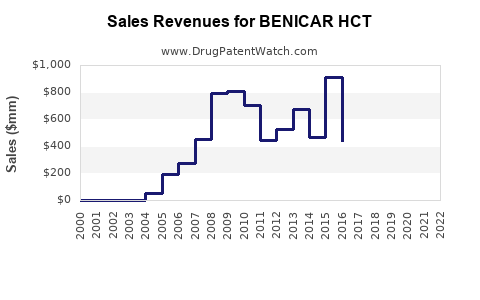
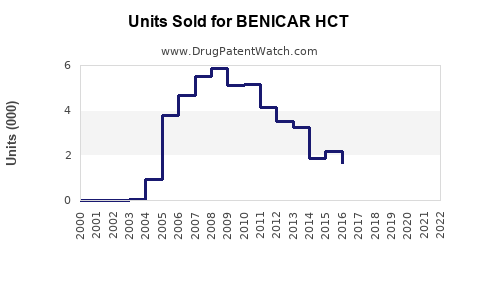
Annual Sales Revenues and Units Sold for BENICAR HCT
| Drug Name | Revenues (USD) | Units | Year |
|---|---|---|---|
| BENICAR HCT | ⤷ Start Trial | ⤷ Start Trial | 2022 |
| BENICAR HCT | ⤷ Start Trial | ⤷ Start Trial | 2021 |
| BENICAR HCT | ⤷ Start Trial | ⤷ Start Trial | 2020 |
| >Drug Name | >Revenues (USD) | >Units | >Year |
Benicar HCT Market Analysis, Patent Expiration and Sales Projections
Benicar HCT, the fixed-dose combination of olmesartan medoxomil and hydrochlorothiazide, is a mature antihypertensive product with limited branded revenue potential. Daiichi Sankyo launched the product in the United States in 2003, but compound and combination-product protection has expired. Generic competition now determines pricing, volume and market access. The branded product’s U.S. sales outlook is effectively residual, while generic olmesartan/hydrochlorothiazide products retain a stable maintenance market.
What is Benicar HCT and who markets it?
Benicar HCT combines an angiotensin II receptor blocker, olmesartan medoxomil, with the thiazide diuretic hydrochlorothiazide. The FDA-approved strengths are:
| Strength | Olmesartan medoxomil | Hydrochlorothiazide |
|---|---|---|
| Low dose | 20 mg | 12.5 mg |
| Intermediate dose | 40 mg | 12.5 mg |
| High dose | 40 mg | 25 mg |
The product is indicated for hypertension in patients who require combination therapy or who have not achieved adequate blood-pressure control with monotherapy.[1]
Daiichi Sankyo developed and commercialized Benicar HCT in the United States. The product was historically sold alongside Benicar, the olmesartan-only formulation. Benicar HCT is an originator small-molecule drug, not a biologic, so biosimilar regulation does not apply.
What is the FDA regulatory status of Benicar HCT?
Benicar HCT received FDA approval under NDA 021687 in 2003.[2] The FDA label identifies the product as a prescription fixed-dose antihypertensive tablet.
The commercial regulatory position is now defined by generic substitution:
- The product remains an FDA-approved branded drug.
- Generic olmesartan medoxomil/hydrochlorothiazide products have been approved through the ANDA pathway.
- Generic manufacturers can obtain therapeutic-equivalence designations when their products meet FDA requirements.
- State pharmacy substitution laws generally favor generic dispensing unless the prescriber or patient prevents substitution.
- There is no biosimilar pathway because Benicar HCT is a chemically synthesized small molecule.
The FDA label also contains a major safety consideration involving sprue-like enteropathy associated with olmesartan. Symptoms can include chronic diarrhea and substantial weight loss. The FDA added information on this risk to olmesartan-containing product labeling in 2013.[3]
What patents protected Benicar HCT?
The core U.S. patent estate centered on olmesartan medoxomil and the fixed-dose combination.
| Patent | Subject matter | Approximate U.S. expiration |
|---|---|---|
| U.S. Patent No. 5,616,599 | Olmesartan-related active pharmaceutical compound | 2016 |
| U.S. Patent No. 6,878,703 | Olmesartan medoxomil and hydrochlorothiazide combination | 2022, before any applicable adjustment |
| Other listed patents | Product-specific formulation or regulatory protection, where applicable | Dependent on Orange Book listing |
U.S. Patent No. 5,616,599 covered the underlying olmesartan compound and provided the principal early exclusivity position.[4] U.S. Patent No. 6,878,703 covered the combination of olmesartan medoxomil and hydrochlorothiazide and extended protection beyond the basic compound patent.[5]
The relevant Orange Book listing, including patent-use codes and any pediatric exclusivity adjustments, controls the regulatory patent record for ANDA applicants.[6] The commercial effect of the estate was substantially reduced after generic entry, even where residual formulation or method-of-use rights remained.
When did Benicar HCT lose exclusivity?
Benicar HCT lost meaningful U.S. exclusivity in stages.
| Period | Exclusivity event | Commercial effect |
|---|---|---|
| 2003 | FDA approval | Originator product entered the U.S. market |
| 2016 | Core olmesartan compound protection expired | Generic olmesartan products became commercially viable |
| 2016-2018 | Generic combination approvals and launches | Price and share pressure increased |
| 2022 | Principal combination patent protection expired | Remaining patent barrier was materially reduced |
| 2023 onward | Mature generic market | Brand demand became small and price-sensitive |
The exact date of first commercial generic entry depends on the ANDA applicant, litigation settlement terms and the particular strength. In practice, generic competition began to limit the branded product’s pricing power well before all listed combination patents expired.
What generic products compete with Benicar HCT?
Generic competitors include olmesartan medoxomil/hydrochlorothiazide tablets in strengths corresponding to Benicar HCT. Competition comes from a broad group of generic manufacturers, including large U.S. and international suppliers that participate in the hypertension market.
Relevant competitive products include:
- Generic olmesartan medoxomil/hydrochlorothiazide
- Generic losartan/hydrochlorothiazide
- Generic valsartan/hydrochlorothiazide
- Generic irbesartan/hydrochlorothiazide
- Generic telmisartan/hydrochlorothiazide
- Generic amlodipine/olmesartan combinations
Benicar HCT competes primarily on formulary status, generic acquisition cost, prescriber familiarity and tolerability. The product does not have a current technology advantage that would support a substantial branded premium.
Were there Paragraph IV challenges to Benicar HCT?
Generic applicants typically use Paragraph IV certifications when they assert that listed patents are invalid, unenforceable or will not be infringed. Olmesartan and olmesartan/hydrochlorothiazide products generated generic patent activity as the relevant patents approached expiration.
The key commercial issues were:
- Challenges to the olmesartan compound patent after its remaining term became short.
- Challenges to the fixed-dose combination patent.
- Potential 30-month stays under the Hatch-Waxman Act when litigation was timely filed.
- Settlement or launch arrangements that could permit an agreed generic entry date before the latest patent expiration.
The existence of an Orange Book patent did not guarantee continued branded market control. Once a settlement permitted entry or the relevant patent term ended, generic substitution rapidly changed the revenue profile.
What is the current Orange Book status of Benicar HCT?
Benicar HCT is an FDA-approved listed drug, and its regulatory reference-product status supports generic ANDA approvals. The commercial relevance of Orange Book listings is now limited because the principal patent barriers have expired or reached the end of their practical market life.
The current assessment is:
| Orange Book issue | Assessment |
|---|---|
| Reference listed drug | Benicar HCT |
| FDA pathway for competitors | ANDA |
| Active biologic exclusivity | Not applicable |
| Core compound patent barrier | Expired |
| Principal combination patent barrier | Expired or no longer commercially controlling |
| Current brand protection | Primarily trademark, manufacturing, supply and commercial factors |
How strong is the Benicar HCT patent estate?
The patent estate was commercially strong during the initial launch period because it combined compound protection with fixed-dose combination protection. Its present strength is low.
Strengths during the protected period
- Broad protection for the olmesartan active ingredient.
- Separate protection for the combination with hydrochlorothiazide.
- Regulatory exclusivity associated with FDA approval.
- Established clinical and commercial use in hypertension.
- Potential delay from ANDA litigation and statutory stays.
Current weaknesses
- The key U.S. patent terms have ended.
- Generic products have demonstrated therapeutic substitution.
- The product has no biologic complexity or device-based barrier.
- Hypertension treatment is highly price-sensitive.
- Multiple alternative ARB/thiazide combinations are available.
- Most payer formularies favor generic products.
The remaining defensibility is commercial rather than patent-based. Brand recognition and physician familiarity can preserve a small residual share, but they do not support premium pricing at scale.
What is the Benicar HCT sales history?
Daiichi Sankyo reported Benicar as a major cardiovascular product during the period when olmesartan products had effective market exclusivity.[7] Public company reporting generally combined Benicar-family products or reported them within broader regional product categories. It did not consistently disclose a stand-alone, worldwide Benicar HCT revenue line.
That limits the reliability of product-specific historical sales estimates. A market analyst should distinguish:
- Benicar HCT brand revenue.
- Benicar olmesartan-only revenue.
- Total olmesartan franchise revenue.
- Generic olmesartan/hydrochlorothiazide revenue.
- Net sales after rebates and discounts.
These categories are not interchangeable. Historical franchise sales materially overstate the revenue attributable to Benicar HCT alone.
What are the Benicar HCT sales projections for 2025-2029?
The following projection estimates branded Benicar HCT revenue, not the entire generic olmesartan/hydrochlorothiazide market. It assumes continued FDA availability, no major supply disruption and normal generic substitution.
| Year | Base-case branded U.S. sales | Downside case | Upside case |
|---|---|---|---|
| 2025 | $1-3 million | Less than $1 million | $4-6 million |
| 2026 | $0.8-2.5 million | Less than $1 million | $3-5 million |
| 2027 | $0.5-2.0 million | Less than $0.5 million | $2-4 million |
| 2028 | $0.3-1.5 million | Less than $0.5 million | $1.5-3 million |
| 2029 | Less than $1.5 million | Less than $0.5 million | $1-2.5 million |
These are analytical estimates rather than company guidance. The base case assumes:
- A continuing decline in branded prescriptions.
- High generic substitution.
- Limited formulary preference for the branded product.
- No material new indication.
- No successful life-cycle product that transfers demand back to Benicar HCT.
- Stable availability of low-cost generic alternatives.
The upside case would require a supply shortage among generic competitors, a contracting strategy that preserves selected institutional accounts or a branded distribution program targeted at patients who cannot access the generic. Those conditions would not change the long-term patent outlook.
What is the generic market opportunity for olmesartan/hydrochlorothiazide?
The generic market is more durable than the branded market. Combination therapy remains clinically useful for patients who need greater blood-pressure reduction than an ARB alone can provide. The combination also offers a lower pill burden than taking the two medicines separately.
Generic market demand is supported by:
- Chronic hypertension prevalence.
- Long-term treatment duration.
- Low acquisition cost.
- Familiar dosing strengths.
- Established clinical use.
- Payer preference for generic combination products.
Generic market risks include price erosion, supplier consolidation, recalls, shortages and substitution by other ARB combinations. Volume is likely to remain stable or decline modestly, while net pricing remains under pressure.
How does Benicar HCT compare with competing antihypertensive combinations?
| Product class | Main advantage | Main commercial weakness |
|---|---|---|
| Olmesartan/HCTZ | Established ARB/thiazide combination | Mature patents and generic pricing |
| Losartan/HCTZ | Large generic base and broad availability | Heavy price competition |
| Valsartan/HCTZ | Familiar ARB and combination use | Generic commoditization |
| Amlodipine/olmesartan | Alternative mechanism combination | More expensive than older generic combinations in some channels |
| ARB monotherapy plus separate HCTZ | Flexible titration | Higher pill burden |
Benicar HCT has no clear commercial advantage over generic competitors when the product is evaluated on price and formulary access. Its strongest position is among established patients whose physicians prefer continuation of the same product.
What generic entry risks exist?
The principal risk is substitution, not a new patent challenge. Generic entry creates four direct effects:
- Lower average selling price.
- Loss of pharmacy shelf preference.
- Reduced prescriber control over product selection.
- Greater dependence on payer and wholesaler contracts.
For investors or licensees, Benicar HCT should be treated as a low-growth, post-exclusivity product. Any valuation based on historical Benicar franchise revenue would materially overstate current brand economics.
Key Takeaways
- Benicar HCT is olmesartan medoxomil plus hydrochlorothiazide.
- FDA approval dates to 2003 under NDA 021687.
- The principal olmesartan compound patent expired in 2016.
- The main combination patent expired around 2022, subject to applicable term adjustments.
- Generic competition is the central commercial factor.
- Biosimilar risk does not apply because Benicar HCT is a small-molecule drug.
- Current branded U.S. sales are likely residual and measured in low single-digit millions or less annually.
- Generic olmesartan/hydrochlorothiazide demand should remain durable but price constrained.
- The patent estate is commercially weak after expiration.
- The product has limited licensing or litigation value unless bundled with a broader cardiovascular portfolio.
FAQs
Is Benicar HCT still sold in the United States?
Yes. The branded product may remain available through selected channels, but generic olmesartan medoxomil/hydrochlorothiazide products dominate dispensing and payer coverage.
Is Benicar HCT the same as olmesartan/HCTZ?
Yes. Olmesartan medoxomil/hydrochlorothiazide is the generic equivalent active-ingredient combination corresponding to Benicar HCT.
Can a generic company launch Benicar HCT without a license?
A generic company can launch an approved ANDA after satisfying applicable patent, certification and regulatory requirements. A brand license is not normally required after relevant patent and exclusivity barriers have expired.
Does Benicar HCT have pediatric exclusivity?
Any pediatric exclusivity associated with a listed patent must be determined from the applicable FDA Orange Book record. Pediatric extensions can alter the effective date for a specific patent but do not restore commercial exclusivity after the relevant protection has ended.
Is Benicar HCT a suitable licensing target?
The product is generally a weak stand-alone licensing target because patent protection has expired and generic substitution is established. Its value is greater as part of a mature cardiovascular portfolio with manufacturing scale, established distribution or a specialized market-access strategy.
References
- U.S. Food and Drug Administration. (2023). Benicar HCT prescribing information.
- U.S. Food and Drug Administration. (2003). Drugs@FDA: Benicar HCT, NDA 021687.
- U.S. Food and Drug Administration. (2013). FDA drug safety communication: FDA approves label changes to include intestinal problems associated with blood pressure drug olmesartan.
- U.S. Patent No. 5,616,599. (1997). Imidazole derivatives. United States Patent and Trademark Office.
- U.S. Patent No. 6,878,703. (2005). Pharmaceutical composition comprising olmesartan medoxomil and hydrochlorothiazide. United States Patent and Trademark Office.
- U.S. Food and Drug Administration. (2024). Approved drug products with therapeutic equivalence evaluations: Orange Book.
- Daiichi Sankyo Co., Ltd. (Various years). Annual reports and financial results.
More… ↓
