Share This Page
Drug Sales Trends for ASMANEX HFA
✉ Email this page to a colleague
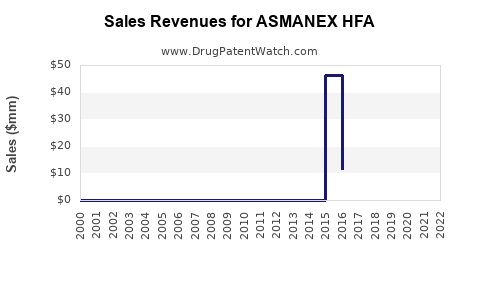
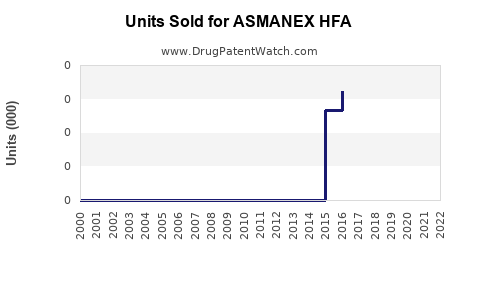
Annual Sales Revenues and Units Sold for ASMANEX HFA
| Drug Name | Revenues (USD) | Units | Year |
|---|---|---|---|
| ASMANEX HFA | ⤷ Start Trial | ⤷ Start Trial | 2022 |
| ASMANEX HFA | ⤷ Start Trial | ⤷ Start Trial | 2021 |
| ASMANEX HFA | ⤷ Start Trial | ⤷ Start Trial | 2020 |
| >Drug Name | >Revenues (USD) | >Units | >Year |
ASMANEX HFA Market Analysis, Patent Position, and Sales Projections
ASMANEX HFA is a low-revenue, mature inhaled corticosteroid product containing mometasone furoate. Its commercial position is weaker than newer inhaled corticosteroid/long-acting bronchodilator combinations because it is a controller monotherapy and competes against generic fluticasone, budesonide, beclomethasone, and mometasone products. Public company filings do not disclose standalone ASMANEX HFA sales. A reasonable U.S. base-case estimate is annual net sales of approximately $5 million to $15 million in 2025, declining to $2 million to $7 million by 2029 as formulary pressure, generic substitution, and portfolio rationalization continue.
What is ASMANEX HFA and what market does it address?
ASMANEX HFA is a pressurized metered-dose inhaler containing mometasone furoate, an inhaled corticosteroid used for the maintenance treatment of asthma. It is not indicated for acute bronchospasm or rescue treatment. The product is administered twice daily and is available in 50-mcg, 100-mcg, and 200-mcg strengths per actuation under U.S. labeling, with approved use dependent on age and dosage regimen. [1]
ASMANEX HFA competes in the inhaled corticosteroid, or ICS, segment. Its principal commercial alternatives include:
| Product | Active ingredient | Device | Market position |
|---|---|---|---|
| ASMANEX HFA | Mometasone furoate | HFA metered-dose inhaler | Branded ICS monotherapy |
| ASMANEX TWISTHALER | Mometasone furoate | Dry-powder inhaler | Older branded mometasone product |
| FLOVENT HFA | Fluticasone propionate | HFA metered-dose inhaler | Historically strong branded ICS |
| FLOVENT DISKUS | Fluticasone propionate | Dry-powder inhaler | Generic competition |
| QVAR RediHaler | Beclomethasone dipropionate | Breath-actuated HFA inhaler | Branded ICS |
| PULMICORT FLEXHALER | Budesonide | Dry-powder inhaler | Branded ICS |
| Generic budesonide and fluticasone | Various | HFA or dry-powder devices | Price-driven competition |
The larger asthma market has shifted toward combination products, including inhaled corticosteroid/long-acting beta agonist products such as Symbicort, Breo Ellipta, Dulera, and AirDuo. ASMANEX HFA lacks a long-acting bronchodilator and therefore has lower treatment intensity and lower expected revenue per patient than combination therapies.
What is the FDA regulatory status of ASMANEX HFA?
ASMANEX HFA received U.S. FDA approval under New Drug Application 204434. The product is regulated as a prescription inhalation aerosol for asthma maintenance therapy. Its regulatory value depends on continued commercial availability, manufacturing continuity, and reimbursement rather than on new clinical differentiation. [1][2]
Publicly available product information identifies ASMANEX HFA as a mature product. Merck historically commercialized ASMANEX products, while Merck’s established-products portfolio later became associated with Organon following the 2021 separation of Merck’s women’s health, biosimilars, and established-brands businesses. Portfolio ownership and commercialization arrangements should be distinguished from the original NDA holder and from any contract manufacturing entity. [3]
The key regulatory risks are:
- Product discontinuation or restricted distribution.
- Manufacturing interruptions affecting pharmacy availability.
- Loss of preferred formulary placement.
- Substitution by generic ICS products.
- Device-specific switching to dry-powder or breath-actuated inhalers.
- Reduced prescriber use because of the absence of a long-acting bronchodilator.
No new indication or major lifecycle expansion is apparent in the public product profile. That limits the probability of a material revenue recovery.
What are the ASMANEX HFA sales and revenue projections?
Standalone sales are not separately disclosed in the public annual reports of the relevant commercial companies. The following estimates are a market model, not reported revenue. The model assumes U.S. branded net sales, excluding sales of ASMANEX TWISTHALER and excluding any international revenue.
Base-case U.S. sales projection
| Year | Estimated net sales | Annual change | Core assumption |
|---|---|---|---|
| 2024 | $10 million-$20 million | - | Mature branded ICS demand |
| 2025 | $7 million-$15 million | -20% to -30% | Continued formulary erosion |
| 2026 | $5 million-$11 million | -20% to -30% | Greater generic and therapeutic substitution |
| 2027 | $4 million-$8 million | -15% to -25% | Stable residual branded use |
| 2028 | $3 million-$7 million | -10% to -20% | Low-volume maintenance market |
| 2029 | $2 million-$6 million | -10% to -20% | Residual demand and possible discontinuation risk |
A reasonable midpoint estimate is approximately $11 million in 2025 U.S. net sales, declining to approximately $4 million by 2029. The estimate should not be treated as reported company revenue.
Scenario analysis
| Scenario | 2025 sales | 2029 sales | Main drivers |
|---|---|---|---|
| Upside | $15 million-$25 million | $8 million-$14 million | Continued supply, stable payer access, limited direct substitution |
| Base | $7 million-$15 million | $2 million-$6 million | Gradual erosion and low new-patient starts |
| Downside | $2 million-$7 million | Below $2 million | Discontinuation, severe supply disruption, or rapid formulary exclusion |
The downside case is commercially credible because mature inhaled products can lose revenue rapidly when a manufacturer reduces promotional support or a payer removes the product from preferred coverage. The upside case is constrained by the product’s lack of combination therapy and weak differentiation against lower-cost ICS options.
How large is the addressable market for ASMANEX HFA?
The potential patient population is large because asthma is prevalent, but the addressable market for this specific product is narrow. ASMANEX HFA must compete for a subset of patients requiring ICS monotherapy who also receive, or retain, access to a branded HFA product.
The market can be divided into four segments:
- Existing ASMANEX HFA users who remain stable on treatment.
- Patients switching from another ICS because of device preference or tolerability.
- New asthma patients requiring controller therapy.
- Patients stepping down from combination therapy.
The first segment is the most commercially defensible. New-patient adoption is limited because guidelines and payer protocols generally favor lower-cost generic ICS products or combination therapies where clinically appropriate. The fourth segment is also unstable because step-down treatment is guided by disease control and may result in a generic ICS prescription.
ASMANEX HFA’s practical addressable market is therefore a maintenance base rather than a growth market.
How does ASMANEX HFA compare with competing inhaled corticosteroids?
ASMANEX HFA has a clinically established active ingredient but lacks a durable commercial advantage over generic alternatives.
| Factor | ASMANEX HFA | Generic fluticasone or budesonide | ICS/LABA products |
|---|---|---|---|
| Therapy | ICS monotherapy | ICS monotherapy | Combination therapy |
| Price position | Usually unfavorable | Favorable | Higher but clinically broader |
| Device differentiation | HFA aerosol | Varies | Device-specific |
| Generic substitution risk | High | Already generic | Increasing |
| Payer leverage | Weak to moderate | Strong | Depends on formulary |
| Growth potential | Low | Volume-driven | Higher treatment value |
| Patent dependence | Moderate | Usually limited | Product-specific |
ASMANEX HFA may retain value where a prescriber prefers mometasone, where a patient is stable on the product, or where the HFA device is preferred over a dry-powder inhaler. These factors support residual demand but are unlikely to produce material growth.
What patents protect ASMANEX HFA?
ASMANEX HFA’s protection is likely based on a combination of formulation, inhalation-device, manufacturing, and method-of-use rights rather than on broad composition-of-matter protection for mometasone furoate. Mometasone furoate is an established corticosteroid, so the commercial patent estate is principally relevant to the specific aerosol product and its delivery system.
Potentially relevant protection categories include:
- Mometasone furoate aerosol formulations.
- Propellant and excipient combinations.
- Metered-dose inhaler valve and canister configurations.
- Particle-size and suspension-control methods.
- Manufacturing processes for inhalation aerosols.
- Asthma-treatment methods using specified doses or regimens.
The exact patent scope and Orange Book status must be determined from the current FDA Orange Book and the relevant U.S. Patent and Trademark Office records. FDA’s Orange Book identifies patents and regulatory exclusivities that an innovator lists for an approved drug, but a patent’s presence in the Orange Book does not guarantee that it will prevent market entry. [2]
What is the likely patent strength of ASMANEX HFA?
The patent estate should be considered moderate to weak for long-term revenue protection.
Composition-of-matter protection is not the primary barrier because the active ingredient is old. Formulation and device patents can delay an identical generic aerosol, but they may not prevent:
- A different formulation.
- A different inhaler device.
- A different mometasone presentation.
- Therapeutic substitution with another ICS.
- Prescriber switching to a generic competitor.
Patent strength is therefore narrower than commercial exclusivity. Even a successful patent position for the exact HFA product would not protect the broader asthma-controller market.
Are there Paragraph IV challenges or generic entry risks?
Generic entry risk is high at the therapeutic level and potentially moderate to high at the product level. A generic company can challenge listed patents through an ANDA with a Paragraph IV certification if it believes the patents are invalid, unenforceable, or not infringed. Under the Hatch-Waxman framework, a Paragraph IV notice can trigger patent litigation and a 30-month stay of approval in defined circumstances. [4]
For ASMANEX HFA, the main generic-entry risks are:
- An ANDA for an equivalent mometasone furoate inhalation aerosol.
- A competing mometasone inhaler with a different device.
- Generic substitution involving fluticasone, budesonide, or beclomethasone.
- A branded product losing reimbursement despite continuing patent coverage.
- Pharmacy-level substitution where state law and payer policy permit it.
No publicly identified major Paragraph IV settlement or litigation outcome is incorporated into the sales model. The absence of a known settlement does not eliminate the risk of future ANDA litigation. The commercial impact of a generic may begin before full substitution because payers can impose higher copay tiers or require prior authorization.
What is the Orange Book status of ASMANEX HFA?
The FDA Orange Book is the controlling public source for current listed patents, exclusivity information, and approved drug-product status. ASMANEX HFA should be evaluated separately from ASMANEX TWISTHALER because the two products use different delivery systems and may have different regulatory and patent records. [2]
An Orange Book review should distinguish among:
- The ASMANEX HFA NDA.
- The ASMANEX TWISTHALER NDA.
- Listed formulation patents.
- Device-related patents.
- Expired or delisted patents.
- Any pediatric exclusivity.
- Any patent litigation that affects approval timing.
A listed patent may protect only the specific inhaler, formulation, or method of use. It does not necessarily block every mometasone-based asthma product.
What litigation and settlement issues affect ASMANEX HFA?
The principal litigation risk is ANDA patent litigation involving an exact or substantially equivalent inhalation aerosol. Other potential disputes include:
- Patent infringement claims over aerosol suspension formulations.
- Device-equivalence disputes.
- Regulatory petitions concerning substitutability.
- Manufacturing and supply agreements.
- Trademark or trade-dress disputes involving inhaler presentation.
No major publicly reported settlement is included in this analysis. A settlement could alter the commercial forecast by permitting an authorized generic, a licensed generic, or a delayed launch date. The economic effect would depend on launch timing and whether the settlement provides a license before the full expiry of relevant patents.
Are biosimilars relevant to ASMANEX HFA?
No. ASMANEX HFA is a small-molecule inhaled drug, not a biologic. Biosimilar competition under the Biologics Price Competition and Innovation Act is not the relevant entry pathway. Competition proceeds through the ANDA pathway for an equivalent drug product or through approval of a different inhaled corticosteroid product under another regulatory route. [4][5]
The relevant competitive threats are generic inhaled corticosteroids and alternative branded inhalers, not biosimilars.
Which companies are challenging or competing with ASMANEX HFA?
The principal competitive set includes manufacturers of generic and branded ICS products:
- Teva Pharmaceutical Industries.
- Viatris.
- Cipla.
- Lupin.
- Hikma Pharmaceuticals.
- AstraZeneca.
- GlaxoSmithKline.
- Organon.
- Chiesi Farmaceutici.
- Pharmaceutical companies marketing generic budesonide, fluticasone, beclomethasone, or mometasone inhalers.
Competition is likely to occur more through payer coverage and therapeutic substitution than through direct head-to-head promotion. Generic manufacturers can capture volume without reproducing the full brand identity, sales force, or patient-support infrastructure.
What licensing and manufacturing barriers affect ASMANEX HFA?
Inhaled products have higher manufacturing barriers than ordinary oral tablets. A competing manufacturer must establish:
- Consistent particle-size distribution.
- Uniform dose delivery.
- Reliable valve performance.
- Container-closure integrity.
- Propellant compatibility.
- Device performance across temperature and humidity conditions.
- Bioequivalence or comparative clinical performance under FDA requirements.
These barriers can delay generic entry, but they do not necessarily create durable commercial protection. Once a competitor establishes an approved manufacturing process and device, the originator may face substantial price pressure.
Licensing could be commercially relevant if the rights holder transfers commercialization to another company with a stronger respiratory portfolio. A licensing deal could preserve distribution but would not solve the product’s limited differentiation. No material public licensing transaction is assumed in the base-case forecast.
What generic launch scenarios exist for ASMANEX HFA?
Scenario 1: No direct generic, continued residual sales
The product remains available but receives limited commercial investment. Sales decline gradually as patients switch to generic ICS products and newer therapies.
Scenario 2: Direct mometasone HFA generic launch
A therapeutically equivalent generic enters after patent or regulatory barriers are resolved. Brand sales could fall by 60% to 90% within two to three years, depending on payer substitution and pharmacy availability.
Scenario 3: Manufacturing discontinuation
The branded product becomes unavailable or intermittently supplied. Most patients migrate to alternative ICS products, causing sales to fall faster than under ordinary generic erosion.
Scenario 4: Portfolio transfer or authorized generic
The rights holder licenses or transfers the product to another manufacturer. Unit volume may remain stable, but net price declines materially. The product becomes a lower-margin cash-flow asset rather than a growth product.
What is the investment and commercial outlook for ASMANEX HFA?
ASMANEX HFA is best viewed as a declining mature-brand asset with limited strategic upside. Its commercial value rests on residual prescriptions, manufacturing reliability, and any remaining device or formulation barriers. It is unlikely to justify significant clinical-development spending unless bundled with a broader respiratory portfolio or used as a platform for a combination product.
The principal downside risks are direct generic entry, supply interruption, loss of formulary access, and manufacturer withdrawal. The principal upside case is limited to a stable niche of patients who prefer the HFA delivery system and remain covered by plans that reimburse the branded product.
Key Takeaways
- ASMANEX HFA is an established mometasone furoate inhaled corticosteroid for asthma maintenance.
- Public filings do not disclose standalone product sales.
- Estimated U.S. net sales are approximately $7 million to $15 million in 2025 under the base case.
- Base-case sales decline to approximately $2 million to $6 million by 2029.
- The product faces high therapeutic substitution risk from generic fluticasone, budesonide, and beclomethasone.
- Patent protection is more likely to involve formulation and device claims than broad active-ingredient protection.
- Paragraph IV and direct generic risks are commercially material, although exact current Orange Book listings require live verification.
- Biosimilars are not relevant because ASMANEX HFA is a small-molecule inhaled drug.
- The product has low growth potential and should be valued as a mature, declining respiratory asset.
FAQs
When did ASMANEX HFA receive FDA approval?
ASMANEX HFA was approved under NDA 204434. FDA labeling identifies mometasone furoate inhalation aerosol as a maintenance treatment for asthma. [1]
Is ASMANEX HFA the same as ASMANEX TWISTHALER?
No. Both contain mometasone furoate, but ASMANEX HFA is a pressurized metered-dose inhaler and ASMANEX TWISTHALER is a dry-powder inhaler. Their regulatory records, patents, and substitution issues can differ.
Is ASMANEX HFA a biologic or biosimilar product?
No. It is a small-molecule inhaled corticosteroid. Generic competition is governed primarily by the ANDA pathway rather than the biosimilar pathway.
What is the largest commercial risk for ASMANEX HFA?
The largest risk is loss of branded volume through therapeutic substitution and payer pressure, even if no direct equivalent generic enters the market.
Can ASMANEX HFA become a growth product?
A material growth recovery is unlikely without a new indication, a differentiated device, a combination product, or a commercial transaction that changes market access. The current product profile supports residual revenue rather than expansion.
References
-
U.S. Food and Drug Administration. (2019). Asmanex HFA: Prescribing information. FDA.
-
U.S. Food and Drug Administration. (2024). Approved drug products with therapeutic equivalence evaluations: Orange Book. FDA.
-
Merck & Co., Inc. (2021). 2020 annual report. Merck.
-
U.S. Food and Drug Administration. (2024). Hatch-Waxman and generic drug approvals. FDA.
-
U.S. Food and Drug Administration. (2024). Biosimilar and interchangeable biosimilar products. FDA.
More… ↓
