Drug Sales Trends for AMLODIPINE BESYLATE
Payment Methods and Pharmacy Types for AMLODIPINE BESYLATE (2022)
Revenues by Pharmacy Type
Units Sold by Pharmacy Type
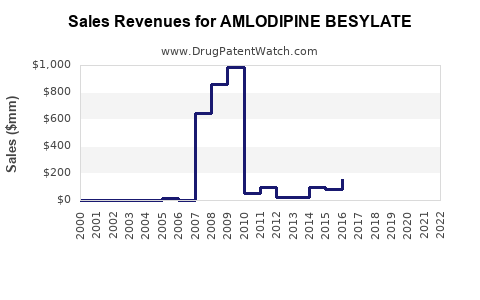
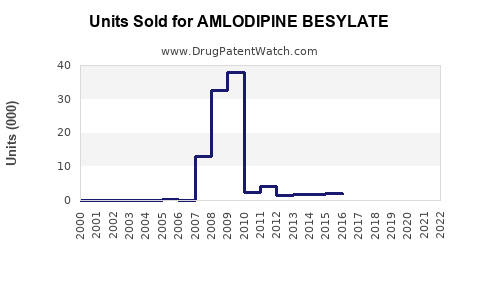
Annual Sales Revenues and Units Sold for AMLODIPINE BESYLATE
| Drug Name | Revenues (USD) | Units | Year |
|---|---|---|---|
| AMLODIPINE BESYLATE | ⤷ Start Trial | ⤷ Start Trial | 2022 |
| AMLODIPINE BESYLATE | ⤷ Start Trial | ⤷ Start Trial | 2021 |
| AMLODIPINE BESYLATE | ⤷ Start Trial | ⤷ Start Trial | 2020 |
| AMLODIPINE BESYLATE | ⤷ Start Trial | ⤷ Start Trial | 2019 |
| AMLODIPINE BESYLATE | ⤷ Start Trial | ⤷ Start Trial | 2018 |
| AMLODIPINE BESYLATE | ⤷ Start Trial | ⤷ Start Trial | 2017 |
| >Drug Name | >Revenues (USD) | >Units | >Year |
Amlodipine Besylate Market Analysis and Sales Projections
Amlodipine besylate is a mature, low-cost generic calcium-channel blocker with broad global use in hypertension and coronary artery disease. Its patent and regulatory exclusivity barriers have expired in major markets. Commercial growth depends on prescription volume, emerging-market access, fixed-dose combinations, hospital procurement, and price competition rather than exclusivity.
A reasonable base-case estimate places the global finished-dose amlodipine market, including monotherapy and selected fixed-dose combinations, at approximately $1.2 billion to $1.5 billion in 2024. Under a 3% to 5% annual growth rate, the market could reach approximately $1.5 billion to $2.0 billion by 2030. Manufacturer revenue will remain under pressure because additional generic suppliers generally reduce average selling prices.
What is the current market position of amlodipine besylate?
Amlodipine besylate is the besylate salt of amlodipine, marketed primarily as an oral tablet. It is a dihydropyridine calcium-channel blocker indicated for:
- Hypertension
- Chronic stable angina
- Vasospastic, or Prinzmetal, angina
- Reduction of cardiovascular risk through blood-pressure control
The drug is available in 2.5 mg, 5 mg, and 10 mg tablet strengths in the United States. The 5 mg and 10 mg strengths account for most prescription volume. Amlodipine is also sold in combination products with:
- Benazepril
- Olmesartan
- Valsartan
- Atorvastatin
- Losartan in certain international markets
- Hydrochlorothiazide in certain markets
The product has a long half-life, once-daily dosing, low manufacturing complexity, and extensive guideline adoption. These factors support high unit demand but limit pricing power.
Market segmentation
| Segment | Commercial position | Growth outlook |
|---|---|---|
| Amlodipine monotherapy | Largest volume segment | Low single-digit growth |
| Amlodipine fixed-dose combinations | Higher value per prescription | Faster than monotherapy |
| Retail generic tablets | Highly competitive | Volume growth, price erosion |
| Hospital and institutional supply | Tender-driven | Stable to modest growth |
| Emerging markets | Underdiagnosed and undertreated hypertension | Highest volume growth |
| Branded amlodipine | Limited in the U.S. | Declining or niche |
How large is the amlodipine besylate market?
Public market reports use inconsistent definitions. Some include only amlodipine tablets; others include amlodipine combinations, branded products, active pharmaceutical ingredient sales, or the broader antihypertensive market. A practical commercial estimate is:
| Market definition | Estimated 2024 value | 2030 base-case estimate |
|---|---|---|
| Global amlodipine finished-dose products | $1.2B-$1.5B | $1.5B-$2.0B |
| Global amlodipine monotherapy | $0.8B-$1.1B | $0.9B-$1.3B |
| Global amlodipine combinations | $0.4B-$0.7B | $0.6B-$0.9B |
| U.S. generic amlodipine products | Approximately $150M-$300M | Approximately $140M-$280M |
| Global amlodipine API | Approximately $100M-$250M | Approximately $120M-$300M |
These estimates represent a market model rather than audited company revenue. The principal uncertainty is whether private-market studies count fixed-dose combinations and hospital tenders as amlodipine revenue.
Key demand drivers
Demand is supported by the global prevalence of hypertension, population aging, increasing blood-pressure screening, and expansion of generic medicine access. The World Health Organization estimates that approximately 1.28 billion adults aged 30 to 79 have hypertension globally, with a substantial proportion untreated or inadequately controlled (World Health Organization, 2023).
Demand is strongest where amlodipine is included in national treatment guidelines and procurement formularies. Generic substitution is widespread in the United States, Europe, India, China, Brazil, and other large pharmaceutical markets.
What are the sales projections for amlodipine besylate?
The base case assumes global finished-dose sales of $1.35 billion in 2024, including monotherapy and amlodipine-containing combinations. It assumes annual market growth of 4%, moderate price erosion, and increasing combination-product penetration.
| Year | Downside case, 2% CAGR | Base case, 4% CAGR | Upside case, 6% CAGR |
|---|---|---|---|
| 2024 | $1.25B | $1.35B | $1.45B |
| 2025 | $1.28B | $1.40B | $1.54B |
| 2026 | $1.30B | $1.46B | $1.63B |
| 2027 | $1.33B | $1.52B | $1.73B |
| 2028 | $1.35B | $1.58B | $1.83B |
| 2029 | $1.38B | $1.65B | $1.94B |
| 2030 | $1.41B | $1.72B | $2.06B |
The base case implies approximately $370 million of incremental annual market value from 2024 through 2030. Unit growth will likely exceed revenue growth because generic pricing remains under pressure.
U.S. sales outlook
The U.S. market is mature. Prescription volume should remain stable or increase modestly as hypertension prevalence rises, while average prices decline or remain compressed. The main U.S. opportunity is operational rather than clinical:
- Reliable API supply
- High-volume ANDA manufacturing
- Contract manufacturing
- Retail pharmacy distribution
- Combination-product portfolios
- Hospital and Medicaid contracting
A U.S. supplier with a competitive cost structure could generate annual product revenue in the following ranges:
| Supplier position | Estimated annual U.S. revenue |
|---|---|
| Small approved supplier | $1M-$10M |
| Mid-sized supplier with broad distribution | $10M-$40M |
| Major generic supplier | $40M-$100M or more |
| Branded or authorized-generic position | Dependent on channel and contract structure |
These ranges are highly sensitive to the number of active suppliers, wholesaler access, and contract pricing.
When did amlodipine besylate lose exclusivity?
Amlodipine’s primary U.S. branded product, Norvasc, was developed and marketed by Pfizer. FDA approved Norvasc in 1992 under NDA 019787. Core patent protection expired in the 2000s, and generic amlodipine approvals began in the United States in 2007 after patent and regulatory barriers were resolved.
| Milestone | Date or status |
|---|---|
| Norvasc U.S. approval | 1992 |
| Core composition-of-matter protection | Expired in the 2000s |
| Generic U.S. entry | 2007 |
| Current U.S. exclusivity | None for standard amlodipine besylate tablets |
| Current commercial status | Mature generic |
| Biosimilar exclusivity relevance | None |
Patent expiry eliminated the primary barrier to entry. The remaining barriers are ordinary pharmaceutical manufacturing, ANDA approval, bioequivalence, quality compliance, and commercial distribution.
What patents protect amlodipine besylate today?
No commercially significant, broad, unexpired patent is generally understood to protect standard amlodipine besylate tablets in the United States. The original amlodipine patent estate covered the active compound and related pharmaceutical use. Those rights expired before the current generic market was established.
Potentially relevant rights may still arise around:
- Specific fixed-dose combinations
- Modified-release systems
- Specialized delivery devices
- Manufacturing processes
- Polymorphic forms
- Crystal structures
- Formulation excipients
- New therapeutic uses
These rights do not normally restore exclusivity to ordinary immediate-release amlodipine besylate tablets. A company evaluating a specific product must review the applicable FDA Orange Book, patent databases, and jurisdiction-specific registers.
What is the FDA regulatory status of amlodipine besylate?
Amlodipine besylate is an FDA-approved prescription drug available through abbreviated new drug applications. Generic applicants must establish pharmaceutical equivalence and bioequivalence to the relevant reference product. Standard tablets do not require a new clinical efficacy program if the ANDA requirements are satisfied.
The regulatory profile is favorable because:
- The active ingredient is well characterized.
- The dosage form is conventional.
- Bioequivalence methods are established.
- Clinical use is extensive.
- Safety and labeling requirements are well established.
- The product is not a biologic.
FDA-approved products are listed in the Orange Book by application number, strength, dosage form, and therapeutic equivalence code. The Orange Book remains the relevant source for current listed patents, exclusivity, and therapeutic-equivalence information (U.S. Food and Drug Administration, 2024a).
ANDA and regulatory risks
The primary regulatory risks are manufacturing and quality-related:
- Content uniformity failures
- Dissolution variability
- Impurity or degradation issues
- Data-integrity findings
- API contamination
- Facility inspection observations
- Supply interruptions
- Inadequate stability data
For a mature generic, an abbreviated approval pathway is not the main obstacle. Consistent commercial-scale production is more important.
Are there Paragraph IV challenges or generic litigation risks?
Paragraph IV risk for standard amlodipine besylate tablets is low because the principal branded patents expired years ago. Generic entrants are more likely to encounter routine ANDA review, manufacturing issues, or commercial contracting disputes than patent litigation.
Paragraph IV litigation can still arise for:
- New combination products
- Controlled-release formulations
- Reformulated dosage forms
- New indications
- Device-enabled delivery products
- Later-developed patents listed against a specific reference product
For conventional immediate-release tablets, the probability of a material patent injunction is low. Any current litigation assessment requires review of the specific ANDA, reference listed drug, patent listing, and district court docket.
What companies compete in the amlodipine market?
Competition is fragmented. Major multinational and regional generic manufacturers have marketed amlodipine or amlodipine combinations, including:
- Viatris
- Teva Pharmaceutical Industries
- Sandoz
- Dr. Reddy’s Laboratories
- Sun Pharmaceutical Industries
- Cipla
- Lupin
- Zydus Lifesciences
- Torrent Pharmaceuticals
- Aurobindo Pharma
- Hikma Pharmaceuticals
- Apotex
- Zhejiang Huahai Pharmaceutical
- Various Chinese, Indian, European, and Latin American suppliers
The relevant competitive advantage is usually cost, supply reliability, regulatory history, and channel access. A company with a lower manufacturing cost may still fail commercially if it lacks wholesaler contracts or cannot maintain uninterrupted supply.
How strong is the patent estate for amlodipine besylate?
The patent estate is weak for standard tablets and stronger only for narrowly defined improvements.
| Patent category | Current strength for standard tablets |
|---|---|
| Original active-ingredient patent | Expired |
| Original hypertension indication | Expired or commercially irrelevant |
| Immediate-release tablet formulation | Generally weak |
| Fixed-dose combination | Product-specific |
| Modified release | Potentially stronger if claims remain valid |
| Manufacturing process | Potentially relevant but narrow |
| Polymorph or salt form | Depends on jurisdiction and claim scope |
| Biologic exclusivity | Not applicable |
The commercial moat is therefore operational. Scale, API procurement, validated processes, and distribution are more valuable than patent ownership.
What generic entry risks exist?
Generic entry risk is already realized in the core product. The market has multiple suppliers, low technical complexity, and no meaningful exclusivity barrier. New entrants can increase supply but will generally pressure price rather than expand the market substantially.
Commercial risks include:
- Price erosion after approval.
- Dependence on a small number of API suppliers.
- Wholesale and pharmacy concentration.
- Product delisting after low margins.
- Regulatory observations or warning letters.
- Tender losses in government and hospital channels.
- Substitution toward other calcium-channel blockers or combination therapies.
For investors, the main risk is margin compression. For buyers, the main risk is supply reliability.
What formulation and combination products have greater commercial potential?
Fixed-dose combinations have stronger growth potential than amlodipine monotherapy because they improve adherence and align with guideline-based treatment strategies. Combination products can also support higher revenue per prescription and differentiation from commodity tablets.
Potentially attractive combinations include:
- Amlodipine plus an angiotensin receptor blocker
- Amlodipine plus an ACE inhibitor
- Amlodipine plus a statin
- Amlodipine plus a diuretic
- Triple antihypertensive combinations
The legal position of each combination must be assessed separately. A combination may have formulation or method-of-use patents even when amlodipine itself is fully generic.
Is biosimilar competition relevant to amlodipine besylate?
No. Amlodipine besylate is a small-molecule drug, not a biologic. Biosimilar pathways, biologic reference-product exclusivity, and interchangeability rules do not apply. Competition occurs through generic drug approvals, therapeutic equivalence, procurement contracts, and private-label distribution.
What licensing deals and manufacturing barriers affect the market?
Large licensing transactions are not usually required for conventional amlodipine tablets. Commercial arrangements commonly involve:
- API supply agreements
- Contract manufacturing
- Technology-transfer agreements
- Private-label distribution
- Regional marketing rights
- Fixed-dose combination licensing
- Authorized-generic arrangements
Manufacturing barriers are moderate to low. A supplier needs validated tablet production, reliable API access, appropriate dissolution and stability performance, and a compliant quality system. The strongest barrier is not formulation science but maintaining low cost and regulatory compliance at scale.
How does amlodipine compare with competing antihypertensive drugs?
| Drug class | Relative commercial position | Competitive effect on amlodipine |
|---|---|---|
| Amlodipine | High-volume generic | Baseline market |
| Losartan and other ARBs | High-volume generic | Strong substitute and combination partner |
| Lisinopril and other ACE inhibitors | High-volume generic | Strong substitute |
| Hydrochlorothiazide | Low-cost generic | Often used in combinations |
| Diltiazem | Established calcium-channel blocker | More specialized use |
| Felodipine | Smaller dihydropyridine market | Limited substitution |
| New branded antihypertensives | Higher price, narrower use | Limited direct effect |
Amlodipine remains competitive because of once-daily dosing, long clinical experience, broad guideline use, and availability across price tiers.
What is the geographic growth outlook?
| Region | Outlook |
|---|---|
| United States | Stable volume, low pricing, mature generic competition |
| Western Europe | Stable demand, tender-driven pricing |
| China | Large volume base and continued generic competition |
| India | Strong domestic volume and combination-product demand |
| Latin America | Moderate growth, variable reimbursement |
| Middle East and Africa | Long-term volume opportunity, procurement sensitivity |
| Southeast Asia | Growth supported by hypertension prevalence and generic access |
Emerging markets offer the strongest unit-growth opportunity. Revenue growth may remain modest because government tenders and local generic competition limit prices.
Key Takeaways
- Amlodipine besylate is a mature, widely used generic antihypertensive.
- Core U.S. patent and exclusivity barriers expired before the current generic market developed.
- The estimated global finished-dose market is approximately $1.2 billion to $1.5 billion in 2024.
- A base-case model projects approximately $1.72 billion in global sales by 2030.
- Fixed-dose combinations should grow faster than monotherapy.
- U.S. pricing is mature and highly competitive.
- Biosimilar risk does not apply.
- Patent litigation risk is low for standard immediate-release tablets.
- The main commercial advantages are manufacturing cost, supply reliability, regulatory execution, and distribution.
- Emerging markets and combination products offer the strongest growth opportunities.
Frequently Asked Questions
What is the annual revenue of amlodipine besylate?
Estimated global finished-dose revenue is approximately $1.2 billion to $1.5 billion annually, depending on whether fixed-dose combinations are included.
Is amlodipine besylate still protected by a patent?
Standard immediate-release amlodipine besylate tablets are not generally protected by the original active-ingredient patents. Product-specific patents may apply to combinations, formulations, or manufacturing processes.
Is amlodipine besylate a generic drug?
Yes. Amlodipine besylate is widely marketed as a generic prescription drug in the United States and internationally.
What is the projected growth rate for the amlodipine market?
A reasonable base case is 3% to 5% annual global growth through 2030, driven mainly by population aging, hypertension treatment, emerging-market access, and combination products.
Which companies manufacture amlodipine besylate?
Manufacturers and marketers include Viatris, Teva, Sandoz, Dr. Reddy’s, Sun Pharma, Cipla, Lupin, Zydus, Torrent, Aurobindo, Hikma, Apotex, and regional suppliers.
References
-
U.S. Food and Drug Administration. (2024a). Approved drug products with therapeutic equivalence evaluations: Orange Book. https://www.accessdata.fda.gov/scripts/cder/ob/
-
U.S. Food and Drug Administration. (2024b). Drugs@FDA: FDA-approved drugs. https://www.accessdata.fda.gov/scripts/cder/daf/
-
World Health Organization. (2023). Global report on hypertension: The race against a silent killer. https://www.who.int/publications/i/item/9789240081062
-
U.S. National Library of Medicine. (2024). DailyMed: Amlodipine besylate. https://dailymed.nlm.nih.gov/dailymed/
-
Pfizer Inc. (1992). Norvasc prescribing information. U.S. Food and Drug Administration labeling archive.
More… ↓
