Share This Page
Drug Sales Trends for ADDERALL XR
✉ Email this page to a colleague
Payment Methods and Pharmacy Types for ADDERALL XR (2022)
Revenues by Pharmacy Type
Units Sold by Pharmacy Type
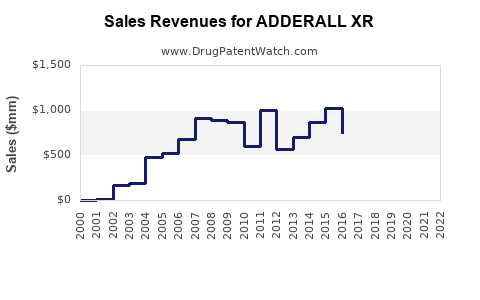
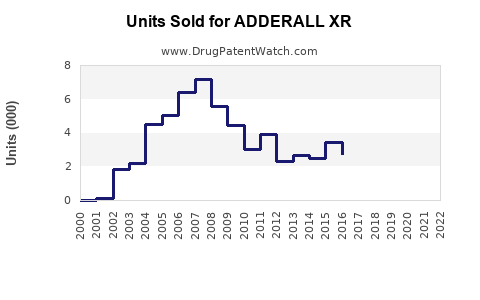
Annual Sales Revenues and Units Sold for ADDERALL XR
| Drug Name | Revenues (USD) | Units | Year |
|---|---|---|---|
| ADDERALL XR | ⤷ Start Trial | ⤷ Start Trial | 2022 |
| ADDERALL XR | ⤷ Start Trial | ⤷ Start Trial | 2021 |
| ADDERALL XR | ⤷ Start Trial | ⤷ Start Trial | 2020 |
| ADDERALL XR | ⤷ Start Trial | ⤷ Start Trial | 2019 |
| ADDERALL XR | ⤷ Start Trial | ⤷ Start Trial | 2018 |
| >Drug Name | >Revenues (USD) | >Units | >Year |
Adderall XR Market Analysis, Sales Projections, Patent Status and Generic Competition
Adderall XR is a mature extended-release stimulant with broad U.S. prescribing, no meaningful remaining branded patent protection, and substantial generic competition. The commercial market is driven by prescription volume, generic availability, manufacturing capacity, controlled-substance quotas and periodic shortages rather than exclusivity. Under a base-case model, U.S. sales across brand and generic mixed amphetamine salts extended-release products could reach approximately $1.3 billion to $1.6 billion in 2029, while branded Adderall XR revenue is likely to remain a minority share of the market.
What is Adderall XR and how large is its addressable market?
Adderall XR is an extended-release capsule containing mixed amphetamine salts. The active ingredients are dextroamphetamine saccharate, amphetamine aspartate, dextroamphetamine sulfate and amphetamine sulfate. The product is approved for the treatment of attention-deficit/hyperactivity disorder in patients age six and older.[1]
The product is marketed in multiple strengths:
| Strength | Dosage form | Typical commercial role |
|---|---|---|
| 5 mg | Extended-release capsule | Initiation and low-dose titration |
| 10 mg | Extended-release capsule | Common pediatric and adult dose |
| 15 mg | Extended-release capsule | Intermediate titration |
| 20 mg | Extended-release capsule | Common maintenance dose |
| 25 mg | Extended-release capsule | Higher maintenance dose |
| 30 mg | Extended-release capsule | Maximum labeled strength |
The commercial market includes:
- Branded Adderall XR.
- Authorized or branded-generic products.
- Generic mixed amphetamine salts extended-release capsules.
- Competing extended-release stimulants, including Vyvanse, Concerta, Ritalin LA, Jornay PM and other methylphenidate or amphetamine formulations.
The addressable market is concentrated in the United States. Adderall XR is not a major global growth asset because controlled-substance rules, reimbursement systems and diagnostic practices limit international expansion.
What are Adderall XR sales and revenue projections?
Public company filings generally do not report Adderall XR revenue as a standalone line item. The following forecast is a market-planning estimate for U.S. sales of branded and generic mixed amphetamine salts extended-release products, based on the product’s mature status, sustained ADHD treatment demand, generic pricing pressure and recurring supply constraints.
U.S. Adderall XR market forecast
| Year | Low case | Base case | High case | Principal driver |
|---|---|---|---|---|
| 2024 | $1.05B | $1.25B | $1.45B | Stable demand, uneven supply |
| 2025 | $1.07B | $1.31B | $1.52B | Prescription growth and normalization |
| 2026 | $1.08B | $1.37B | $1.60B | Volume growth offset by price erosion |
| 2027 | $1.08B | $1.43B | $1.69B | Higher treatment persistence |
| 2028 | $1.07B | $1.49B | $1.77B | Continued demand, limited nominal growth |
| 2029 | $1.06B | $1.55B | $1.85B | Volume expansion with generic competition |
The base case implies an approximately 4.5% compound annual growth rate from 2024 through 2029. That growth is expected to come primarily from prescription volume and higher treatment duration. Unit growth is more likely than price growth because generic competition limits net pricing.
Branded Adderall XR forecast
| Year | Estimated branded share | Estimated branded sales range |
|---|---|---|
| 2024 | 10%-18% | $125M-$225M |
| 2025 | 8%-16% | $105M-$210M |
| 2026 | 7%-14% | $95M-$190M |
| 2027 | 6%-13% | $85M-$185M |
| 2028 | 5%-12% | $75M-$180M |
| 2029 | 4%-11% | $65M-$170M |
These projections assume that brand retention continues in patients who are stable on the branded product, but that payers maintain generic-first policies. Brand revenue is exposed to formulary restrictions, pharmacy substitution and generic availability.
When does Adderall XR lose exclusivity?
Adderall XR lost meaningful U.S. market exclusivity years ago. The original product was approved by the FDA in 2001 under NDA 021303. Generic extended-release mixed amphetamine salts products entered the market after FDA approvals beginning in 2012.[2]
| Event | Date or status |
|---|---|
| FDA approval of Adderall XR | 2001 |
| Original sponsor | Shire Pharmaceuticals |
| Current branded commercial ownership history | Shire acquired by Takeda in 2019 |
| Generic entry | Began in 2012 |
| Current patent-based exclusivity | Expired |
| Current commercial barrier | Manufacturing, supply and controlled-substance compliance |
Adderall XR is therefore a post-exclusivity product. The primary commercial question is not whether a competitor can launch after patent expiry. It is whether the competitor can obtain approval, secure active pharmaceutical ingredient supply, satisfy Drug Enforcement Administration requirements and maintain reliable distribution.
What patents protect Adderall XR?
The original Adderall XR estate focused on the extended-release delivery system, capsule technology, bead composition and dosing profile. The key commercial protections have expired or no longer prevent generic competition.
| Protection category | Commercial relevance today |
|---|---|
| Mixed amphetamine salts composition | Low; generic products contain the same active ingredients |
| Extended-release bead technology | Low; legacy protection has expired |
| Capsule dosage form | Low; multiple approved generics exist |
| ADHD method of use | Low; treatment indication is broadly genericized |
| Manufacturing know-how | Moderate; process consistency and supply reliability remain relevant |
| Trademark and brand recognition | Moderate; supports residual brand demand |
| FDA labeling and safety data | Low as an exclusivity barrier; generics may rely on the reference product |
The remaining intellectual-property value is concentrated in know-how, quality systems, manufacturing scale and commercial brand equity. Those assets do not create conventional patent exclusivity.
What is the Orange Book status of Adderall XR?
The FDA Orange Book lists Adderall XR as a reference listed drug. Orange Book listings historically covered patents related to the product’s extended-release formulation and delivery technology. Listed patents do not create a current barrier to generic supply where the patents have expired or are no longer enforceable against approved generic products.[3]
Generic manufacturers used abbreviated new drug applications, or ANDAs, that relied on Adderall XR’s safety and efficacy findings. Because generic applicants generally certify that relevant patents have expired, are not infringed or are invalid, the product’s patent estate became commercially ineffective after generic entry.
Which companies compete with Adderall XR?
The competitive field has two layers: generic mixed amphetamine salts manufacturers and branded ADHD therapies.
Generic manufacturers
Generic availability has included products marketed by large U.S. generic companies and specialty manufacturers. Teva has been a prominent supplier in the amphetamine market through its U.S. generic platform, while other approved manufacturers have supplied various strengths and package sizes.
Competition varies by strength. A manufacturer may have approval for 5 mg and 10 mg capsules but face capacity constraints in 25 mg or 30 mg presentations. Pharmacy-level shortages can therefore occur even when the overall market has several approved suppliers.
Branded competitors
| Product | Active ingredient | Release profile | Competitive position |
|---|---|---|---|
| Adderall XR | Mixed amphetamine salts | Extended release | Established amphetamine brand |
| Vyvanse | Lisdexamfetamine | Long acting | Premium branded alternative; patent expiry has increased generic risk |
| Concerta | Methylphenidate | Extended release | Major non-amphetamine alternative |
| Ritalin LA | Methylphenidate | Extended release | Established methylphenidate option |
| Jornay PM | Methylphenidate | Delayed and extended release | Differentiated evening-dosing product |
| Mydayis | Mixed amphetamine salts | Longer duration | Competing amphetamine formulation |
Adderall XR competes most directly with Vyvanse and Mydayis on amphetamine mechanism and with Concerta on long-acting ADHD treatment. The competitive decision is often based on duration, tolerability, insurance coverage, abuse-deterrence perceptions, dose flexibility and availability.
How does Adderall XR compare with Vyvanse and Concerta?
| Factor | Adderall XR | Vyvanse | Concerta |
|---|---|---|---|
| Drug class | Amphetamine | Amphetamine prodrug | Methylphenidate |
| Generic competition | Extensive | Increasing after lisdexamfetamine patent expiry | Extensive |
| Branded pricing power | Low to moderate | Historically higher | Moderate |
| Duration | Generally once daily | Generally once daily | Generally once daily |
| Patient switching risk | Moderate | High as generic access expands | Moderate |
| Supply exposure | High during amphetamine shortages | High during stimulant shortages | Moderate to high |
| Differentiation | Established mixed-salt profile | Prodrug design and longer clinical positioning | OROS delivery system |
Adderall XR has a lower price ceiling than newer branded products because physicians and payers can substitute generic mixed amphetamine salts. Its advantage is familiarity and a large installed patient base.
What FDA regulatory issues affect Adderall XR sales?
Adderall XR is a Schedule II controlled substance. The product is subject to federal requirements governing manufacturing quotas, distribution records, prescribing, diversion controls and pharmacy dispensing.[4]
The main regulatory risks are:
- DEA annual production quotas for amphetamine active ingredients.
- FDA-reported shortages involving specific strengths or manufacturers.
- Limits on telehealth prescribing that affect controlled-substance access.
- State prescribing and monitoring requirements.
- Pharmacy inventory controls.
- Enforcement actions involving suspicious orders or inadequate controlled-substance systems.
FDA shortage data has shown that stimulant availability can vary by strength and manufacturer. Shortages create temporary substitution opportunities, but they also reduce realized sales when pharmacies cannot fill prescriptions. A reliable supplier can gain market share without changing the underlying prescription demand.
What generic entry risks exist for Adderall XR?
Patent-based entry risk is effectively complete. The principal risks are commercial and operational.
Generic price erosion
Generic products typically reduce average selling prices after several suppliers enter. The erosion is less severe when:
- Only a small number of manufacturers supply a strength.
- Controlled-substance quotas limit production.
- Payers prefer a specific generic manufacturer.
- Shortages reduce competitive inventory.
- Retail pharmacy contracts consolidate purchasing.
Authorized generic risk
A branded or authorized-generic arrangement can preserve some supply-chain economics for the originator or its commercial partner. It can also reduce the price gap between brand and generic products, accelerating payer substitution.
Shortage-driven share volatility
Shortages create unstable market shares. A company with inventory can capture prescriptions temporarily, but the share may reverse when competing supply returns. This limits the value of short-term volume gains.
What licensing deals affect Adderall XR?
Shire developed and commercialized Adderall XR before its acquisition by Takeda. Takeda acquired Shire in 2019, transferring Shire’s ADHD portfolio and associated commercial rights.[5]
The principal transaction affecting the product is therefore corporate ownership rather than a new product licensing deal:
| Transaction | Date | Relevance |
|---|---|---|
| Shire acquires New River Pharmaceuticals | 2007 | Expanded Shire’s ADHD portfolio |
| Takeda acquires Shire | 2019 | Transferred Adderall XR ownership to Takeda |
| Generic supplier expansion | Post-2012 | Reduced originator economics |
Generic manufacturers commercialize their own approved products under ANDAs. These products do not depend on a conventional license from the branded sponsor, although supply, distribution and authorized-generic arrangements can affect market structure.
What patent litigation and Paragraph IV challenges affect Adderall XR?
Adderall XR’s important Paragraph IV period occurred before and around generic entry. Generic applicants used patent certifications to challenge or bypass listed patents, allowing ANDA approvals after applicable regulatory and litigation barriers were resolved.
Current litigation risk is limited because the central patent estate has expired and generic products are already marketed. Future disputes are more likely to concern:
- Product quality and manufacturing compliance.
- Patent claims covering a new delivery system or reformulation.
- Trademark use and trade dress.
- Supply agreements.
- Controlled-substance distribution practices.
- State-level product liability claims.
A new formulation using a materially different release profile could create a separate patent estate, but it would compete with, rather than restore, exclusivity for the legacy Adderall XR product.
How strong is the Adderall XR patent estate?
The estate is weak as a current blocking right and moderate as a historical technology estate.
| Attribute | Assessment |
|---|---|
| Blocking power against generics | Low |
| Remaining formulation exclusivity | Low |
| Manufacturing know-how | Moderate |
| Brand recognition | Moderate |
| Regulatory differentiation | Low |
| Litigation leverage | Low |
| Supply-chain value | Moderate to high |
The product’s commercial durability comes from prescription familiarity, physician habit, clinical experience and patient continuity. Those factors support demand but do not prevent substitution.
What generic launch scenarios could affect Adderall XR sales?
Base case
Generic supply remains available but uneven. The market grows in prescription volume by approximately 3% to 5% annually. Net prices decline by 1% to 3% annually. Total U.S. market sales rise toward $1.5 billion by 2029, while branded share declines.
Downside case
FDA and DEA supply constraints ease, additional generic suppliers enter, and payers intensify mandatory substitution. Total market revenue remains near $1.1 billion, with branded sales falling below $100 million annually.
Upside case
ADHD diagnosis and treatment persistence expand, stimulant shortages remain intermittent, and a limited number of manufacturers maintain supply. Total market sales approach $1.8 billion by 2029. The upside is volume-led; generic price inflation is unlikely to persist.
What geographic markets offer growth?
The United States remains the core market. Canada and selected European markets have ADHD stimulant demand, but Adderall XR has less commercial reach because of regulatory restrictions, local treatment preferences and limited availability of mixed amphetamine salts.
Geographic expansion is constrained by:
- National controlled-substance rules.
- Local approval requirements.
- Different ADHD diagnostic practices.
- Reimbursement limits.
- Import and distribution controls.
- Physician preference for methylphenidate products in some markets.
The most actionable geographic opportunity is U.S. supply reliability rather than international patent expansion.
What manufacturing and intellectual-property barriers remain?
Manufacturing is the main barrier to entry. A supplier must control:
- Amphetamine active pharmaceutical ingredient procurement.
- DEA quota allocation.
- Extended-release bead production.
- Content uniformity across strengths.
- Dissolution performance.
- Capsule filling and packaging.
- Serialization and controlled-substance distribution.
- FDA quality-system compliance.
The formulation is technically mature, but reproducible release characteristics are important. A generic product must demonstrate bioequivalence and meet dissolution requirements across strengths. Production interruptions can affect revenue faster than patent disputes.
Key Takeaways
- Adderall XR is a mature, post-exclusivity stimulant with extensive generic competition.
- The original product was FDA-approved in 2001, and generic entry began in 2012.
- Patent protection is no longer the principal commercial barrier.
- The U.S. mixed amphetamine salts extended-release market is estimated at about $1.25 billion in 2024 under the base case.
- Base-case market sales could reach approximately $1.55 billion by 2029.
- Branded Adderall XR sales are projected to decline as a percentage of the market, with estimated 2029 revenue of $65 million to $170 million.
- The strongest commercial variables are prescription volume, generic pricing, DEA quotas, FDA shortages and pharmacy supply.
- Takeda inherited the branded product through its 2019 acquisition of Shire.
- Biosimilar risk is not applicable because Adderall XR is a small-molecule drug; the relevant threat is generic substitution.
- Future value is concentrated in manufacturing reliability, supply agreements and brand retention rather than patent exclusivity.
FAQs About Adderall XR Market and Commercial Outlook
Is Adderall XR still patent protected?
No material blocking patent protection remains for the legacy Adderall XR product. Generic products have been marketed since 2012.
Who owns the Adderall XR brand?
Takeda owns the branded Adderall XR business through its acquisition of Shire Pharmaceuticals in 2019.
Are Adderall XR generics therapeutically equivalent?
FDA-approved generic mixed amphetamine salts extended-release products must demonstrate bioequivalence to the reference product and are generally substitutable under applicable state and payer rules.
Could Adderall XR sales increase despite generic competition?
Yes. Total market sales can rise if prescription volume, diagnosis rates or treatment persistence increase. Brand sales would require stronger patient or payer retention because generic substitution remains extensive.
Is Vyvanse a direct substitute for Adderall XR?
Vyvanse is a direct therapeutic competitor but contains lisdexamfetamine, an amphetamine prodrug, rather than mixed amphetamine salts. Prescribers may switch patients based on duration, tolerability, insurance coverage and product availability.
References
- U.S. Food and Drug Administration. (2023). Adderall XR prescribing information. FDA.
- U.S. Food and Drug Administration. (2024). Drugs@FDA: Adderall XR, NDA 021303. FDA.
- U.S. Food and Drug Administration. (2024). Approved drug products with therapeutic equivalence evaluations: Orange Book. FDA.
- Drug Enforcement Administration. (2024). Controlled substance quotas and amphetamine manufacturing controls. U.S. Department of Justice.
- Takeda Pharmaceutical Company Limited. (2019). Annual report and information regarding the acquisition of Shire plc. Takeda.
More… ↓
