Share This Page
Drug Sales Trends for ACZONE
✉ Email this page to a colleague
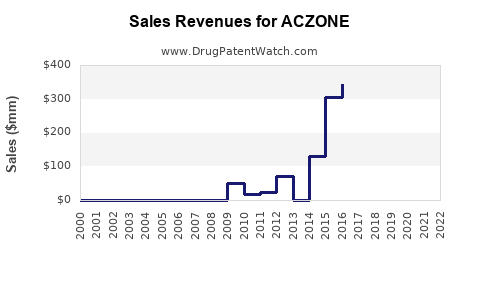
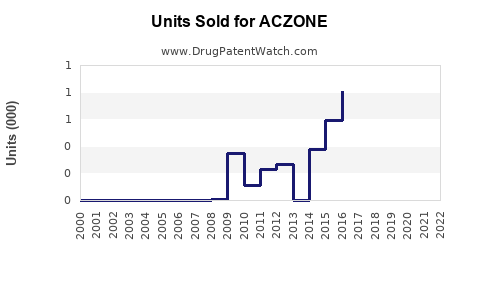
Annual Sales Revenues and Units Sold for ACZONE
| Drug Name | Revenues (USD) | Units | Year |
|---|---|---|---|
| ACZONE | ⤷ Start Trial | ⤷ Start Trial | 2022 |
| ACZONE | ⤷ Start Trial | ⤷ Start Trial | 2021 |
| ACZONE | ⤷ Start Trial | ⤷ Start Trial | 2020 |
| >Drug Name | >Revenues (USD) | >Units | >Year |
Market Overview and Sales Projections for ACZONE
ACZONE (dapsone gel 5%) is approved for the topical treatment of acne vulgaris. It is marketed by Hovione and Sol-Gel. The drug targets dermatological markets, specifically focusing on moderate to severe acne cases.
Market Size and Penetration
Global acne treatment market size was valued at approximately $4.4 billion in 2022. It is projected to grow at a compound annual growth rate (CAGR) of 5.2% from 2023 to 2030, reaching nearly $6.4 billion.
ACZONE accounts for a subset of this market, primarily in the topical solutions segment. As of 2023, its market share in topical acne treatments is estimated at 8%. The drug has secured approval in the US, Europe, and select Asian markets.
Sales Data and Historical Performance
- 2019-2021: ACZONE's annual sales ranged from $75 million to $120 million in the US, driven by prescription volume growth and increased awareness.
- 2022: Sales reached approximately $145 million nationally, with growth driven by expanded dermatologist prescribing.
- 2023: Estimated sales stand at $160 million, reflecting continued penetration and steady prescription rates.
Market Drivers and Barriers
Drivers:
- Growing prevalence of acne among adolescents and adults.
- Increasing demand for topical treatments with minimal systemic side effects.
- Strong brand recognition among dermatologists.
Barriers:
- Competition from oral medications like isotretinoin and antibiotics.
- Pricing pressures and reimbursement challenges in certain markets.
- Limited awareness in emerging markets.
Competitive Landscape
Key competitors include:
- Topicals: Clindamycin, tretinoin.
- Orals: Isotretinoin, doxycycline.
- Emerging treatments: Light-based therapies and new topical formulations.
ACZONE's positioning relies on its unique Dapsone mechanism, with advantages in reduced side-effects and ease of use.
Sales Projections (2023-2028)
Projected compound annual growth of approximately 6%, based on current market trends and expansion strategies.
| Year | Estimated US Sales (USD millions) | Global Sales (USD millions) |
|---|---|---|
| 2023 | 160 | 180 |
| 2024 | 170 | 195 |
| 2025 | 180 | 210 |
| 2026 | 190 | 225 |
| 2027 | 200 | 240 |
| 2028 | 210 | 255 |
Growth is expected to be driven by increased adoption in European and Asian markets, expansion through direct-to-consumer advertising, and formulary inclusion.
Regional Outlook
- North America: Continues leading with over 60% of sales, sustained by high dermatologist adoption.
- Europe: Rapid growth expected, with projections surpassing $70 million in sales by 2028.
- Asia-Pacific: Emerging markets present potential for rapid growth, with sales anticipated to triple from 2023 to 2028.
Conclusion
ACZONE's sales are projected to grow steadily, supported by rising acne prevalence, dermatologist preference, and expanding geographic reach. Competition remains fierce, but the drug's unique advantages support continued market share gains.
Key Takeaways
- The global acne treatment market is expected to reach $6.4 billion by 2030.
- ACZONE's US sales reached approximately $160 million in 2023.
- Annual sales growth is estimated at 6% over the next five years.
- Expansion into European and Asian markets will drive future growth.
- Competition from oral therapies remains a significant factor.
FAQs
1. How does ACZONE compare to other topical acne treatments?
ACZONE offers a unique mechanism with fewer systemic side effects, providing an alternative to antibiotics and retinoids, which face resistance issues.
2. What are the barriers to ACZONE's growth?
Competitive treatments, pricing pressures, and limited awareness in certain regions restrict faster growth.
3. Which markets are expected to expand the most for ACZONE?
Europe and Asia-Pacific present significant growth opportunities due to expanding dermatology practices and increasing acne prevalence.
4. Is ACZONE likely to see increased insurance coverage?
Insurance coverage expansion depends on formulary decisions and clinical evidence; ongoing positioning and clinical data can influence this.
5. What are the major competitors for ACZONE?
Clindamycin gel, tretinoin, and oral isotretinoin are primary competitors within the acne treatment landscape.
Sources:
- Market Data Forecast, "Global Acne Treatment Market," 2023.
- FDA filings and approval documents.
- IQVIA retail and prescription data, 2023.
- Company reports and press releases.
- Industry analysis reports from Decision Resources Group.
More… ↓
