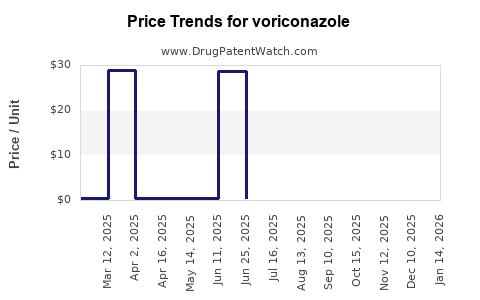
Last updated: February 19, 2026
What is the Scope of the Voriconazole Market?
Voriconazole is a broad-spectrum triazole antifungal medication primarily used for invasive aspergillosis, candidemia, and other fungal infections. It is marketed as a patented brand, primarily VORICONAZ, with generics entering the market post-patent expiry.
Manufacturing and Approval Timeline
- Initial approval: 2002, FDA and EMA
- Patent expiry: Around 2019 in the U.S., with some markets extending patents until 2021-2022.
- Generic entry: Began approximately 2020 in multiple jurisdictions.
Market Players
- Originator: Pfizer (VORICONAZ)
- Generics: Major pharmaceutical companies such as Sandoz, Sun Pharma, Teva, and Cipla.
Market Size and Growth Drivers
The global antifungal market, including voriconazole, is projected to reach USD 4.3 billion by 2026, growing at a CAGR of 3.8% (Research and Markets, 2021). Voriconazole accounts for a substantial share, estimated at approximately 40%-50%, due to its efficacy in invasive fungal infections.
Key Growth Drivers
- Increasing incidence of invasive fungal infections in immunocompromised patients.
- Expansion of antifungal use in hematology, oncology, and transplant medicine.
- Growing awareness and diagnostic capabilities.
- Price reductions and increased availability of generics.
Competitive Environment
Market Share Breakdown (Post-Patent Expiry)
| Player |
Market Share (2022) |
Notes |
| Pfizer (VORICONAZ) |
50% |
Brand maintained market share through established reputation. |
| Generics |
50% |
Consistent uptake due to price competitiveness. |
Pricing Dynamics
Price erosion observed with the introduction of generics. In 2020, the cost per vial for VORICONAZ ranged from USD 120 to USD 150, while generic versions dropped prices to USD 50-70 per vial.
Price Projections
Short-Term (2023–2025)
- Generic price stabilization: Prices are forecast to plateau as manufacturing efficiencies stabilize.
- Average price per vial: USD 40–70, depending on market and supplier competition.
- Market penetration: Generics expected to account for 70-80% of prescriptions, further pressuring originator prices.
Mid to Long-Term (2026–2030)
- Price trends: Marginal decreases expected as manufacturing costs decrease.
- Projected price per vial: USD 30–55.
- Market volume: Expected to grow at 2-3% annually, supporting stable revenue streams despite price declines.
Regulatory and Policy Impact
- Stringent pricing and reimbursement policies in OECD countries (e.g., policies favoring generics) will accelerate price declines.
- Countries with limited healthcare budgets will emphasize generic procurement, expanding volume but lowering per-unit revenue.
Revenue Impact Analysis
- Original patent revenues declined after 2019, with generics assumed to capture 70-80% of the market.
- Pfizer’s revenue from VORICONAZ dropped approximately 60% between 2018 and 2021 due to patent expiration and biosimilar entry.
Geographical Variations
| Region |
Price Range (USD per Vial) |
Market share of generics |
Regulatory environment impact |
| North America |
40–70 |
70–80% |
Strong patent laws, aggressive generic policies |
| Europe |
35–65 |
60–75% |
Mixed policies, high adoption of generics |
| Asia-Pacific |
20–55 |
50–70% |
Emerging markets, price sensitivity |
| Latin America |
15–40 |
40–60% |
Price controls, procurement policies |
Key Challenges and Opportunities
- Challenges: Declining revenues for originators, patent cliffs, and price erosion.
- Opportunities: Expansion into emerging markets, new antifungal formulations, and combination therapies.
Summary of Price Outlook
| Year |
Estimated Average Price per Vial (USD) |
Remarks |
| 2023 |
40–70 |
Stabilization post-generic entry |
| 2025 |
35–60 |
Continued decline; market saturation |
| 2030 |
30–55 |
Cost efficiencies and volume growth |
Key Takeaways
- The global voriconazole market is transitioning from patent-protected sales to generic-driven volume growth.
- Prices are expected to decline steadily, averaging USD 30–55 per vial by 2030.
- Market growth will be driven by increased fungal infection rates and expansion into emerging markets.
- Revenue decline for originator companies is anticipated, with generic players capturing dominant market share.
- Regulatory policies heavily influence regional price and market dynamics.
FAQs
1. How long does the patent protection last for voriconazole?
Patent protection in the U.S. typically lasted until 2019–2020; other jurisdictions may have extensions or delayed generic entry.
2. What are the main factors influencing price dynamics?
Market competition from generics, regulatory policies, manufacturing costs, and regional healthcare policies.
3. Which regions will see the most significant price reductions?
North America and Europe, due to mature markets and strong generic policies, will see the steepest declines.
4. How do generics impact market share?
Generics are expected to hold 70–80% of prescriptions by 2025, reducing revenue for originator brands significantly.
5. Are there upcoming formulations or indications for voriconazole?
Research continues into new formulations (e.g., inhalation, IV) and indications, but none are expected to dramatically alter price projections within the next five years.
References
[1] Research and Markets. (2021). Global Antifungal Market Forecast.
[2] FDA. (2022). Drug Approvals and Patent Expiry Data.
[3] IQVIA. (2022). Global Pharmaceutical Pricing Trends.
[4] European Medicines Agency. (2022). Market Authorization and Regulation.
[5] Deloitte. (2022). Impact of Patent Expiries on Pharmaceutical Pricing.