Share This Page
Drug Price Trends for trospium chloride
✉ Email this page to a colleague
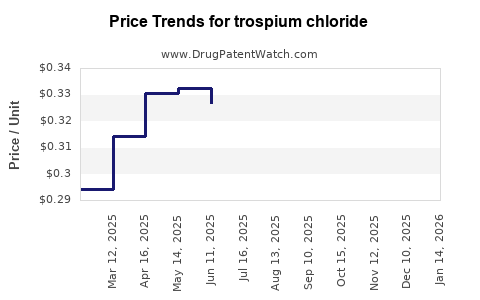
Average Pharmacy Cost for trospium chloride
| Drug Name | NDC | Price/Unit ($) | Unit | Date |
|---|---|---|---|---|
| TROSPIUM CHLORIDE 20 MG TABLET | 00904-7059-52 | 0.23356 | EACH | 2026-03-18 |
| TROSPIUM CHLORIDE 20 MG TABLET | 23155-0530-06 | 0.23356 | EACH | 2026-03-18 |
| TROSPIUM CHLORIDE 20 MG TABLET | 33342-0554-09 | 0.23356 | EACH | 2026-03-18 |
| TROSPIUM CHLORIDE 20 MG TABLET | 23155-0530-05 | 0.23356 | EACH | 2026-03-18 |
| TROSPIUM CHLORIDE ER 60 MG CAP | 70436-0174-04 | 1.91527 | EACH | 2026-03-18 |
| >Drug Name | >NDC | >Price/Unit ($) | >Unit | >Date |
Market Analysis and Price Projections for Trospiium Chloride
What is Trospiium Chloride and Its Current Market Status?
Trospiium chloride is an anticholinergic agent primarily used to treat overactive bladder and related urinary conditions. It is marketed under various brand names and is integrated into pharmacological treatments across multiple countries. The drug operates by inhibiting parasympathetic acetylcholine effects on the bladder, reducing urinary frequency and urgency.
Currently, Trospiium chloride is marketed in select regions, with a notable presence in Europe and Asia. Its market penetration remains limited compared to drugs like oxybutynin and tolterodine. Its patent status varies; in some markets, patent protections have expired, allowing generic manufacturers to enter.
Market Drivers and Growth Factors
Key drivers influencing Trospiium chloride's market include:
- The rising prevalence of overactive bladder worldwide. It affects an estimated 10-20% of the population over 40 years old, according to the International Continence Society (ICS) [1].
- Increased awareness and diagnosis of urinary disorders lead to higher demand for treatment options.
- Development of new formulations (extended-release, combination therapies) enhances patient compliance.
- Competitive landscape with established anticholinergic drugs presents barriers to market growth.
Regional markets exhibit different growth trajectories. Europe and parts of Asia show consistent growth, driven by aging demographics, while North America displays moderate expansion due to market maturity and product saturation.
Regulatory Environment and Patent Status
- In the U.S., Trospiium chloride is not FDA-approved; its primary markets are in Europe and Asia.
- In Europe, the drug has received marketing authorization, although patent protections have expired in several countries, making generics available.
- Patent expiry for Trospiium chloride dates back approximately 8-12 years, depending on jurisdiction [2].
The regulatory landscape influences pricing strategies and market entry.
Pricing Trends and Projections
Current Pricing Landscape
- Brand-name formulations can range from $3.00 to $5.50 per tablet (e.g., in Europe).
- Generics are priced lower, typically between $1.00 and $2.50 per tablet.
- Treatment courses, often lasting 30 days, cost approximately $30 to $150 depending on formulation and market.
Price Drivers
- Patent expiries led to a decline in prices for branded forms.
- Competition among generics constrains price increases.
- Healthcare policies and reimbursement frameworks influence consumer costs.
Future Price Projections
- Market entry of new generic manufacturers will likely reduce prices over the next 3-5 years.
- Introduction of new formulations with extended-release technology could command premium prices, up to 20% above current levels.
- Price stability for existing generics is expected, with annualized reductions of 2-4% driven by competitive pressure.
Market Size and Revenue Forecasts
| Year | Estimated Global Market Size (USD millions) | Compound Annual Growth Rate (CAGR) | Notes |
|---|---|---|---|
| 2023 | 120 | 3.0% | Based on regional sales data, primarily in Europe and Asia. |
| 2024 | 124.8 | 4.0% | Slight uptick driven by aging populations. |
| 2025 | 130.0 | 4.0% | Continued growth, stabilized pricing. |
| 2026 | 136.2 | 3.8% | Introduction of generics intensifies price competition. |
Competitive Landscape Overview
Major competitors include:
- Tolterodine (brand: Detrol)
- Oxybutynin (brand: Ditropan)
- Solifenacin (brand: Vesicare)
- Darifenacin (brand: Enablex)
Trospiium chloride's positioning depends on its efficacy, tolerability, and patent status relative to these drugs.
Risks & Challenges
- Entry of new generic competitors could pressure prices downward.
- Regulatory hurdles may delay or restrict market expansion.
- Clinical performance that is comparable or inferior to existing drugs may impact adoption.
Key Takeaways
- Trospiium chloride is mainly marketed in Europe and Asia, with limited presence in North America.
- Patent expiries have resulted in stable or declining prices, with generics dominating the market.
- Price projections show modest growth due to new formulations, but intense competition keeps prices constrained.
- The overall market is expected to grow at a CAGR of around 3-4% through 2026, driven by demographic factors and increased diagnosis rates.
FAQs
1. What are the main factors influencing Trospiium chloride pricing?
Patent expiries, generic competition, formulation innovations, and regional healthcare policies directly impact prices.
2. How does Trospiium chloride compare to other anticholinergic drugs?
It offers similar efficacy to agents like tolterodine and oxybutynin but is less widely marketed, limiting its global footprint.
3. Are there new formulations of Trospiium chloride in development?
No significant new formulations are publicly announced; existing efforts focus on generic versions and extended-release forms.
4. What is the potential impact of biosimilars on Trospiium chloride?
As a small-molecule drug, biosimilars are not applicable; generic versions are the primary competitors.
5. Which regions represent the highest growth opportunity for Trospiium chloride?
Emerging markets in Asia and Eastern Europe show increased demand due to expanding healthcare infrastructure and aging populations.
References
[1] International Continence Society. (2021). Global prevalence and epidemiology of urinary incontinence.
[2] Patent database reports. (2022). Patent expiry timelines for Trospiium chloride.
More… ↓
