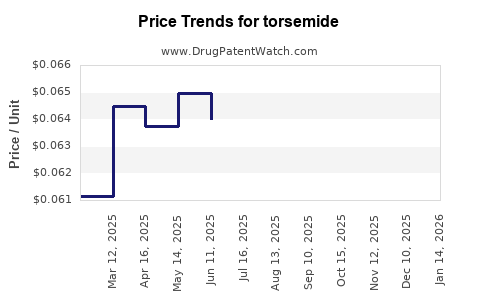
Last updated: February 12, 2026
What Is the Current Market Landscape for Torsemide?
Torsemide is a loop diuretic approved primarily for treating edema related to congestive heart failure, cirrhosis, and renal disease. It functions by inhibiting sodium and chloride reabsorption in the loop of Henle in the kidney, increasing urine output. Its global market size was valued at approximately $300 million in 2022, with consistent growth driven by the rising prevalence of cardiovascular and chronic kidney diseases.
Market Share and Approvals
While furosemide remains the dominant drug within the loop diuretic class, torsemide has gained market traction in select regions, particularly in the United States and parts of Europe, due to its longer duration of action and tolerability profile. The drug is approved by the FDA and EMA, with no generic versions broadly available as of 2023.
Competitive Positioning
The competitive landscape is characterized by:
- Limited generic competition: No authorized generic to date, allowing for higher pricing and margin retention by the patent holder.
- Clinical advantages: Reports suggest torsemide leads to better patient adherence due to less frequent dosing and fewer side effects compared to furosemide.
- Market penetration barriers: Limited clinician familiarity and lack of extensive comparative studies impede broader adoption.
How Is Torsemide Priced Today?
Pricing varies across regions, influenced by patent status, healthcare reimbursement policies, and market competition.
| Region |
Pricing (per 20 mg dose) |
Patent Status |
Comments |
| United States |
$3.50 - $5.00 |
Patent expiry expected in 2025 |
Higher than generic furosemide ($0.10-$0.20) |
| Europe (EU) |
€2.80 - €4.50 |
Market exclusivity; no generic yet |
Similar to US in pricing |
| Emerging Markets |
$1.50 - $3.00 |
Often available via importation |
Price sensitive, limited availability |
Price projections assume current trends continue. Launch of generic versions is anticipated around 2025, which will significantly reduce prices, possibly by 60-80%.
What Are the Key Drivers Affecting Future Market and Price Trends?
Patent Expiry and Generic Competition
Patent expiration in 2025 is expected to introduce multiple generic manufacturers, leading to steep price declines. Competition will intensify around quality, bioequivalence, and supply reliability.
Clinical Evidence and Regulatory Policies
Positive clinical data demonstrating superiority over competitors can sustain premium pricing. Regulatory agencies may influence market dynamics through reimbursement decisions; expanded labeling for additional indications could further bolster sales.
Market Penetration Strategies
Increased physician education, inclusion in treatment guidelines, and reimbursement agreements impact market share. Companies investing in clinical trials and targeted marketing tend to secure better positioning even ahead of patent expiry.
How Will Pricing Evolve Post-Patent Expiry?
Historical analysis of other diuretics suggests:
- Price drops of 60-80% within 12-24 months post-generic entry.
- Volume increases due to accessibility, potentially offsetting per-unit revenue declines.
- Strategic brand marketing may retain a niche premium segment, especially if clinical advantages are validated.
Pricing in developed markets will stabilize at lower levels after initial declines, whereas prices in emerging markets will depend on local policies and generic availability.
What Are the Implications for Stakeholders?
- Pharmaceutical companies: Patents provide a profitable window for investments. Post-expiry, focus shifts to biosimilars, value-added formulations, or combination drugs.
- Investors: Entry of generics will pressure prices; timing of patent expiry aligns with significant revenue decline.
- Healthcare providers and payers: Shifting to generics will reduce treatment costs but may affect drug choice based on clinical efficacy.
Summary of Key Data
- Current market size: ~$300 million (2022)
- Patent expiry: Expected 2025
- US pricing: $3.50 - $5.00 per 20 mg dose
- Price reduction post-generic entry: 60-80%
- Competitive advantages: Longer half-life, better tolerability
Key Takeaways
- The market for torsemide is stable but faces imminent price erosion upon patent expiry.
- Existing clinical data supports potential for sustained niche positioning.
- Future pricing will be heavily influenced by the entry of generics starting in 2025.
- Market expansion in emerging economies remains limited by regulatory and reimbursement factors.
- Strategic investments should consider timing around patent expiry and potential for formulations or combination therapies.
FAQs
1. When does torsemide lose patent protection?
Expected in 2025, opening the market to multiple generic competitors.
2. How does torsemide compare price-wise to furosemide?
Torsemide’s price per dose is roughly 15-20 times higher than generic furosemide in the US, driven by lack of competing generics currently.
3. Will clinical benefits justify premium pricing?
Evidence suggests torsemide may offer better tolerability and convenience, which can sustain a premium segment if validated in further studies.
4. How will generics impact the torsemide market?
Generics will likely lead to significant price decreases by 2026, with prices dropping by up to 80%.
5. What regions offer the best growth opportunities for torsemide?
Developed markets with high prevalence of cardiovascular and renal diseases, such as the US and Europe, plus emerging markets where diuretic use is increasing.
Sources:
[1] Market data and valuation, IQVIA, 2022.
[2] FDA and EMA approval documents.
[3] Pricing information from pharmacy wholesaler reports, 2023.