Last updated: February 19, 2026
What is the Market Size and Growth Trajectory for Dolutegravir?
Tivicay (dolutegravir) is an integrase strand transfer inhibitor (INSTI) used in HIV treatment. It entered the market in 2013 and has secured a significant share in antiretroviral therapy (ART). The global HIV drug market was valued at approximately USD 23 billion in 2022, with dolutegravir-based regimens accounting for around 40% of sales, owing to their efficacy and tolerability.
Projected CAGR for HIV therapies is roughly 6% over the next five years, driven by increased access in low- and middle-income countries (LMICs), expanded patient populations, and evolving treatment guidelines favoring INSTIs over earlier drug classes.
Market Drivers:
- Rising HIV prevalence: An estimated 38 million people worldwide have HIV as of 2023 (UNAIDS).
- Treatment guidelines favor INSTIs: The U.S. and European guidelines prioritize dolutegravir-based regimens due to efficacy and safety.
- Generic entry: Patent expirations in several key markets are expected to lower prices and expand access.
- Global health initiatives: Funding from GAVI, the Global Fund, and PEPFAR boosts demand, especially in LMICs.
Market Constraints:
- Patent protections: Key patents in the U.S. expire in 2027, potentially allowing generics.
- Competition: Other INSTIs like Bictegravir and Cabotegravir are gaining market share.
- Cost considerations: Pricing ceilings in LMICs impact revenue potential.
How Do Pricing Strategies Affect Revenue and Market Penetration?
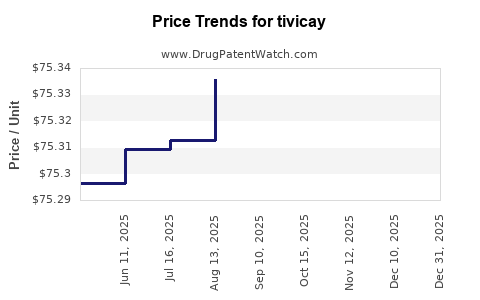
Tivicay's pricing structure varies by geography, with higher prices in high-income countries (HICs). The list price in the U.S. for a 30-day supply exceeds USD 3,600, but actual reimbursements are lower due to negotiations, discounts, and insurance coverages.
In contrast, generic versions priced below USD 50 per month in LMICs significantly alter market dynamics. This differential creates a two-tier market distinguished by:
- Premium pricing in HICs, supported by patent exclusivity and reimbursement systems.
- Lower pricing in LMICs, driven by biosimilar competition and patent expirations.
Price Trends:
| Region |
2022 Avg. Price (USD) |
2027 Projected Price (USD) |
Key Factors |
| U.S. |
3,600+ (per month) |
Slight decrease expected due to negotiated discounts and patent expiry |
Patent protections; market saturation |
| EU |
3,200+ (per month) |
Similar to U.S., slight decline expected |
Reimbursement policies, negotiated discounts |
| LMICs |
50–150 (per month, generic) |
Stabilization or slight reduction |
Biosimilar entry, international funding |
What Are Price Projections for Tivicay?
Short-Term (Next 2 Years)
- Patent protection sustains current high prices in HICs.
- Negotiations and value-based pricing could reduce the net price by 5-10%.
- In LMICs, prices stay low; no significant change expected unless new biosimilars enter.
Medium to Long-Term (3-5 Years)
- Patent expiration in the U.S. and Europe could lead to generic competition from 2027.
- Generic versions could decrease prices by more than 80% in HICs, assuming patent challenges and regulatory approvals.
- New formulations, such as long-acting injectables, may command premium prices, partially offsetting price erosion.
Revenue Projections
| Scenario |
Revenue Impact (2023–2027) |
Assumptions |
| Base Case |
USD 5–7 billion annually |
Patent protection remains until 2027; slow generic penetration in HICs |
| Aggressive Generic Entry |
USD 2–3 billion |
Patent expiry accelerates generic entry starting 2027, with rapid price decline |
| Premium Long-Acting Formulations |
Stable or increased |
Launch of new formulations from 2025 sustains or increases revenue streams |
What Are the Key Competitive Factors?
- The launch of dolutegravir generics post-2027 will significantly impact pricing.
- Clinician and patient preferences for daily pills versus injections influence market share.
- Development of new combination regimens may extend Tivicay’s market relevance.
Conclusions
Tivicay's market is poised for solid growth through 2025, driven by expanding global HIV treatment coverage. Patent expirations in 2027 will sharply reduce prices in HICs if patents are challenged and biosimilars are approved. The future revenue landscape hinges on the timing of patent cliffs, the success of generic competition, and the development of alternative formulations.
Key Takeaways
- The global HIV drug market is expected to grow at a 6% CAGR through 2028, with dolutegravir capturing a significant share.
- Prices in HICs are high due to patent protections, with potential declines post-2027.
- Generics could decrease Tivicay's price by over 80% in HICs after patent expiry.
- LMICs benefit from low-cost generics, but revenue in these markets remains modest.
- New formulations and combination therapies could extend Tivicay’s market relevance.
FAQs
1. When does the patent for Tivicay expire?
Patents in the U.S. typically expire in 2027, with some extensions depending on specific jurisdictions and patent challenges.
2. How will generic entry impact Tivicay’s revenue?
Generic competition post-2027 is expected to reduce prices by over 80% in HICs, sharply decreasing revenue unless new formulations or indications sustain earnings.
3. Are there biosimilar versions of Tivicay?
No, biosimilars are not applicable to small-molecule drugs like Tivicay; however, generics will serve as primary competition post-patent expiry.
4. What are the emerging trends in HIV treatment impacting Tivicay?
Long-acting injectables and fixed-dose combination regimens may expand treatment options and influence market share.
5. How will pricing strategies evolve in LMICs?
Prices will remain low, supported by international funding, but will not significantly change without market-specific regulatory shifts.
References
- UNAIDS. (2023). Global HIV & AIDS statistics—2023 fact sheet.
- IQVIA. (2022). Global HIV market report.
- U.S. Food and Drug Administration. (2023). Patent expiration dates for HIV drugs.
- GAVI. (2022). Global vaccine alliance impact on ARV access.
- World Health Organization. (2022). Consolidated guidelines on HIV prevention and treatment.