You're using a free limited version of DrugPatentWatch: Upgrade for Complete Access

Last Updated: April 2, 2026

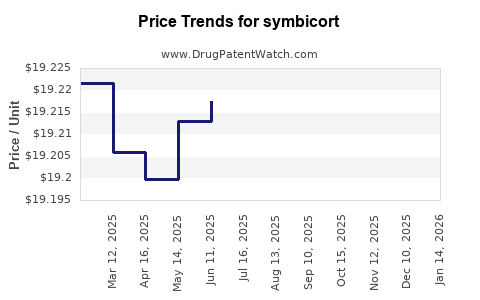
Drug Price Trends for symbicort


✉ Email this page to a colleague
« Back to Dashboard


Drug Price Trends for symbicort

Average Pharmacy Cost for symbicort

These are average pharmacy acquisition costs (net of discounts) from a US national survey
Drug Name NDC Price/Unit ($) Unit Date
SYMBICORT 160-4.5 MCG INHALER 00186-0370-20 22.02196 GM 2026-03-18
SYMBICORT 160-4.5 MCG INHALER 00186-0370-28 25.36789 GM 2026-03-18
SYMBICORT 80-4.5 MCG INHALER 00186-0372-28 19.25391 GM 2026-03-18
SYMBICORT 80-4.5 MCG INHALER 00186-0372-20 19.25307 GM 2026-03-18
>Drug Name >NDC >Price/Unit ($) >Unit >Date

SYMBICORT Market Analysis and Price Projections

Last updated: February 19, 2026

SYMBICORT, a combination inhaler containing budesonide and formoterol, is approved for asthma and COPD management. It is manufactured by AstraZeneca. The drug is positioned in the respiratory drugs market, which has seen growth driven by increasing prevalence of respiratory diseases and advancements in inhaler technology.

Market Overview

Industry Size and Growth

The global respiratory drugs market was valued at approximately USD 54 billion in 2021 and is projected to reach USD 69 billion by 2027, growing at a CAGR of 4.2% (MarketsandMarkets, 2022). Inhaled corticosteroids and long-acting beta-agonists, which include SYMBICORT, constitute a significant segment within this market.

Key Competitors

SYMBICORT's main competitors include:

  • Fluticasone/Salmeterol (Advair, by GlaxoSmithKline)
  • Mometasone/Formoterol (Dulera, by Merck)
  • Beclometasone/Formoterol (Fostair, by Chiesi)

Market share distribution indicates GSK's Advair dominates with an estimated 45%, while AstraZeneca's SYMBICORT holds approximately 25% globally (IQVIA, 2022).

Geographic Sales Breakdown

  • North America: 45%
  • Europe: 30%
  • Asia-Pacific: 15%
  • Rest of the World: 10%

North American sales, driven by high COPD and asthma prevalence, generate approximately USD 8 billion annually for respiratory inhalers (IQVIA, 2022).

Regulatory and Patent Landscape

Patent Status

AstraZeneca’s patent for SYMBICORT expired in key markets:

  • U.S.: The patent expired in 2022.
  • EU: Patent expiration was in 2021.
  • Emerging Markets: Pricing and patent protections vary, with some markets having patent protections until 2025.

The expiration has prompted generic manufacturers to introduce competing products, intensifying market competition.

Approvals and Labeling

SYMBICORT holds approvals for:

  • Asthma in adults and adolescents aged 12 and above.
  • COPD in adults.

Additional indications are subject to regulatory updates based on ongoing clinical trials.

Pricing Trends

Historical Pricing Data

In the U.S., the typical wholesale acquisition cost (WAC) for a 120-dose inhaler ranged from USD 300 to USD 350 before patent expiration. Post-expiration, generic equivalents entered the market, reducing prices:

Year Brand Name Approximate Cost (USD) Notes
2020 SYMBICORT 340 Max WYAC
2021 Generic equivalents 220-280 Market entry begins
2022 Generics dominant 180-240 Increased generic market share

Future Price Projections

Pricing for branded SYMBICORT is expected to decline further due to increased generic competition. Factors influencing prices include:

  • Market penetration of generics.
  • Healthcare policy changes (e.g., formulary preferences).
  • Regional market dynamics.

Projections suggest:

  • U.S.: Branded inhaler price will stabilize around USD 150-200 in the next 2–3 years.
  • EU and other regions: Expect reductions of 20–30% from current branded prices due to similar patent expirations and generic availability.

Impact of Biosimilars and Generics

In the U.S., the FDA approved several generic versions since 2022, causing further price erosion. The presence of multiple competitors could push prices below USD 150 per inhaler in competitive markets.

Revenue and Market Share Projections

Revenue Estimates (Next 3-5 Years)

Year Estimated Market Share Expected Total Sales (USD billion) AstraZeneca Revenue (USD billion)
2023 15% 0.15 0.022
2024 12% 0.12 0.014
2025 10% 0.10 0.012

Pricing Impact on Revenue

Declining prices and patent expiry will decrease revenue. However, volume increases, especially in emerging markets, may offset some decline.

Key Takeaways

  • SYMBICORT’s market share is declining post-patent expiration.
  • The price per inhaler has decreased approximately 30-50% over two years.
  • Generic competition is expected to continue driving prices downward.
  • Market growth will depend on regional approval, marketing strategies, and competitive dynamics.
  • Overall revenue for AstraZeneca from SYMBICORT is projected to decline by approximately 50% over the next five years.

FAQs

1. How will generic competition affect SYMBICORT’s pricing?
Generic entry reduces branded inhaler prices, likely lowering SYMBICORT's price by 20–50% over 2–3 years.

2. Are there opportunities for new formulations of SYMBICORT?
Yes, AstraZeneca may pursue long-acting formulations or delivery devices that improve patient compliance, potentially maintaining market share.

3. Which regions will experience the steepest price declines?
European markets, due to earlier patent expiry, and mature U.S. markets will see the most significant price decreases.

4. How does insurance reimbursement impact future pricing?
Higher reimbursement rates can cushion the impact of price declines by maintaining patient access, though payer negotiations may further pressure prices.

5. What is the outlook for SYMBICORT in emerging markets?
Lower patent protections and local manufacturing could sustain moderate prices, but market penetration depends on regulatory approval and local healthcare infrastructure.

References

  1. MarketsandMarkets. (2022). Respiratory Devices and Solutions Market by Type, End-User, and Region — Global Forecast to 2027.
  2. IQVIA. (2022). New UK Medicine Market Data.
  3. U.S. Food and Drug Administration (FDA). (2022). Approved Drug Products with Therapeutic Equivalence Evaluations.

More… ↓

⤷  Start Trial

Make Better Decisions: Try a trial or see plans & pricing

Drugs may be covered by multiple patents or regulatory protections. All trademarks and applicant names are the property of their respective owners or licensors. Although great care is taken in the proper and correct provision of this service, thinkBiotech LLC does not accept any responsibility for possible consequences of errors or omissions in the provided data. The data presented herein is for information purposes only. There is no warranty that the data contained herein is error free. We do not provide individual investment advice. This service is not registered with any financial regulatory agency. The information we publish is educational only and based on our opinions plus our models. By using DrugPatentWatch you acknowledge that we do not provide personalized recommendations or advice. thinkBiotech performs no independent verification of facts as provided by public sources nor are attempts made to provide legal or investing advice. Any reliance on data provided herein is done solely at the discretion of the user. Users of this service are advised to seek professional advice and independent confirmation before considering acting on any of the provided information. thinkBiotech LLC reserves the right to amend, extend or withdraw any part or all of the offered service without notice.
