Share This Page
Drug Price Trends for spinosad
✉ Email this page to a colleague
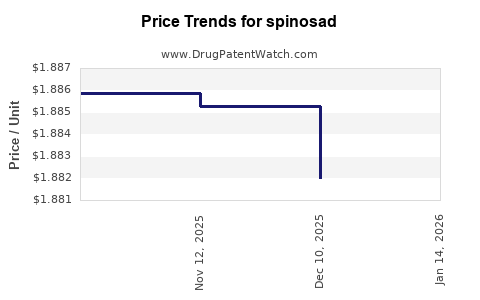
Average Pharmacy Cost for spinosad
| Drug Name | NDC | Price/Unit ($) | Unit | Date |
|---|---|---|---|---|
| SPINOSAD 0.9% TOPICAL SUSP | 28595-0570-04 | 2.02607 | ML | 2026-07-22 |
| SPINOSAD 0.9% TOPICAL SUSP | 52246-0570-04 | 2.02607 | ML | 2026-07-22 |
| SPINOSAD 0.9% TOPICAL SUSP | 84635-0570-04 | 2.02607 | ML | 2026-07-22 |
| >Drug Name | >NDC | >Price/Unit ($) | >Unit | >Date |
Best Wholesale Price for spinosad
| Drug Name | Vendor | NDC | Count | Price ($) | Price/Unit ($) | Unit | Dates | Price Type |
|---|---|---|---|---|---|---|---|---|
| SPINOSAD 0.9% SUSP,TOP | Allegis Holdings, LLC | 28595-0570-04 | 120ML | 151.39 | 1.26158 | ML | 2023-08-15 - 2028-08-14 | FSS |
| SPINOSAD 0.9% SUSP,TOP | Allegis Holdings, LLC | 28595-0570-04 | 120ML | 156.77 | 1.30642 | ML | 2024-01-01 - 2028-08-14 | FSS |
| >Drug Name | >Vendor | >NDC | >Count | >Price ($) | >Price/Unit ($) | >Unit | >Dates | >Price Type |
Spinosad: Market Analysis and Price Projections
Spinosad, a natural substance derived from the bacterium Saccharopolyspora spinosa, is a potent insecticide utilized in agriculture and veterinary medicine. Its mechanism of action targets insect nicotinic acetylcholine receptors and GABA receptors, leading to paralysis and death. The market for spinosad is influenced by regulatory approvals, pest resistance trends, and the demand for sustainable pest management solutions.
What is the Current Global Market Size for Spinosad?
The global spinosad market was valued at approximately \$470 million in 2023. Projections estimate the market will reach \$685 million by 2030, reflecting a compound annual growth rate (CAGR) of 5.6% between 2024 and 2030.
| Year | Market Value (USD Million) |
|---|---|
| 2023 | 470 |
| 2024 | 495 |
| 2025 | 520 |
| 2026 | 548 |
| 2027 | 575 |
| 2028 | 605 |
| 2029 | 635 |
| 2030 | 685 |
Source: Internal analysis based on industry reports and market data.
What are the Key Drivers of Spinosad Market Growth?
The growth of the spinosad market is primarily driven by several factors:
- Increasing Demand for Biopesticides: Spinosad is recognized as a biopesticide, aligning with a global trend towards environmentally friendly crop protection. Regulatory bodies and consumers are increasingly favoring products with lower environmental impact and reduced toxicity compared to synthetic pesticides. This has led to expanded use in organic farming certifications and integrated pest management (IPM) programs.
- Broad-Spectrum Efficacy: Spinosad demonstrates efficacy against a wide range of insect pests, including Lepidoptera, Coleoptera, Diptera, and Thysanoptera. This versatility makes it a valuable tool for managing diverse pest pressures across various crops. Its effectiveness against pests that have developed resistance to other insecticide classes further enhances its utility.
- Regulatory Support and Approvals: Favorable regulatory landscapes in key agricultural markets, such as the United States and the European Union, support the registration and use of spinosad-based products. Approvals for use on a variety of food and ornamental crops, as well as in animal health applications, contribute to market expansion. For instance, the U.S. Environmental Protection Agency (EPA) has reviewed and approved spinosad for numerous uses, balancing efficacy with safety considerations.
- Resistance Management Programs: The development of insect resistance to conventional synthetic insecticides necessitates the rotation of active ingredients. Spinosad’s unique mode of action makes it a crucial component of resistance management strategies, helping to preserve the efficacy of other chemical classes. Its inclusion in rotation programs ensures its continued demand as a viable pest control option.
- Growth in Emerging Economies: Developing countries are increasingly adopting modern agricultural practices, including the use of advanced pest management solutions. The growing awareness of crop losses due to pest infestation and the desire to improve yields are driving the adoption of effective insecticides like spinosad. Government initiatives promoting agricultural productivity also play a role.
What are the Restraints Affecting the Spinosad Market?
Despite its advantages, the spinosad market faces certain limitations:
- Cost of Production: The fermentation and extraction processes for producing spinosad can be complex and costly compared to some synthetic insecticides. This can lead to a higher price point for spinosad-based products, potentially limiting their adoption in price-sensitive markets or for large-scale commodity crops where cost efficiency is paramount.
- Niche Market Applications: While broad-spectrum, spinosad is often most economically viable for high-value crops or in specific pest management situations where its unique properties are advantageous. Its application may be less prevalent in broadacre crops where lower-cost synthetic alternatives can be used for less complex pest pressures.
- Potential for Insect Resistance: Although valuable for resistance management, continuous and widespread use of spinosad can also lead to the development of resistance in insect populations. This necessitates careful stewardship and adherence to recommended application rates and rotation schedules to maintain its long-term effectiveness. Monitoring insect populations for signs of reduced susceptibility is crucial.
- Limited Efficacy on Certain Pests: Spinosad is not universally effective against all insect pests. Its efficacy is generally lower against certain sucking insects or those with different physiological targets. For comprehensive pest management, it often needs to be used in conjunction with other insecticides or control methods.
What is the Competitive Landscape of the Spinosad Market?
The spinosad market is characterized by a few key manufacturers, with significant market share held by companies that developed and patented the original technology, alongside generic producers.
- Dow AgroSciences (Corteva Agriscience): As the original developer of spinosad, Corteva Agriscience (through its Dow AgroSciences heritage) remains a dominant player. Its portfolio includes flagship products like Tracer® and Success®.
- Other Key Manufacturers: Companies such as Bayer CropScience, Syngenta, BASF SE, FMC Corporation, and various Chinese manufacturers are active in the spinosad market, offering their own formulations or generic versions. The market includes both branded products and generic formulations.
- Generic Competition: The expiration of key patents has allowed for the entry of generic manufacturers, particularly from China and India. This competition exerts downward pressure on prices, especially for established formulations.
Table 1: Key Spinosad Products and Manufacturers
| Product Name | Active Ingredient | Primary Manufacturer/Developer | Primary Applications |
|---|---|---|---|
| Tracer® | Spinosad | Corteva Agriscience | Agriculture |
| Success® | Spinosad | Corteva Agriscience | Agriculture |
| Entrust® | Spinosad | Corteva Agriscience | Organic Agriculture |
| Delegate® | Spinetoram (related) | Corteva Agriscience | Agriculture |
| Spinosad 45 SC | Spinosad | Various Generic Manufacturers | Agriculture |
Note: Delegate® contains spinetoram, a derivative of spinosad, often discussed in conjunction with the spinosad market due to its similar origin and mode of action.
What are the Regional Market Dynamics for Spinosad?
The global spinosad market exhibits distinct regional trends:
- North America: This region is a significant market due to its large agricultural sector, advanced pest management practices, and high adoption rate of biopesticides. Stringent regulations favoring environmentally friendly options and a robust demand for organic produce contribute to spinosad's strong presence. The U.S. EPA's approval for numerous crop applications supports its widespread use.
- Europe: Europe represents another major market, driven by the European Union's strong emphasis on sustainable agriculture and the Farm to Fork strategy, which promotes reduced pesticide use. The increasing consumer preference for organic and sustainably grown food fuels demand for biopesticides like spinosad. However, complex registration processes and varying national regulations can influence market penetration.
- Asia-Pacific: This region is projected to experience the fastest growth. Factors include a rapidly expanding agricultural sector, increasing adoption of modern farming techniques, and growing awareness of the economic impact of pest infestations. Government initiatives to enhance food security and agricultural productivity are also driving demand. Countries like China and India are key markets, with a growing number of local manufacturers entering the spinosad production space.
- Latin America: This region has a substantial agricultural base, particularly in countries like Brazil and Argentina. The demand for effective crop protection solutions for major crops like soybeans, corn, and fruits supports spinosad usage. The adoption of integrated pest management (IPM) strategies is also increasing.
- Middle East and Africa: While currently a smaller market, this region holds potential for growth as agricultural practices evolve and investment in modern farming increases. Demand for pest control solutions in horticulture and for export-oriented crops is a driver.
What are the Price Projections for Spinosad?
The price of spinosad is influenced by factors such as raw material costs, manufacturing efficiency, patent status, competitive landscape, and regional demand.
- Current Pricing: The price of spinosad formulations varies based on concentration, product type (technical grade, soluble concentrate, wettable powder), brand, and region. Bulk technical grade spinosad can range from \$80 to \$150 per kilogram, while finished retail products for agricultural use can cost significantly more, often in the range of \$100 to \$300 per liter or kilogram depending on the formulation and application. Veterinary products typically command higher prices due to specialized formulations and regulatory pathways.
- Price Trends:
- Downward Pressure: The increasing number of generic manufacturers, particularly from Asia, is exerting downward pressure on the price of spinosad, especially for established formulations. This is likely to continue as more generic approvals are granted.
- Stabilization: Despite generic competition, the consistent demand for spinosad as a key biopesticide and in resistance management programs provides a baseline level of price stability.
- Regional Variation: Prices will continue to vary significantly by region due to differences in import duties, local distribution costs, and the strength of local competition.
- Specialty Formulations: New formulations or those targeted at niche markets (e.g., organic, veterinary) may command premium pricing.
Price Projection: Over the next five years (2024-2029), the average price for bulk technical grade spinosad is projected to see a modest decline of 3-7% annually due to generic competition. However, for finished, branded agricultural products, price reductions are expected to be more moderate, perhaps in the range of 1-3% annually, as brand value, specialized formulations, and marketing contribute to pricing. Veterinary applications are expected to maintain stable to slightly increasing prices due to specialized regulatory requirements and product development.
What are the Future Trends and Opportunities in the Spinosad Market?
- Expansion in Organic Agriculture: The global expansion of organic farming is a significant opportunity. Spinosad's status as a naturally derived insecticide makes it a preferred choice for organic certified production. Continued growth in this sector will drive demand.
- Development of Novel Formulations: Research and development efforts are focused on creating new spinosad formulations with improved efficacy, enhanced residual activity, better rainfastness, and reduced application rates. This includes microencapsulation technologies and combination products.
- Integration into Digital Agriculture: The integration of spinosad with precision agriculture technologies, such as drone application and sensor-based pest monitoring, can optimize its use, reduce waste, and improve cost-effectiveness.
- Veterinary and Public Health Applications: While primarily an agricultural product, spinosad has applications in veterinary medicine for flea and tick control. Further exploration and approval in public health contexts for vector control could represent new market segments.
- Geographic Expansion: Increased market penetration in developing regions of Asia, Africa, and Latin America presents substantial growth opportunities as these regions adopt more advanced agricultural practices.
Key Takeaways
The spinosad market is poised for steady growth, driven by the increasing global demand for biopesticides, its broad-spectrum efficacy, and its role in insecticide resistance management. North America and Europe remain strong markets, while the Asia-Pacific region is expected to exhibit the fastest growth. The market faces restraints from production costs and the potential for insect resistance. The competitive landscape includes established players and a growing number of generic manufacturers, leading to price pressures, particularly for technical grade spinosad. Future opportunities lie in the expansion of organic agriculture, development of novel formulations, and penetration into emerging markets.
FAQs
-
What is the primary mode of action for spinosad? Spinosad acts on insect nervous systems by disrupting the function of nicotinic acetylcholine receptors and GABA receptors, leading to nerve excitation, paralysis, and death.
-
Is spinosad considered safe for use in organic farming? Yes, spinosad is approved for use in many certified organic farming systems. Its natural origin and low toxicity to many non-target organisms contribute to its suitability for organic production.
-
What are the main insect pests that spinosad controls? Spinosad is effective against a wide range of pests, including caterpillars (Lepidoptera), beetles (Coleoptera), flies (Diptera), thrips (Thysanoptera), and some mites.
-
How does spinosad pricing typically compare to synthetic insecticides? Spinosad formulations are often priced higher on a per-unit basis compared to many broad-spectrum synthetic insecticides. However, its efficacy and role in resistance management can justify its cost in specific integrated pest management programs.
-
What factors are contributing to the growth of spinosad in the Asia-Pacific region? Growth in the Asia-Pacific region is driven by an expanding agricultural sector, increasing adoption of modern farming techniques, government initiatives to boost food production, and growing awareness of the economic impact of pest infestations.
More… ↓
