Last updated: August 28, 2025
Introduction
Prednisone is a synthetic glucocorticoid widely prescribed for its anti-inflammatory and immunosuppressive properties. It is used in numerous therapeutic areas, including autoimmune diseases, allergic reactions, respiratory conditions, and certain cancers. Given its extensive application, understanding the current market landscape, competitive dynamics, pricing trends, and future projections is vital for stakeholders across pharmaceutical manufacturing, healthcare investment, and policy sectors.
Market Overview
Global Market Size and Growth Trends
The prednisone market has demonstrated steady growth driven by rising prevalence of autoimmune and inflammatory conditions and expanding therapeutic indications. As of 2022, the global corticosteroid market, which includes prednisone, was estimated at approximately USD 10.5 billion, with prednisone accounting for a significant share due to its widespread use and cost-effectiveness [1].
The increasing incidence of autoimmune diseases such as rheumatoid arthritis and lupus, coupled with aging populations in developed economies, propels demand. Moreover, the expansion of indications into oncology and dermatology further sustains growth trajectories.
Major Markets and Regional Dynamics
-
North America: Dominates due to high healthcare spending, well-established prescribing patterns, and a substantial prevalence of autoimmune diseases. The U.S. remains the largest market, with an estimated compound annual growth rate (CAGR) of around 3-4% over the next five years.
-
Europe: Shows similar trends with robust healthcare infrastructure and regulatory approvals. The European corticosteroids market is expected to grow at a CAGR of 3% until 2027.
-
Asia-Pacific: The fastest-growing region driven by increasing healthcare access, urbanization, and expanding pharmaceutical manufacturing. Prednisone is often used as a first-line treatment in emerging markets, further accelerating demand.
Manufacturers and Supply Dynamics
Key players include Pfizer, Teva Pharmaceuticals, Mylan (now part of Viatris), and generic manufacturers globally. The majority of prednisone is produced via generic synthesis, resulting in a highly competitive pricing landscape and robust supply chains.
Pricing Landscape
Current Pricing Dynamics
Prednisone’s pricing varies significantly across regions, influenced by generic competition, manufacturing costs, regulatory policies, and insurance coverage.
-
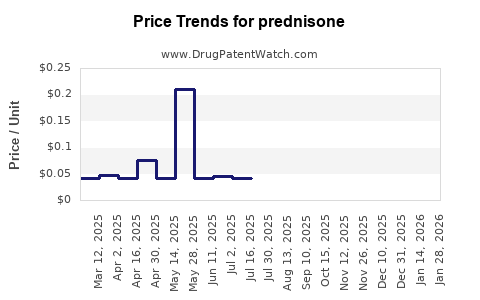
United States: The average retail price for a 20 mg tablet can range from USD 0.05 to 0.10 per tablet, with fluctuations depending on pharmacy discounts and insurance negotiations [2]. Generic penetration has kept prices low, making prednisone a cost-effective option for chronic therapy.
-
Europe: Prices are comparable, with some countries benefitting from price ceilings imposed by health authorities. The average is approximately EUR 0.02-0.10 per tablet, depending on national regulations [3].
-
Emerging Markets: Prices are often lower, sometimes below USD 0.01 per tablet, due to local manufacturing, price controls, and differing market dynamics.
Price Trends and Regulation Impact
The generic nature of prednisone contributes to generally stable and low prices. However, patent expirations on corticosteroids and regulatory adjustments influence market stability. Price negotiations and reimbursement policies, particularly in the U.S. and Europe, aim to maintain affordability while incentivizing quality manufacturing.
Market Drivers and Challenges
Drivers:
- Rising Disease Incidence: Increasing autoimmune and inflammatory disorders fuel demand.
- Cost-Effectiveness: Prednisone’s affordability compared to newer biologic agents makes it a preferred first-line therapy.
- Generic Availability: Facilitates widespread access and lower prices.
Challenges:
- Safety and Side Effects: Long-term corticosteroid therapy faces side effects like osteoporosis and metabolic issues, prompting some providers to consider alternative therapies.
- Regulatory Scrutiny: Strict regulatory frameworks in some regions can impact manufacturing and pricing strategies.
- Competition from Newer Agents: Biologics and targeted therapies are replacing steroids in certain indications, potentially constraining future market growth.
Pricing and Market Projections (2023-2030)
Forecast Assumptions
- Continued prevalence growth for autoimmune and inflammatory diseases.
- Persistent generic competition maintaining low price points.
- Minimal impact from patent laws, as prednisone is an established off-patent product.
- Increased regulation may influence manufacturing and distribution costs.
Predicted Market Size and Pricing Trends
- The global corticosteroid (including prednisone) market is projected to reach approximately USD 15 billion by 2030, growing at a CAGR of 3-4% (2022-2030) [1].
- Prednisone’s unit price will likely remain stable or decline marginally further, especially in mature markets, with prices expected to hover around USD 0.02-0.10 per tablet in Europe and North America.
- In emerging markets, prices might stabilize around USD 0.005-0.02 per tablet due to local manufacturing efficiencies and regulatory controls.
Potential Influences on Pricing
-
Regulatory Changes: Stringent regulation could increase production costs, marginally raising prices in some regions.
-
Supply Chain Disruptions: Global events like pandemics or geopolitical tensions can temporarily influence availability and cost.
-
Market Consolidation: Increased mergers among generic manufacturers could influence pricing strategies, either driving prices up through reduced competition or down via economies of scale.
Strategic Implications
Stakeholders should monitor regulatory environments, regional demand patterns, and generic competition closely. For manufacturers, maintaining high-quality standards and exploring biosimilar or new formulations can open additional revenue streams. Healthcare payers should consider the long-term cost benefits of prednisone versus newer therapies, especially in resource-constrained settings.
Key Takeaways
- The prednisone market remains robust, predominantly driven by its cost-effectiveness and widespread therapeutic use.
- Prices are expected to stay low or decline marginally, shaped predominantly by generic competition and regional regulatory policies.
- The global market is projected to grow steadily, reaching approximately USD 15 billion by 2030, with Asia-Pacific leading growth.
- Long-term competitiveness will depend on regulatory trends, safety data, and evolving treatment paradigms.
- Stakeholders should prioritize supply chain resilience, cost management strategies, and vigilant regulatory monitoring to capitalize on market stability.
FAQs
1. How does prednisone pricing compare across different regions?
Prednisone prices are lowest in emerging markets (USD 0.005-0.02 per tablet) due to local manufacturing and regulatory policies, while developed regions like North America and Europe maintain prices around USD 0.02-0.10 per tablet, influenced by insurance negotiations and regulatory frameworks.
2. What factors are influencing prednisone’s future demand?
Rising autoimmune and inflammatory disease prevalence, aging populations, and the drug’s affordability sustain demand. However, competition from biologics and newer therapies may gradually impact prescription volumes.
3. Are there any upcoming regulatory changes that could affect prednisone prices?
Future regulatory adjustments may emerge around safety, manufacturing standards, or reimbursement policies, especially in markets like the EU and US. These could marginally affect pricing and supply.
4. How is the increasing shift toward biologics impacting prednisone?
Biologics are increasingly replacing corticosteroids in specific indications due to targeted efficacy and safety profiles, which could limit but not eliminate prednisone’s role, especially where cost considerations dominate.
5. What opportunities exist for market expansion or innovation in prednisone?
Opportunities include developing novel formulations with reduced side effects, exploring biosimilars, and enhancing supply chain efficiencies to lower costs further, particularly in cost-sensitive markets.
References
[1] MarketWatch. "Corticosteroids Market Size, Share & Industry Forecast," 2022.
[2] GoodRx. "Prednisone Prices and Coupons," 2023.
[3] European Medicines Agency. "Pricing and Reimbursement Policies," 2022.
Disclaimer: This report provides updated insights based on current data and projections. Market conditions are subject to change based on regulatory, economic, and technological developments.