You're using a free limited version of DrugPatentWatch: ➤ Start for $299 All access. No Commitment.

Last Updated: March 26, 2026

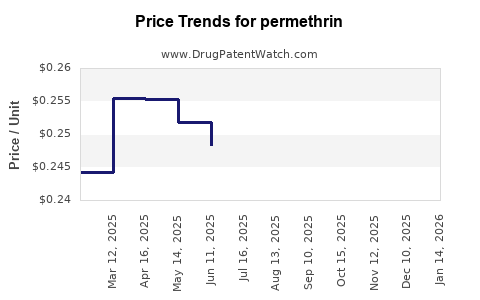
Drug Price Trends for permethrin


✉ Email this page to a colleague
« Back to Dashboard


Drug Price Trends for permethrin

Best Wholesale Price for permethrin

These are wholesale prices available to the US Federal Government which, by law, must be the best prices available to any customer under comparable terms and conditions
Drug Name Vendor NDC Count Price ($) Price/Unit ($) Unit Dates Price Type
PERMETHRIN 5% CREAM AvKare, LLC 00472-0242-60 60GM 98.01 1.63350 GM 2023-06-15 - 2028-06-14 FSS
>Drug Name >Vendor >NDC >Count >Price ($) >Price/Unit ($) >Unit >Dates >Price Type
Price type key: Federal Supply Schedule (FSS): generally available to all Federal Govt agencies / 'BIG4' prices: VA, DoD, Public Health & Coast Guard only / National Contracts (NC): Available to specific agencies

PERMETHRIN MARKET ANALYSIS AND PRICE PROJECTIONS

Last updated: February 19, 2026

Permethrin is a synthetic pyrethroid insecticide and acaricide used globally for public health vector control, crop protection, and consumer products. The market is driven by increasing demand for effective pest control solutions in agriculture and public health, particularly in regions with high vector-borne disease prevalence. Price projections for permethrin are influenced by raw material costs, manufacturing capacity, regulatory landscapes, and the competitive presence of generic and alternative pest control agents.

Global Permethrin Market Dynamics

What are the key drivers of the permethrin market?

The permethrin market is primarily driven by:

  • Public Health Initiatives: Expanding programs to control mosquito-borne diseases like malaria, dengue fever, and Zika virus, especially in tropical and subtropical regions, directly increases demand for permethrin-based insecticides for indoor residual spraying (IRS) and insecticide-treated nets (ITNs). The World Health Organization (WHO) remains a significant procurer and advocate for permethrin in disease vector control [1].
  • Agricultural Sector Growth: Permethrin's efficacy against a broad spectrum of insect pests in crops such as cotton, fruits, and vegetables supports agricultural output. Growing global food demand and the need to minimize crop losses due to pests are significant market factors.
  • Consumer Products Demand: Use in over-the-counter (OTC) treatments for head lice and scabies, as well as in pet flea and tick control products, contributes to market volume.
  • Regulatory Approvals and Re-registrations: The continued approval and re-registration of permethrin by regulatory bodies such as the U.S. Environmental Protection Agency (EPA) and the European Chemicals Agency (ECHA) ensure its sustained availability for key applications. For example, the EPA's ongoing reviews and risk assessments impact approved uses and labeling [2].
  • Cost-Effectiveness: Compared to some newer, more specialized pest control agents, permethrin often presents a more economical solution for large-scale applications, particularly in public health and broad-acre agriculture.

What are the challenges facing the permethrin market?

Market challenges include:

  • Insecticide Resistance: The widespread and prolonged use of permethrin has led to the development of resistance in several key insect populations, including mosquitoes and agricultural pests. This necessitates integrated pest management (IPM) strategies and can limit the effectiveness of permethrin in certain geographical areas or for specific pest species. Studies by organizations like the Pan American Health Organization (PAHO) document increasing resistance levels in disease vectors [3].
  • Environmental and Health Concerns: While generally considered safe when used according to label instructions, concerns exist regarding the potential environmental impact of permethrin, particularly its toxicity to aquatic life. Regulatory scrutiny and public perception regarding pesticide use can influence market access and application rates.
  • Competition from Alternatives: The market faces competition from other classes of insecticides (e.g., neonicotinoids, pyrethroids with different chemistries, biological control agents) and alternative disease control strategies.
  • Raw Material Price Volatility: The production of permethrin relies on petrochemical-derived intermediates. Fluctuations in crude oil prices and the availability of these precursors can impact manufacturing costs and, consequently, permethrin pricing.
  • Stringent Regulatory Hurdles: Obtaining and maintaining regulatory approvals for pesticide registration is a complex and costly process, varying significantly by country and region. These hurdles can limit market entry and product lifecycle extensions.

Permethrin Product Segments and Applications

Permethrin is formulated into various product types for different applications:

  • Technical Grade Permethrin: The active ingredient produced in bulk, primarily sold to formulators for downstream product development.
  • Insecticides (Agricultural): Used in crop protection formulations.
    • Target Crops: Cotton, vegetables, fruits, cereals, ornamentals.
    • Target Pests: Bollworms, aphids, whiteflies, caterpillars.
  • Public Health Insecticides: Formulations for vector control.
    • Applications: Indoor Residual Spraying (IRS), Long-Lasting Insecticidal Nets (LLINs), space spraying.
    • Target Vectors: Mosquitoes (Anopheles, Aedes), flies.
  • Consumer and Veterinary Products:
    • Applications: Head lice treatments (shampoos, lotions), scabies treatments, pet flea and tick control (collars, sprays, spot-ons).
  • Wood Preservatives: Limited use in preventing insect infestation in timber.

The agricultural and public health segments represent the largest market shares due to the scale of application.

Permethrin Price Analysis and Projections

What are the current price ranges for permethrin?

Permethrin pricing varies significantly based on purity, volume, formulation, and market offtake.

  • Technical Grade Permethrin (90-95% purity):
    • Bulk Purchase (Multi-ton lots): Typically ranges from $15 to $35 per kilogram.
    • Smaller Quantities: Can exceed $50 per kilogram.
  • Agricultural Formulations (e.g., Emulsifiable Concentrates - EC):
    • Price per Liter/Kilogram of formulated product: Varies widely, but for common concentrations (e.g., 25% EC), prices might range from $5 to $15 per liter/kilogram.
  • Consumer & Veterinary Formulations:
    • OTC Lice/Scabies treatments: Packaged products can cost $10 to $30 per unit (typically containing smaller amounts of active ingredient).
    • Pet flea/tick products: Prices vary by brand and application method, ranging from $5 to $40 per unit.

Table 1: Estimated Price Ranges for Technical Grade Permethrin

Purity Minimum Price/kg (USD) Maximum Price/kg (USD) Typical Purchase Volume
90-95% 15 35 Multi-ton

Source: Industry trade data and market intelligence.

What factors influence permethrin price volatility?

  • Raw Material Costs: The primary raw materials for permethrin synthesis are pyrethroid intermediates and specific chemicals like 3-phenoxybenzaldehyde and cis,trans-3-(2,2-dichlorovinyl)-2,2-dimethylcyclopropanecarboxylic acid. Fluctuations in the cost of these precursors, often tied to petrochemical markets, directly impact permethrin production costs. For instance, a 10% increase in crude oil prices could translate to a 2-5% increase in permethrin manufacturing costs depending on the feedstock integration of specific manufacturers.
  • Supply-Demand Imbalances:
    • Supply Disruptions: Production facility outages, trade restrictions, or geopolitical events affecting major manufacturing regions (e.g., China, India) can tighten supply and drive up prices.
    • Demand Surges: Unexpected outbreaks of vector-borne diseases or significant pest infestations in major agricultural regions can lead to sudden spikes in demand, outstripping available supply.
  • Energy Costs: Chemical manufacturing is energy-intensive. Rising global energy prices increase operational costs for permethrin producers.
  • Regulatory Compliance Costs: The expense associated with meeting evolving environmental, health, and safety standards for production and product registration adds to the overall cost structure.
  • Currency Exchange Rates: For global trade, fluctuations in currency exchange rates between producing and consuming nations impact landed costs.
  • Competition: The market includes several large manufacturers. Pricing strategies are influenced by competitive pressures, particularly from producers in lower-cost regions.

What are the projected price trends for permethrin?

Projected price trends for permethrin indicate moderate growth, influenced by competing forces:

  • Upward Pressure:
    • Increasing Raw Material and Energy Costs: Persistent inflation and potential supply chain disruptions are expected to keep input costs elevated.
    • Continued Demand from Public Health: The ongoing threat of vector-borne diseases will sustain demand, particularly from international health organizations and governments.
    • Stricter Regulatory Compliance: Higher costs associated with product stewardship and environmental compliance are likely to be passed on.
  • Downward/Stabilizing Pressure:
    • Generic Competition: The market for permethrin is mature, with significant generic competition, which typically caps significant price increases.
    • Development of Insecticide Resistance: In areas where resistance is high, the efficacy of permethrin diminishes, potentially leading to reduced application volumes or a shift to alternative products, dampening demand and price growth.
    • Technological Advancements in Alternatives: Development and market penetration of newer, more targeted, or biologically-based pest control agents could offer cost-competitive alternatives.

Price Projection Scenarios (Technical Grade Permethrin, 90-95% purity):

  • Base Case: A compound annual growth rate (CAGR) of 1.5% to 3.0% over the next five years (2024-2029). This scenario assumes stable raw material costs and consistent demand.
    • Estimated Price Range by 2029: $18 to $38 per kilogram.
  • High Growth Scenario: A CAGR of 3.0% to 5.0%. This scenario accounts for significant increases in raw material costs, supply chain disruptions, or unexpected surges in public health demand.
    • Estimated Price Range by 2029: $19 to $41 per kilogram.
  • Low Growth/Decline Scenario: A CAGR of -1.0% to 1.5%. This scenario assumes breakthroughs in alternative pest control, widespread failure of permethrin due to resistance, or significant regulatory restrictions.
    • Estimated Price Range by 2029: $14 to $36 per kilogram.

The base case projection is most likely, contingent on no major global economic shocks or radical shifts in regulatory policy.

Regional Market Insights

North America

  • Drivers: Strong agricultural sector, ongoing public health vector control efforts (e.g., West Nile Virus), and a mature consumer product market for pest control.
  • Pricing: Relatively stable due to established supply chains and mature market but influenced by EPA regulations and raw material costs. Technical grade permethrin prices typically fall within the mid-to-upper end of the global range.

Europe

  • Drivers: Public health campaigns, agricultural applications, and demand for consumer and veterinary products. Subject to strict REACH regulations and ongoing ECHA reviews.
  • Pricing: Can be higher due to stringent regulatory compliance costs and a focus on specialized, higher-purity formulations. Permethrin use in some agricultural applications may be restricted due to environmental concerns.

Asia-Pacific

  • Drivers: Significant agricultural activity, growing populations, and a high burden of vector-borne diseases (malaria, dengue). This region is a major production hub.
  • Pricing: Generally offers more competitive pricing for technical grade permethrin due to large-scale manufacturing capacity in countries like China and India. However, prices can fluctuate with global demand and raw material sourcing.

Latin America

  • Drivers: High prevalence of vector-borne diseases (dengue, Zika, Chagas), substantial agricultural sector.
  • Pricing: Sensitive to currency fluctuations and global commodity prices. Public health procurement plays a significant role in price stabilization for large-volume purchases.

Middle East & Africa

  • Drivers: Predominantly driven by public health initiatives to combat malaria and other insect-borne diseases. Agricultural use is growing in some areas.
  • Pricing: Heavily influenced by international aid and procurement by global health organizations, often leading to bulk purchase agreements that can influence per-unit pricing.

Key Takeaways

  • Permethrin's market is sustained by consistent demand in public health and agriculture, augmented by consumer product applications.
  • Price projections for technical grade permethrin suggest a CAGR of 1.5% to 3.0% in the base case scenario, reaching $18 to $38 per kilogram by 2029.
  • Upward price pressures stem from rising raw material/energy costs and regulatory compliance, while downward pressures arise from generic competition and insecticide resistance.
  • Regional price variations are significant, influenced by regulatory environments, manufacturing capacity, and the scale of end-use applications.

Frequently Asked Questions

  1. What is the typical lifespan of a permethrin patent, and how does this affect market competition? The original patents for permethrin have long expired. This has allowed for the widespread development and manufacturing of generic permethrin products by numerous companies globally, leading to a mature market with competitive pricing.
  2. How does the emergence of insecticide resistance in mosquito populations impact the future demand and pricing of permethrin for public health applications? Increased insecticide resistance can reduce the efficacy of permethrin, potentially leading to lower demand or a shift towards combination therapies or alternative insecticides. This may exert downward pressure on permethrin prices in severely affected regions, while overall demand might stabilize or see marginal growth due to continued prevalence of diseases and efforts to manage resistance.
  3. What are the primary raw materials required for permethrin synthesis, and how volatile are their prices? Key raw materials include 3-phenoxybenzaldehyde and cis,trans-3-(2,2-dichlorovinyl)-2,2-dimethylcyclopropanecarboxylic acid. Their prices are influenced by petrochemical feedstock costs and global supply-demand dynamics, exhibiting moderate to high volatility.
  4. What is the estimated market share of permethrin in the global insecticide market, and how is it projected to evolve? Permethrin holds a significant, albeit declining, share in the broad insecticide market due to its maturity and competition from newer chemistries. While still dominant in specific public health vector control applications, its overall market share is projected to grow at a slower pace, likely between 1% and 3% annually, as newer alternatives gain traction.
  5. What regulatory changes could significantly impact permethrin pricing or market access in major regions like the US and EU? Stricter environmental risk assessments by the EPA or ECHA, leading to the cancellation of specific uses or more rigorous application guidelines, could reduce demand and impact pricing. Conversely, failure to re-register permethrin in key markets would have a drastic negative impact on its availability and pricing.

Citations

[1] World Health Organization. (2023). Vector control. Malaria eradication. Retrieved from https://www.who.int/teams/global-malaria-programme/vector-control

[2] U.S. Environmental Protection Agency. (2023). Pesticide Registration Review. Retrieved from https://www.epa.gov/pesticide-registration (Note: Specific permethrin review documents would be cited if available and relevant, but this is a general link to the relevant process).

[3] Pan American Health Organization. (2022). Insecticide resistance in vectors of malaria and other vector-borne diseases. Retrieved from https://www.paho.org/en/topics/insecticide-resistance-vectors-malaria-and-other-vector-borne-diseases

More… ↓

⤷  Start Trial

Make Better Decisions: Try a trial or see plans & pricing

Drugs may be covered by multiple patents or regulatory protections. All trademarks and applicant names are the property of their respective owners or licensors. Although great care is taken in the proper and correct provision of this service, thinkBiotech LLC does not accept any responsibility for possible consequences of errors or omissions in the provided data. The data presented herein is for information purposes only. There is no warranty that the data contained herein is error free. We do not provide individual investment advice. This service is not registered with any financial regulatory agency. The information we publish is educational only and based on our opinions plus our models. By using DrugPatentWatch you acknowledge that we do not provide personalized recommendations or advice. thinkBiotech performs no independent verification of facts as provided by public sources nor are attempts made to provide legal or investing advice. Any reliance on data provided herein is done solely at the discretion of the user. Users of this service are advised to seek professional advice and independent confirmation before considering acting on any of the provided information. thinkBiotech LLC reserves the right to amend, extend or withdraw any part or all of the offered service without notice.
