Share This Page
Drug Price Trends for nitroglycerin
✉ Email this page to a colleague
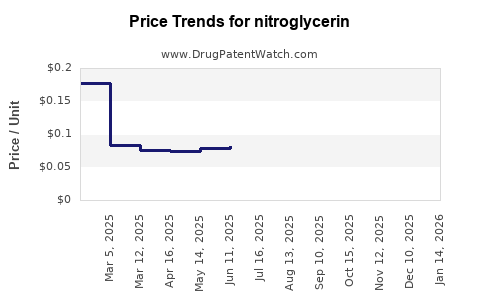
Average Pharmacy Cost for nitroglycerin
| Drug Name | NDC | Price/Unit ($) | Unit | Date |
|---|---|---|---|---|
| NITROGLYCERIN 0.1 MG/HR PATCH | 00378-9102-93 | 0.47059 | EACH | 2026-03-18 |
| NITROGLYCERIN 0.2 MG/HR PATCH | 00378-9104-16 | 0.60599 | EACH | 2026-03-18 |
| NITROGLYCERIN 0.2 MG/HR PATCH | 00378-9104-93 | 0.60599 | EACH | 2026-03-18 |
| NITROGLYCERIN 0.1 MG/HR PATCH | 43598-0896-30 | 0.47059 | EACH | 2026-03-18 |
| NITROGLYCERIN 400 MCG SPRAY | 66993-0241-50 | 23.69354 | GM | 2026-03-18 |
| >Drug Name | >NDC | >Price/Unit ($) | >Unit | >Date |
Best Wholesale Price for nitroglycerin
| Drug Name | Vendor | NDC | Count | Price ($) | Price/Unit ($) | Unit | Dates | Price Type |
|---|---|---|---|---|---|---|---|---|
| NITROGLYCERIN 5MG/ML INJ | American Regent, Inc. | 00517-4810-25 | 25x10ML | 266.00 | 2023-09-29 - 2028-09-28 | FSS | ||
| NITROGLYCERIN 0.4MG/SPRAY AEROSOL | Allegis Holdings, LLC | 28595-0120-49 | 4.9 | 39.20 | 8.00000 | EACH | 2024-01-01 - 2028-08-14 | FSS |
| NITROLINGUAL PUMPSPRAY/0.4MG | Allegis Holdings, LLC | 28595-0550-12 | 12 | 285.46 | 23.78833 | EACH | 2023-08-15 - 2028-08-14 | FSS |
| NITROLINGUAL PUMPSPRAY/0.4MG | Allegis Holdings, LLC | 28595-0550-12 | 12 | 268.96 | 22.41333 | EACH | 2024-01-01 - 2028-08-14 | FSS |
| NITROLINGUAL PUMPSPRAY/0.4MG | Allegis Holdings, LLC | 28595-0550-49 | 4.9 | 176.04 | 35.92653 | EACH | 2023-08-15 - 2028-08-14 | FSS |
| >Drug Name | >Vendor | >NDC | >Count | >Price ($) | >Price/Unit ($) | >Unit | >Dates | >Price Type |

Nitroglycerin: Market Dynamics and Price Outlook
Executive Summary
The global nitroglycerin market is characterized by its established use in treating angina and its role as a precursor in explosives manufacturing. In pharmaceuticals, the market is driven by the prevalence of cardiovascular diseases, particularly angina pectoris. Competition exists from alternative therapies and generic formulations. The explosives sector, while substantial, is influenced by industrial demand and regulatory frameworks. Price projections for pharmaceutical-grade nitroglycerin are expected to remain stable to slightly declining due to generic competition and therapeutic alternatives. Industrial-grade nitroglycerin prices will be more sensitive to raw material costs and global manufacturing activity.
What is the Current Market Size and Segmentation for Nitroglycerin?
The market for nitroglycerin can be segmented into two primary sectors: pharmaceutical and industrial (explosives).
Pharmaceutical Sector: The pharmaceutical market for nitroglycerin is primarily driven by its application in the treatment of angina pectoris. It is available in various dosage forms including sublingual tablets, sprays, patches, and intravenous solutions.
- Key Indications: Angina pectoris, myocardial infarction (as an adjunct), pulmonary hypertension.
- Market Drivers:
- Increasing prevalence of cardiovascular diseases globally, linked to aging populations and lifestyle factors.
- Established efficacy and cost-effectiveness of nitroglycerin compared to some newer therapies.
- Continued use in emergency settings for acute chest pain.
- Market Restraints:
- Emergence of newer, more targeted cardiovascular drugs with improved side effect profiles.
- The availability of generic versions, which drives down prices and limits revenue growth for branded products.
- Patient adherence challenges with certain formulations (e.g., frequent dosing of sublingual forms).
- Estimated Market Value (Pharmaceutical): While precise figures for nitroglycerin alone are difficult to isolate from broader cardiovascular drug markets, the global market for anti-anginal drugs was estimated to be in the billions of U.S. dollars in recent years. Nitroglycerin, as a foundational therapy, holds a significant, albeit mature, segment within this market.
Industrial Sector: Nitroglycerin is a primary component in the manufacture of dynamite and other explosives used in mining, construction, and military applications.
- Key Applications: Blasting agents in mining and quarrying, demolition, tunneling, specialized military ordnance.
- Market Drivers:
- Global demand for raw materials extraction (mining).
- Infrastructure development projects requiring excavation and demolition.
- Defense spending influencing military applications.
- Market Restraints:
- Stringent regulations regarding the production, transport, and use of explosives.
- Environmental concerns and the search for less hazardous alternatives.
- Fluctuations in commodity prices impacting mining activity.
- Estimated Market Value (Industrial): The global industrial explosives market, of which nitroglycerin is a component, is substantial, with estimates placing it in the range of several billion U.S. dollars annually. The specific contribution of nitroglycerin is a proprietary aspect of explosive manufacturers' formulations.
What are the Key Therapeutic and Industrial Applications of Nitroglycerin?
Therapeutic Applications:
Nitroglycerin's therapeutic action is primarily due to its ability to cause vasodilation. It is a potent vasodilator that works by releasing nitric oxide, which relaxes smooth muscles in blood vessel walls.
- Treatment of Angina Pectoris: This is the most common therapeutic use. Nitroglycerin reduces the workload on the heart by dilating coronary arteries and peripheral veins. This decreases both preload (volume of blood returning to the heart) and afterload (resistance the heart pumps against), thereby reducing myocardial oxygen demand.
- Sublingual Tablets and Sprays: Provide rapid relief of acute angina episodes.
- Transdermal Patches: Offer sustained release for prophylaxis of angina.
- Intravenous Infusions: Used in hospital settings for unstable angina and myocardial infarction.
- Management of Myocardial Infarction (Heart Attack): Nitroglycerin is used to reduce chest pain and improve blood flow to the heart muscle during a heart attack. It can also help lower blood pressure and reduce the heart's oxygen demand.
- Treatment of Pulmonary Hypertension: In certain cases, intravenous nitroglycerin may be used to reduce pressure in the pulmonary arteries.
- Adjunct in Heart Failure: In acute decompensated heart failure, intravenous nitroglycerin can help reduce preload and afterload, improving cardiac output and relieving symptoms like pulmonary edema.
Industrial Applications:
Nitroglycerin's high explosive power makes it a valuable component in industrial explosives. Its controlled detonation properties are critical for various applications.
- Dynamite Manufacturing: Nitroglycerin is the active explosive ingredient in dynamite, which is a mixture of nitroglycerin absorbed onto a stabilizer material like diatomaceous earth or wood pulp. This makes it safer to handle and transport than pure liquid nitroglycerin.
- Blasting in Mining and Quarrying: Used extensively for breaking rock and ore in open-pit and underground mines, as well as in quarries for stone extraction.
- Construction and Demolition: Employed in the construction of tunnels, roads, and other infrastructure projects, as well as for controlled demolition of structures.
- Specialty Explosives: Used in certain specialized explosive devices and propellants where its energy density and controlled burn rate are required.
What is the Competitive Landscape for Nitroglycerin in Pharmaceuticals?
The pharmaceutical market for nitroglycerin is characterized by a mature product lifecycle with significant generic competition.
Key Competitors and Product Landscape:
- Generic Manufacturers: Numerous companies produce generic versions of nitroglycerin in various forms. These include major pharmaceutical generic players and smaller regional manufacturers. Examples of common generic formulations include:
- Nitroglycerin 0.4 mg sublingual tablets
- Nitroglycerin transdermal patches (e.g., 0.2 mg/hr, 0.4 mg/hr, 0.6 mg/hr)
- Nitroglycerin spray (e.g., 0.4 mg per spray)
- Intravenous nitroglycerin solutions
- Branded Products: While branded nitroglycerin products exist, their market share is often limited due to the widespread availability and lower cost of generics. Examples historically included Nitrostat (Parke-Davis/Pfizer) for sublingual use and Minitran (3M) or Nitro-Dur (Key Pharmaceuticals/Schering-Plough, now Merck) for transdermal patches.
- Emerging Therapies: The competitive landscape is also shaped by the development and adoption of newer therapeutic classes for cardiovascular conditions. These include:
- Beta-blockers: (e.g., Metoprolol, Atenolol) Widely used for angina prophylaxis and management.
- Calcium channel blockers: (e.g., Amlodipine, Diltiazem) Also effective for angina and hypertension.
- Long-acting nitrates: Other oral or transdermal nitrate formulations.
- Ranolazine: A distinct anti-anginal medication with a different mechanism of action.
- Antiplatelet agents and anticoagulants: Crucial for managing underlying coronary artery disease.
- Percutaneous Coronary Intervention (PCI) and Coronary Artery Bypass Grafting (CABG): Revascularization procedures that address the underlying coronary artery blockages.
Market Share Dynamics:
- Generic formulations dominate the market in terms of volume and value due to price competition.
- Branded products may retain a niche in specific markets or through physician preference for particular delivery systems or perceived quality.
- The overall market for nitroglycerin is considered stable or slowly declining in terms of real growth, as newer treatments gain traction and the drug's primary indication (angina) faces evolving management strategies.
What are the Production Processes and Raw Materials for Nitroglycerin?
The synthesis of nitroglycerin is a well-established chemical process involving the nitration of glycerol.
Production Process:
The core manufacturing process is the nitration of glycerol using a mixture of concentrated nitric acid and concentrated sulfuric acid.
- Acid Mixture Preparation: Concentrated sulfuric acid is added to concentrated nitric acid. Sulfuric acid acts as a dehydrating agent, absorbing the water produced during the reaction and allowing the nitration to proceed efficiently. The mixture is typically cooled to control the exothermic reaction.
- Glycerol Addition: Glycerol (glycerine) is slowly added to the cooled acid mixture under strict temperature control. The temperature must be maintained below a critical point (typically around 20-30°C) to prevent runaway reactions and decomposition, which can lead to violent explosions.
- The chemical reaction is: C₃H₅(OH)₃ + 3 HNO₃ → C₃H₅(ONO₂)₃ + 3 H₂O
- Separation and Purification: After the reaction is complete, the mixture is allowed to settle. The nitroglycerin, being less dense, separates from the spent acid. The nitroglycerin layer is carefully decanted.
- Washing and Neutralization: The crude nitroglycerin is then washed multiple times with water to remove residual acids. It is subsequently neutralized with a dilute alkaline solution (e.g., sodium carbonate) to remove any remaining acidic traces that could catalyze decomposition.
- Stabilization: For pharmaceutical use, further purification steps may be employed. For industrial explosives, nitroglycerin is often adsorbed onto an inert absorbent material (like kieselguhr or sawdust) to create dynamite, which significantly enhances its stability and safety for handling and transport.
Key Raw Materials:
- Glycerol (Glycerine): A viscous alcohol that is a byproduct of soap manufacturing (saponification of fats and oils) and biodiesel production. Pharmaceutical-grade glycerol must meet stringent purity standards.
- Concentrated Nitric Acid (HNO₃): A strong oxidizing acid. Production typically involves the Ostwald process (oxidation of ammonia).
- Concentrated Sulfuric Acid (H₂SO₄): A strong dehydrating agent and catalyst. Production typically involves the contact process (oxidation of sulfur dioxide).
- Neutralizing Agents: Such as sodium carbonate (soda ash) or sodium bicarbonate.
- Absorbent Materials (for industrial use): Diatomaceous earth, wood pulp, or other inert porous materials.
Manufacturing Considerations:
- Safety: The production of nitroglycerin is inherently hazardous due to its explosive nature. Manufacturing facilities employ extreme safety protocols, specialized equipment, remote operation, and explosion-proof designs.
- Purity: Pharmaceutical-grade nitroglycerin requires exceptionally high purity to ensure efficacy and patient safety. Impurities can affect stability and potency. Industrial grades may have slightly less stringent purity requirements but still demand consistency.
- Regulation: Production and handling are subject to strict governmental regulations worldwide due to the explosive nature of the substance.
What are the Price Trends and Projections for Nitroglycerin?
Historical and Current Pricing:
Nitroglycerin pricing is bifurcated by its end-use.
Pharmaceutical-Grade Nitroglycerin:
- Sublingual Tablets/Sprays: These formulations are characterized by high volume and intense generic competition. Prices for generic sublingual tablets have been historically low and have remained largely stable or experienced gradual declines over the past decade. Average wholesale prices (AWP) for a bottle of 25-100 tablets can range from $15 to $50, depending on the manufacturer and pharmacy. Sprays, being a more convenient but higher-cost delivery system, can range from $30 to $80 for a unit.
- Transdermal Patches: These are typically more expensive than oral forms due to the more complex delivery system. Prices vary significantly by dosage and the number of patches per box. A box of 30 patches can range from $100 to $300 or more. Generic competition exists but is less aggressive than for tablets.
- Intravenous Solutions: Used in hospital settings, pricing is often bundled into overall hospital charges or based on the specific solution concentration and volume.
Industrial-Grade Nitroglycerin (as part of explosives):
- Pricing Factors: The price of nitroglycerin for industrial applications is closely tied to the cost of raw materials (glycerol, acids), energy costs for production, transportation logistics, and global demand for explosives in mining and construction.
- Market Fluctuations: Prices can fluctuate based on global supply chain disruptions, geopolitical events affecting raw material availability, and the cyclical nature of commodity markets.
- Price Range: The price of dynamite or other nitroglycerin-based explosives is typically quoted per pound or per kilogram and can range from $2 to $10 or more, depending on the specific product, quantity, and region.
Price Projections:
Pharmaceutical-Grade Nitroglycerin:
- Short to Medium Term (1-3 years): Prices for generic sublingual tablets and sprays are expected to remain stable or see marginal declines of 1-3% annually, driven by ongoing generic competition and cost-containment pressures in healthcare systems. Transdermal patches may see slightly more stability or minor increases due to formulation complexity, but overall market growth will be limited.
- Long Term (5+ years): The market share of nitroglycerin will likely continue to face pressure from newer cardiovascular therapies and interventional procedures. Without significant new indications or formulation innovations, price erosion for generic forms may continue, while branded products will struggle to maintain market presence.
Industrial-Grade Nitroglycerin:
- Short to Medium Term (1-3 years): Prices are expected to be influenced by volatile raw material costs, particularly glycerol prices linked to biodiesel production and palm oil supply chains. Energy costs will also play a significant role. Projections suggest potential price increases of 3-7% annually if raw material and energy costs rise, or relative stability if these factors remain constant.
- Long Term (5+ years): Demand will be linked to global mining output and infrastructure investment. Regulatory pressures favoring less hazardous alternatives or improvements in manufacturing efficiency could impact pricing. Overall, price trends will likely mirror industrial commodity cycles and energy market dynamics.
Factors Influencing Future Prices:
- Raw Material Availability and Cost: Glycerol price volatility is a key factor for both sectors.
- Energy Costs: Production of acids and the manufacturing process are energy-intensive.
- Regulatory Environment: Stricter safety and environmental regulations can increase production costs.
- Therapeutic Advancements (Pharma): Development of superior anti-anginal drugs or improved cardiac intervention techniques.
- Industrial Demand (Industrial): Global economic growth, commodity prices, and infrastructure spending.
- Generic Penetration (Pharma): Continued competition from multiple generic manufacturers.
Key Takeaways
- The nitroglycerin market is bifurcated, with distinct dynamics for pharmaceutical and industrial applications.
- In pharmaceuticals, nitroglycerin is a mature, highly genericized product for angina treatment, facing competition from newer drug classes.
- Industrial applications of nitroglycerin in explosives are driven by mining and construction demand, with pricing sensitive to raw material and energy costs.
- Pharmaceutical-grade nitroglycerin prices are projected to remain stable to slightly declining due to generic competition.
- Industrial-grade nitroglycerin prices will be more volatile, influenced by global commodity markets and energy prices.
- Safety and regulatory compliance are paramount in the production of nitroglycerin for both sectors.
Frequently Asked Questions
-
What are the primary drivers for the pharmaceutical nitroglycerin market? The primary drivers are the prevalence of cardiovascular diseases like angina pectoris, the established efficacy of nitroglycerin, and its cost-effectiveness, particularly in generic forms.
-
How do raw material costs impact the price of industrial nitroglycerin? The cost of glycerol and strong acids (nitric and sulfuric) directly influences the production cost of nitroglycerin for explosives. Fluctuations in the price of these raw materials, often linked to global commodity markets, lead to corresponding price changes in industrial explosives.
-
Are there significant new therapeutic indications being explored for nitroglycerin? While nitroglycerin is a well-established drug, significant new therapeutic indications are not actively being pursued or widely adopted. Research efforts are more focused on novel cardiovascular agents with different mechanisms of action.
-
What are the main safety concerns associated with nitroglycerin production? Nitroglycerin is a highly unstable and explosive compound. The primary safety concerns revolve around preventing accidental detonation during synthesis, purification, handling, and storage, which necessitates stringent temperature control, specialized equipment, and rigorous safety protocols.
-
How does the rise of interventional cardiology affect the market for nitroglycerin? The increasing use of procedures like percutaneous coronary intervention (PCI) and coronary artery bypass grafting (CABG) to treat coronary artery disease can reduce the reliance on pharmacological management for some patients with angina, potentially impacting the demand for nitroglycerin in the long term.
More… ↓
