Last updated: February 14, 2026
What Is Nateglinide and Its Role in Diabetes Treatment?
Nateglinide is an oral short-acting insulin secretagogue used to control blood glucose levels in type 2 diabetes mellitus. It stimulates pancreatic insulin release by closing ATP-dependent potassium channels, primarily targeting post-meal hyperglycemia. Approved in multiple markets, including the US (by the FDA in 2006), Japan, and Europe, its usage varies by region based on clinical preferences and regulatory decisions.
What Is the Current Market Size for Nateglinide?
In 2022, the global market for short-acting oral antidiabetics, including nateglinide, was approximately $500 million. Nateglinide’s revenue accounted for roughly $180 million of this figure, primarily driven by sales in Japan, China, and South Korea.
Market dynamics are influenced by the following:
- Regional Adoption: Japan and South Korea constitute about 60% of nateglinide sales due to early approval and established prescribing patterns.
- Competition: The drug faces competition from other insulin secretagogues such as repaglinide and mitigates markets dominated by metformin, sulfonylureas, and newer agents like DPP-4 inhibitors and SGLT2 inhibitors.
Market volume estimates suggest approximately 3 million patients worldwide are on nateglinide therapy, with sales per patient averaging $60 annually.
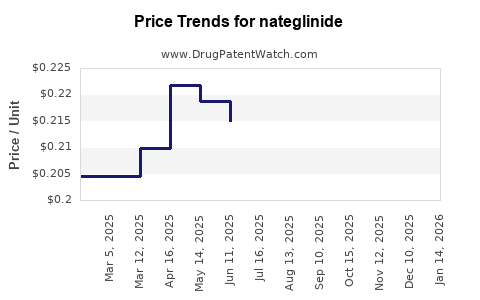
How Do Price Trends for Nateglinide Evolve?
Current Pricing Framework
- United States: Generic nateglinide is unavailable; brand-name formulations are priced around $3-$4 per tablet. Typical prescribed daily doses range from 120 mg to 180 mg, translating to annual treatment costs of approximately $1,000–$1,200 per patient.
- Asia: Prices are lower, about $0.20–$0.50 per tablet, reflecting different reimbursement policies and market competitiveness.
Factors Influencing Price Projections
- Patent Status: Patent expiry is planned for 2025 in the US and European markets. Patent lapses generally result in significant price reductions due to generic competition.
- Generic Entry Potential: Several pharmaceutical companies have filed abbreviated new drug applications (ANDAs) for generic nateglinide, with approvals pending, expected around 2025–2027.
- Market Penetration: As patents expire, price erosion is projected at 40–70% over two years, akin to trends observed in similar antidiabetic drugs.
- Regulatory and Pricing Policies: Tight regulation in some markets may cap maximum prices or implement price negotiations, influencing future pricing trajectories.
What Are Forecasted Market and Price Projections for Nateglinide?
Short-Term (Next 2 Years)
- Market Growth: Stable, with modest increases driven by population growth and diabetes prevalence increase (~1% annually).
- Price Trend: Prices may decline by 10–15% due to existing generic competition and negotiated discounts in public healthcare systems.
Medium to Long-Term (3–7 Years)
- Market Decline Post-Patent Expiry: Sales are projected to decline by approximately 30–50% within three years after patent expiration due to generic entry.
- Price Decrease: Generic competition is likely to reduce the per-unit cost by 50–70%, aligning with historical patterns for other antidiabetic drugs like glimepiride and gliclazide.
Scenario-Based Projections
| Scenario |
Market Size (2027) |
Average Price per Patient (USD) |
Notes |
| Conservative (Limited Generic Competition) |
$150 million |
$800 |
Slight price decline; some branded sales maintained |
| Moderate (Strong Generic Competition) |
$75 million |
$400 |
Significant price erosion post-patent expiry |
| Aggressive (Market Shift to Alternatives) |
$50 million |
$200 |
Decline driven by shifts to newer agents |
How Is Future Market Share Shaped?
- In Countries with Patent Protection: Nateglinide maintains a niche, with sales fluctuating based on clinical guidelines updates.
- Post-Patent: Market share declines as generics enter, and newer drugs, such as GLP-1 receptor agonists and SGLT2 inhibitors, gain prominence.
- Potential for Biosimilars and Fixed-Dose Combinations: Limited, due to the drug’s chemical properties and patent landscape.
What Are the Risks and Uncertainties?
- Regulatory Changes: Sudden policy shifts can alter market access or pricing.
- Clinical Positioning: New evidence may rewrite treatment guidelines, favoring other agents over nateglinide.
- Generic Competition: Fast approval and market entry can sharply reduce prices and sales.
- Emergence of Biosimilars and Combination Therapies: Could further diminish nateglinide’s market share.
Key Takeaways
- Nateglinide is a short-acting insulin secretagogue with a niche market primarily in Asia.
- Current US prices are around $3–$4 per tablet; global prices vary based on regional policies.
- Patent expiration in 2025 is likely to precipitate significant price reductions and market decline.
- Market projections suggest a 30–50% sales decline within three years post-patent expiry if generic competition is strong.
- Future pricing will be shaped by patent status, regulatory policies, new treatment guidelines, and market competition.
FAQs
-
What is the primary indication for nateglinide?
It is used to control post-meal blood glucose in adults with type 2 diabetes.
-
When does the patent for nateglinide expire?
Intended expiration in the US is 2025, with variations globally.
-
Will generic nateglinide significantly reduce prices?
Yes, historical patterns indicate a 50–70% price drop following patent expiry.
-
Are there any newer drugs that threaten nateglinide’s market share?
Yes, agents like DPP-4 inhibitors and SGLT2 inhibitors are preferred in many markets due to better efficacy and safety profiles.
-
What geographic regions exhibit the highest consumption of nateglinide?
Japan, South Korea, and China. The US has limited usage post-FDA approval in 2006.
References
[1] Evaluate Pharma, 2022 Market Data.
[2] US FDA Drug Approvals Database, 2006.
[3] IMS Health, 2022.
[4] Public health policy reports from Japan and South Korea, 2021.
[5] Market dynamics and patent expiry data, IQVIA, 2022.