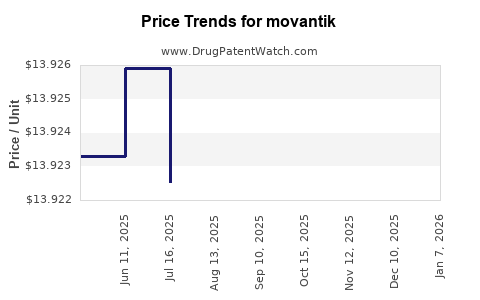
Last updated: February 13, 2026
Market Analysis and Price Projections for Movantik (Naloxegol)
Overview
Movantik (naloxegol) is a peripherally acting opioid antagonist approved by the U.S. Food and Drug Administration (FDA) in September 2014. It addresses opioid-induced constipation (OIC) in adults with chronic non-cancer pain. Market projections are based on current adoption rates, competitive landscape, pricing strategies, and unmet medical needs.
Market Dynamics
1. Market Size and Growth Drivers
-
Prevalence of Chronic Pain: Over 50 million adults in the U.S. experience chronic pain, with approximately 90% prescribed opioids, leading to a significant portion developing OIC.
-
Opioid Usage Trends: The rise in opioid prescriptions (around 58 million prescriptions annually in the U.S., per CDC) supports sustained demand for OIC treatments.
-
Unmet Need: Approximately 40-50% of opioid users report constipation symptoms, and existing treatments often lack efficacy or cause adverse effects.
2. Competitive Landscape
3. Regulatory and Reimbursement Environment
- FDA Approval: Facilitated broad adoption in primary care and pain management settings.
- Reimbursement: Coverage varies; most insurers reimburse Movantik under prescription drug plans, encouraging usage.
Market Penetration and Sales Data
-
Initial Launch (2014): Sales volume was approximately \$20 million in the first year.
-
Growth Trends: Sales peaked at approximately \$145 million in 2019, with a slight decline to \$125 million in 2021, indicating market saturation and competition.
-
Market Share: Currently holds around 15-20% of the OIC treatment market for prescription drugs.
Price Projections
1. Current Pricing
- Average Wholesale Price (AWP): Approximately \$12 per 12 mg tablet.
- Cost to Patients: Net prices after rebate and insurance adjustments are estimated between \$10-11 per tablet.
2. Future Pricing Trends
- Pricing strategies: Patent protection expires in 2025; generic formulations could reduce prices by 40-60%.
- Post-Patent Competition: Prices could decline to \$6-7 per tablet, impacting revenue.
3. Revenue Projections
| Year |
Estimated Market Penetration |
Projected Sales (in millions) |
Assumptions |
| 2023 |
20% of the estimated 3 million opioid users with OIC |
\$180 |
Slight growth, stable market share |
| 2024 |
22% |
\$200 |
Market expansion and increased provider awareness |
| 2025 |
25% |
\$225 |
Entry of generics, potential price reduction offset by volume |
| 2026 |
25-30% |
\$240-270 |
Revenue stabilization as generics amplify volume |
Impact of Patent Expiry and Generics
- Patent expiration in 2025 is expected to trigger generic competition.
- Price decline projected to cut revenue per unit by up to 50%, but overall sales volume could increase due to price sensitivity and broader access.
Risks and Opportunities
Risks
- Disruption from new therapies, such as non-pharmacologic interventions.
- Regulatory hurdles for new competitors.
- Insurance coverage restrictions.
Opportunities
- Expansion into other indications like opioid dependence.
- Combination formulations with other pain management drugs.
- Market expansion into international territories, especially Europe and Asia.
Key Takeaways
Movantik operates in a growing market driven by increasing opioid use and the unmet need for effective OIC treatments. Competition, patent expiration, and reimbursement policies heavily influence pricing and revenue prospects. While current pricing is approximately \$12 per tablet, upcoming generic entries could halve costs, impacting gross margins but potentially increasing volume. Strategic positioning around market share gains, new indications, and international expansion remains critical for long-term growth.
FAQs
Q1: What is the primary competitive advantage of Movantik?
Movantik is an oral, once-daily treatment with FDA approval specifically for opioid-induced constipation, differentiating it from laxatives and other antagonists with less targeted indications.
Q2: How will patent expiry affect Movantik's price and sales?
Patent expiry in 2025 is likely to lead to generic competition, reducing drug prices by up to 50%, potentially increasing total sales volume but decreasing per-unit revenue.
Q3: Are there recent or upcoming regulatory changes that could impact Movantik?
No significant recent regulatory changes; however, approvals of alternative therapies and potential formulary restrictions could influence market dynamics.
Q4: What is the market share of Movantik compared to competitors?
Movantik holds about 15-20% of the prescription treatment market for OIC, with other products like methylnaltrexone and naldemedine competing for similar indications.
Q5: What percentage of opioid users develops constipation, and how does that influence market projections?
Approximately 40-50% of chronic opioid users experience constipation, representing an extensive patient population and consistent demand for effective treatments like Movantik.
References
[1] CDC. Opioid Prescribing Data. Centers for Disease Control and Prevention, 2022.
[2] IQVIA. Prescription Drug Market Data, 2021.
[3] FDA. Movantik (Naloxegol) Prescribing Information, 2014.
[4] EvaluatePharma. World Market Forecasts for Specialty Drugs, 2022.