Last updated: February 12, 2026
What is the Current Market Size for Methotrexate?
Methotrexate is a generic, widely prescribed drug used primarily in oncology, autoimmune diseases, and ectopic pregnancies. The global market size for methotrexate was valued at approximately $300 million in 2021 and is projected to grow at a compound annual growth rate (CAGR) of 4-6% through 2030.
The key drivers include:
- Increasing prevalence of rheumatoid arthritis and psoriasis.
- Expanding use in cancer treatments.
- Growing awareness among clinicians and patients.
Major markets include the United States, Europe, and Asia-Pacific, accounting for over 70% of sales in 2021. The U.S. alone represented nearly $150 million in sales, driven by a high prevalence of autoimmune diseases.
What Are the Main Factors Impacting Methotrexate Pricing?
Price trajectories are influenced by several factors:
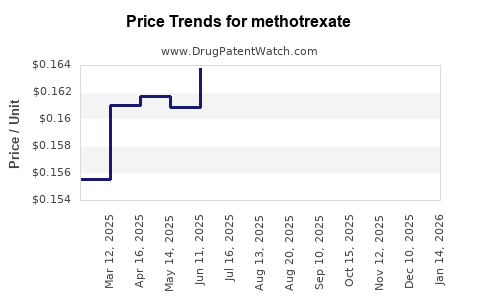
Generic Competition: Since patent expiry, multiple manufacturers produce methotrexate tablets and injections. Price erosion results from increased generic availability. The average wholesale price (AWP) for oral methotrexate was approximately $0.10 per 2.5 mg tablet in 2022, down from about $0.20 in 2015.
Regulatory Changes: Increased regulatory scrutiny and quality standards can influence pricing. Biologics and high-cost specialty drugs often command higher prices, whereas generics like methotrexate compete aggressively on price.
Market Penetration and Prescribing Patterns: In regions where biosimilars and generics are adopted in clinical practice, prices tend to decrease faster.
Supply Chain Factors: Disruptions, raw material costs, and manufacturing capacity affect pricing stability.
How Will Existing Developments Affect Future Market Dynamics?
Recent developments include:
- Increased use in low- and middle-income countries due to affordability.
- Ongoing research into alternative formulations that improve bioavailability or reduce side effects.
- Entry of biosimilars in adjacent biologics, influencing analogy-based pricing strategies.
The potential for new formulations or delivery methods (e.g., subcutaneous injections, slow-release tablets) could moderately influence prices but are unlikely to dramatically alter the overall generics-driven market.
What Are Price Projections for the Next Decade?
Assuming steady escalation in global demand and competitive dynamics, average prices for oral methotrexate are forecasted to decline marginally:
| Year |
Estimated Price per 2.5 mg Tablet |
Notes |
| 2022 |
$0.10 |
Current baseline |
| 2025 |
$0.08 |
Continued generic competition |
| 2030 |
$0.07 |
Market maturation |
Injectable formulations are priced higher but follow similar declining trends due to biosimilar entries. The injectable market was valued at approximately $50 million in 2021, with a projected CAGR of 5%.
How Do Prices Vary Across Regions?
| Region |
Typical Price per 2.5 mg Tablet |
Key Factors |
| United States |
$0.10 – $0.15 |
High prescription volumes, insurance coverage |
| Europe |
$0.08 – $0.12 |
Price regulation, universal healthcare |
| Asia-Pacific |
$0.05 – $0.09 |
Lower manufacturing costs, high volume |
| Latin America |
$0.07 – $0.10 |
Market size, generic penetration |
Region-specific policies can cause pricing deviations of up to 30% from the global average.
What Market Opportunities and Risks Exist?
Opportunities:
- Greater adoption in emerging markets.
- Development of combination therapies reducing overall treatment costs.
- Innovation in formulations offering convenience and compliance.
Risks:
- Potential introduction of biosimilars targeting biologic equivalents.
- Regulatory barriers delaying market access.
- Pricing pressures from healthcare payers and insurers.
Key Takeaways
- The global methotrexate market has been stable, with continuous growth driven by increasing disease prevalence.
- Prices are in decline, especially for oral formulations, due to generic competition.
- Regional pricing varies significantly, with North America and Europe maintaining higher prices compared to Asia-Pacific.
- Future price reductions are expected, but the drug remains a cost-effective staple in many treatment protocols.
- Market expansion into emerging regions offers growth potential, but price pressure from biosimilars and regulatory shifts pose risks.
5 FAQs
1. Will the price of methotrexate increase with new formulations?
Unlikely. New formulations typically command higher prices initially but tend to follow market trends of price stabilization and decline due to competition and generics.
2. How does biosimilar entry affect methotrexate pricing?
Biosimilar availability primarily impacts biologic therapies. For methotrexate, which is mostly generic, biosimilars are less relevant; biosimilar effects are more felt in drugs like infliximab and rituximab.
3. Are patents still protecting any formulations of methotrexate?
Most formulations are off-patent. The last patents expired around 2010-2012, allowing broad generic manufacturing.
4. How does the pricing of methotrexate compare to other RA drugs?
Methotrexate remains one of the most affordable disease-modifying anti-rheumatic drugs (DMARDs). Biologics like adalimumab or etanercept cost thousands per year, whereas methotrexate is often less than $100 annually.
5. What regulatory trends could influence future prices?
Increased price controls and reimbursement policies in Europe and Asia can suppress prices further. Conversely, approval processes for new formulations can temporarily raise prices.
Sources
- Grand View Research. "Methotrexate Market Size, Share & Trends Analysis Report," 2022.
- IQVIA. "Global Trends in Oncology and Rheumatology Pharmaceutical Markets," 2021.
- U.S. Food and Drug Administration. "Patents and Exclusivities," 2022.
- EvaluatePharma. "World Preview 2023," 2023.
- National Health Service (NHS). "Drug Tariffs and Pricing," 2022.