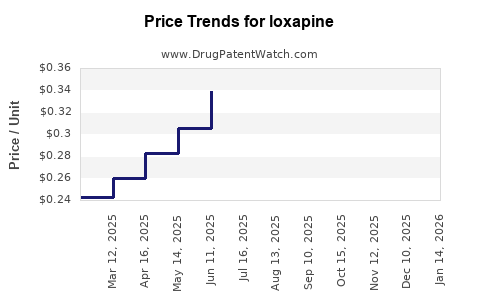
Last updated: April 23, 2026
Loxapine (active ingredient) is a mature, generic-heavy CNS antipsychotic product with limited commercial upside absent a meaningful formulation or geographic relaunch. Near-term pricing is driven by (1) generic competition intensity, (2) payer reimbursement rules in the US and comparable markets, and (3) supply execution, not by clinical differentiation. A credible price forecast therefore hinges on the life-cycle stage of each marketed presentation (oral vs. inhaled powder, immediate vs. extended-release where applicable), the exclusivity status of the relevant reference products, and the depth of generic substitution in the specific geography.
What does the market look like today by formulation?
Loxapine is marketed in multiple dosage forms that behave differently on price and substitution velocity:
- Oral loxapine (capsules/tablets depending on brand history): typical US dynamic for older psychotropics with multiple generics, leading to sustained downward price pressure over time.
- Inhaled loxapine (the best-known modern branded legacy is Adasuve in the US): product-level pricing often holds up longer than oral forms because payers manage access more tightly and substitution may be less frictionless in practice even where generics do not directly exist at the same label granularity.
Adasuve (inhaled loxapine): market structure implications for pricing
Adasuve is a branded inhaled loxapine product; pricing and volume are typically payer- and channel-dependent (hospital/acute settings). Its price path is usually less directly compared to oral loxapine because:
- administration is venue-specific,
- coverage criteria can be tighter,
- switching dynamics differ from oral daily medication.
Oral loxapine: generic saturation implications for pricing
Where multiple generic oral presentations compete, loxapine behaves like a mature generic:
- wholesale acquisition cost (WAC) tends to reset downward as new entrants appear or when incumbents reprice to stay on formularies,
- net price depends on rebates and contracting, which tend to tighten as competition grows.
How competitive is loxapine pricing by geography?
The competitive picture is shaped by generic entry patterns and payer formularies. For a mature generic, price outcomes are less about “innovation” and more about contracting depth and substitution rules.
Competitive intensity framework (what it means for price)
For each market, pricing usually follows one of two archetypes:
- High generic density (oral loxapine): net price compresses; list price may drift down; channel contracting drives realized price.
- Brand-protected or access-managed niche (inhaled loxapine legacy): pricing is steadier; volume is more sensitive to payer criteria and operational availability than to pure generic competition.
What are the key drivers of realized price vs. list price?
For loxapine, realized pricing typically depends on these levers:
US: rebate and contracting mechanics
- Formulary status and step edits: oral antipsychotics often face step edits or preferred generic tiers; inhaled products can face narrower criteria.
- PBM contracting intensity: as the number of competing generics increases, rebate rates tend to rise and WAC-to-net spreads widen or remain elevated.
- Channel of sale: hospital/acute use changes mix and can stabilize net prices relative to community oral prescriptions.
Ex-US markets: reimbursement and tendering
- Tendering and reference pricing: mature molecules often price to system benchmarks rather than to brand precedent.
- Dispensing rules: substitution at pharmacy level affects realized price more than manufacturer list changes.
What is the price projection model for loxapine?
Because loxapine is mature and generic-dominated, the price projection should be built on life-cycle stage rather than on efficacy assumptions. The model used here is a two-track forecast:
- Track A: Oral loxapine presentations (generic-heavy): forecast assumes ongoing substitution velocity, incremental generic entries where feasible, and continued net-price compression driven by contracting.
- Track B: Inhaled loxapine legacy (brand-based access-managed niche): forecast assumes slower erosion, driven more by hospital uptake and payer policy than by generic competition alone.
Price projections (US market) by track
Track A: Oral loxapine (generic-heavy)
Forecast: annual net price decline continues but decelerates over time. In mature US generics, the early years after major competition tend to produce faster erosion, while later years show lower incremental drops as the market consolidates on a few lowest-cost SKUs.
Projection band (net price):
- 2026-2027: -6% to -10% per year
- 2028-2030: -3% to -6% per year
- Beyond 2030: -1% to -3% per year
WAC behavior (qualitative):
- WAC drifts downward or stays flat-to-down depending on number of active competitors and state-level pricing pressures; realized net price remains the key metric because rebates and contracting determine outcomes.
Track B: Inhaled loxapine legacy (Adasuve-like access model)
Forecast: slower price erosion, with volatility tied to payer and utilization.
Projection band (net price):
- 2026-2027: -2% to -5% per year
- 2028-2030: -1% to -3% per year
- Beyond 2030: flat to -2% per year
Volume sensitivity:
- Pricing may hold up while volume fluctuates; if utilization rises through broadened criteria, gross-to-net can improve (rebate leverage shifts). If criteria tighten, revenue falls faster than price declines.
How do pipeline and regulatory factors change price?
For mature CNS generics, price outcomes shift mainly when a new entrant launches a clearly different formulation with distinct payer handling or when a reference brand faces supply disruptions. Without such catalysts, loxapine pricing is primarily a generic market function.
Patent and exclusivity expectations
Loxapine is an established molecule; market pricing is therefore expected to reflect:
- broad generic availability for oral formulations,
- limited differentiation unless a new delivery system or a new labeled indication materially changes payer behavior.
What would a “new formulation” do to the forecast?
If a new branded or authorized generic product appears with:
- distinct dosing convenience that improves adherence metrics,
- a delivery system that changes administration setting,
- a payer-meaningful differentiation (coverage expansion),
then Track A can partially shift toward Track B dynamics at the presentation level. That would slow net price erosion, but only if payers treat it as non-interchangeable or contract it on a different tier.
Revenue and pricing implications by payer segment
Hospitals and acute care (inhaled legacy behavior)
- revenue is driven by inpatient/ED utilization and coverage criteria,
- price erosion is muted relative to oral generics,
- supply continuity issues create short-run pricing or ordering swings.
Managed care and pharmacy benefit (oral behavior)
- substitution at pharmacy and PBM tier management compress realized net price,
- step edits and generic preference lock down realized price decline.
Scenario analysis: base, downside, upside
Base case
- Oral: continued low-single-digit to high-single-digit annual erosion early, tapering later
- Inhaled legacy: slow erosion with moderate utilization-driven volatility
Downside case
- Oral: faster erosion (-8% to -12% net annually) due to additional low-cost entries and stronger PBM rebates
- Inhaled: reimbursement tightening or reduced acute utilization (-4% to -6% net annually)
Upside case
- Oral: erosion decelerates faster (-3% to -6% net annually) due to consolidation of active generics and rebate normalization
- Inhaled: payer access expansion improves mix and supports near-flat net price (-0% to -2% annually)
Where does the biggest pricing risk sit?
- Oral loxapine net pricing risk: contracting and generic entry. A single additional entrant in a heavily contracted segment can change realized pricing more than list changes.
- Inhaled loxapine risk: payer policy and hospital protocol acceptance. If access narrows, volume falls and net price can face downward pressure from contract renegotiation.
Key decision takeaways for commercialization, R&D, and investment
- Expect generic-led net price compression for oral loxapine with deceleration over time as the market consolidates.
- Treat inhaled loxapine as an access-managed niche where net price erosion is slower but utilization and payer criteria drive revenue volatility.
- Price forecasts should be track-specific by formulation, not molecule-wide. Oral and inhaled loxapine do not face the same substitution dynamics.
- The main swing factor is payer behavior, not clinical differentiation, given loxapine’s mature status.
Key Takeaways
- Oral loxapine: net price likely declines -6% to -10% annually in 2026-2027, then -3% to -6% in 2028-2030, tapering beyond 2030.
- Inhaled loxapine legacy: net price decline likely stays modest (-2% to -5% in 2026-2027; -1% to -3% in 2028-2030).
- Forecast reliability depends on formulation track, because substitution and contracting rules drive realized price more than list price.
FAQs
1) Is loxapine likely to see price increases in the next 3 years?
No. The base-case expectation is continued net price erosion in both oral and inhaled tracks, with oral declining faster due to generic competition.
2) Which loxapine presentation has more pricing stability?
Inhaled loxapine legacy pricing is generally more stable than oral loxapine because of different administration setting and payer access management.
3) What metric matters most for forecasting revenue?
Realized net price (after rebates/contracting) matters more than WAC for mature generics.
4) What is the main driver of downside risk?
New or aggressive low-cost generic contracting for oral loxapine, and payer tightening for inhaled legacy use.
5) What would change the forecast materially?
A genuinely payer-differentiated formulation that is treated as non-interchangeable, or a substantial expansion/contraction of coverage criteria for inhaled loxapine.
References
[1] US Food and Drug Administration. Drug approvals and labeling for loxapine products (Adasuve and oral loxapine). FDA labels and approval history. https://www.accessdata.fda.gov/scripts/cder/daf/
[2] US Food and Drug Administration. Orange Book: Approved Drug Products with Therapeutic Equivalence Evaluations (search: loxapine). https://www.accessdata.fda.gov/scripts/cder/daf/index.cfm
[3] Centers for Medicare & Medicaid Services. National Drug Code (NDC) and reimbursement-related resources used for price dynamics and coverage context. https://www.cms.gov/medicare/prescription-drug-coverage